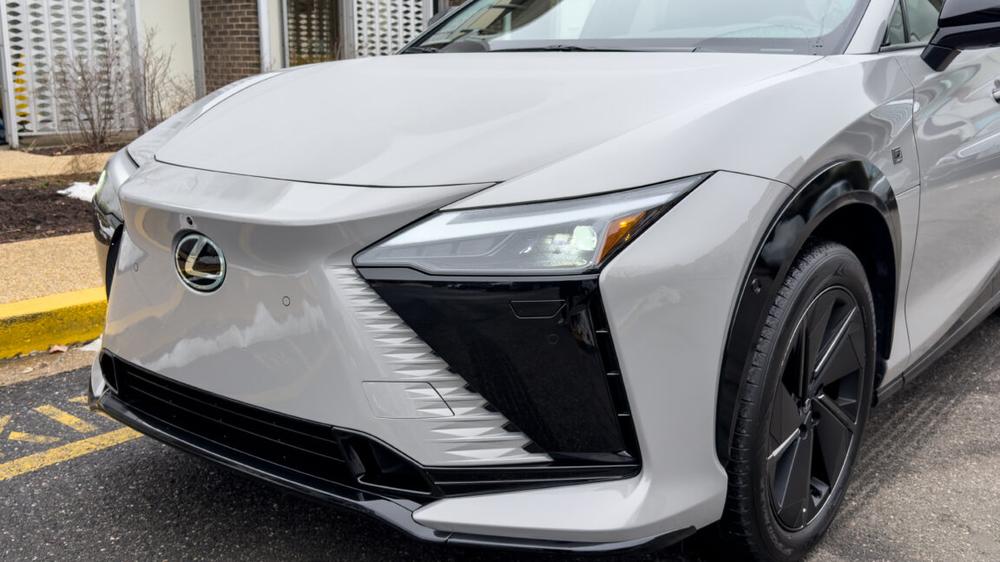
Sometimes you drive a car you just don’t gel with.
The original Lexus RZ was such a case. It was Lexus’ first battery EV, and I was less than impressed when I drove it in 2023. In fact, I compared it negatively to the extremely not-good Vinfast VF8. Lexus knew there was room for improvement, too, so it reworked the RZ with new motors, a new battery, and NACS charging for North America, among other tweaks, for model year 2026. A front-wheel drive RZ 350e is now the range’s entry point at $47,295, and there’s also a $58,295 all-wheel drive RZ 550e F Sport that tops the range. We spent a week with the latter.
Mindful of how little I liked the first RZ I drove, I made sure to approach the 550e F Sport with an open mind. And despite a number of the car’s shortcomings, I find I have warm feelings for the electric Lexus.
New battery, new motors
There are new batteries for all MY2026 RZs, but the 550e benefits from a slightly larger capacity, at 77 kWh. Each axle features a permanent magnet synchronous motor, now with silicon carbide electronics, that delivers a combined 402 hp (300 kW). There’s also some new body stiffening, plus added sound dampening. As an F Sport Lexus, the 550e also gains some styling additions compared to its lesser siblings. There are new bumpers and a new front grille, plus 20-inch wheels wearing aero covers that hide blue-painted brake calipers.
On those 20-inch wheels, the range is just 229 miles (369 km), and that’s only in optimum ambient conditions. In chilly but not sub-freezing February weather, the RZ 550e averaged 2.5 miles/kWh, and with the battery at 50 percent state of charge, the car reported only 88 miles (142 km) of range. AC charging now peaks at 11 kW rather than just 7 kW, and with its NACS port, the RZ can DC fast-charge from 10 to 80 percent in as little as 30 minutes, Lexus says.
In practice, it took 26 minutes to fast-charge from 43 to 80 percent, taking on 35.2 kWh. As with the recently tested Nissan Leaf, connecting to a Tesla supercharger is a fraught experience in which you play chicken with the car’s automatic emergency braking to get close enough to the charger so the cable can reach the socket. As you can see from the photograph, we’re talking about a space that’s within an inch. Between this and the ethical concerns that many will have about paying Tesla for services, it’s good to know you can also use CCS1 machines with the included NACS-CCS1 adapter as an alternative.
On the inside is a new F-Sport interior, perhaps the highlight of this EV. Much of it is upholstered in Ultrasuede, including the door panels, which also feature subtle animated lighting.
That said, the interface could be better. Almost all of the car’s functions are controlled via the infotainment touchscreen, including the climate settings. The infotainment features wireless Apple CarPlay and Android Auto, and I found little to criticize, unlike with the steering wheel’s multifunction controls. These are soft-touch capacitive panels, and even just brushing one will conjure a digital re-creation of that panel on the driver’s main instrument display to remind you what each button does. This could possibly be turned off in the settings, but I couldn’t figure out how. I also couldn’t work out how to stop the car from prompting me to enter a six-digit PIN I didn’t know, but nothing bad happened when I didn’t.
M Mode needs work
Behind the steering wheel, you’ll find a pair of paddles that, in normal driving, simply increase or decrease the amount of regenerative braking that occurs when you lift off the throttle pedal. Even the strongest setting is not true one-pedal driving, as the RZ will only slow to single-digit miles per hour rather than coming to a complete halt. But if you press the M Mode button on the center console, the paddles mimic an eight-speed automatic transmission, similar to the Hyundai Ioniq 5 N. Here, each “gear” changes both the throttle mapping (and thus acceleration) as well as the lift-off regen (mimicking engine braking).
Hyundai’s fake gears are engaging enough to convert even the most skeptical reviewers. Sadly, they’re not as well-implemented in the Lexus as in the Korean car. The shifts are jerky unless you’re completely off-throttle, which sort of undermines the point of having them. There’s little about the RZ 550e that makes you want to drive it hard. The steering has weight but little feel, and while it’s pretty rapid in Sport mode (0–60 mph in 4.1 seconds), there’s not too much grip available from the tires. Plus, driving the car hard really eats into the battery.
On the other hand, I enjoyed driving in Eco mode despite its more sluggish power delivery. With lift-off regen set to one of the lighter settings, the car drives well in the city, although some road harshness occasionally intrudes into what is mostly a serene cabin. It also cruises admirably on the highway, though it won’t coast very well, as you can’t fully turn off lift-off regen.
Beyond the F Sport interior, the above probably reads as more of an endorsement of the base RZ, which is more than $10,000 cheaper and has a 301-mile (484 km) range to boot. At just under $59,000, the RZ 550e probably isn’t a great value given its limited range and compromised M Mode, even if I found it oddly charming.
 RAM now represents 35 percent of bill of materials for HP PCs