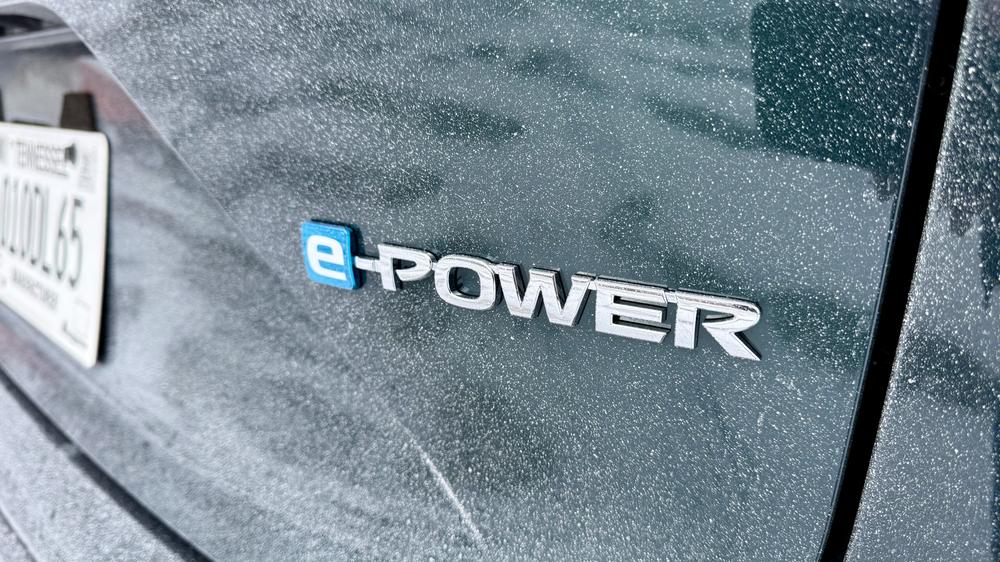
While Toyota and Honda’s showrooms are littered with electrified offerings, Nissan hasn’t had much to counter. Globally, Nissan offers a series hybrid system called E-Power, but the company has been reluctant to offer it Stateside. If you ask anyone at the company about it, they’ll tell you that while it makes sense in Europe, Japan, and other parts of Asia, it is not optimized for the type of driving we do this side of the pond.
Nissan’s hybrid offerings in North America have been lackluster at best. There was the Altima that borrowed Toyota’s hybrid system from the Camry, and there was the Rogue hybrid that failed to deliver noticeably better fuel economy. And that’s really it.
That, however, is about to change with the company’s third-generation system.
To demonstrate it, Nissan loaded a couple of brand-new European-spec Qashqais onto a boat bound for North America so we could get a taste of the powertrain that will debut later this year in the Nissan Rogue. The Qashqai is a bit smaller than the new Rogue—a previous generation was sold here as the Rogue Sport—but the powertrain will be the same.
That powertrain is a new, unique-to-E-Power 1.5 L turbocharged 3-cylinder engine. Being a series hybrid, power from that engine goes through the inverter to either the front electric motor or to the onboard 2.1 kWh battery pack for use later; it’s never used to directly power the front wheels.
The front electric motor is lifted straight from the all-new Nissan Leaf and has a maximum output of 202 hp (151 kW) in this application. Qashqai is a front-wheel-drive vehicle, but the Rogue E-Power will feature all-wheel drive powered by an electric motor on the rear axle. Output will be higher, but Nissan isn’t saying what that will be at this point.
Nissan engineers told us that the new three-cylinder engine was designed with operating in the US and Canada in mind and that the turbocharger helps improve the engine’s efficiency at higher rpm loads. No other engine Nissan makes, including the VC-Turbo, can deliver the efficiency that the company demands in this particular application. Nissan also boasts that this engine has a 42 percent thermal efficiency.
The entire powertrain is designed to be as compact as possible; the modular powertrain combines the electric motor, generator, inverter, reducer, and increaser into a package that’s lighter than before.
On the road
On a very snowy and 27° F (minus 3°C) morning, I pulled out of Nissan’s tech center in Farmington Hills, Michigan, to begin a mixed-drive route designed to test the powertrain in a variety of situations.
The first thing I noticed, and the biggest demerit of the entire experience, is the brake performance. The car stops perfectly well, but the blending of regenerative and friction braking needs some improvement. When you first use the brake pedal, the car will slow with regen, but once you push a little harder, the friction brakes engage with a jerk. It’s like riding with someone just learning how to drive. To ensure it wasn’t a fluke, I asked a colleague if he had a similar experience, and he did. Some of the grabbiness could certainly be attributed to the wet road conditions, but the new Toyota RAV4 hybrid handles this much better.
The rest of the experience I’d describe as perfectly fine. It’s not slow, but it’s not particularly fast, either. Since there is no transmission, speeding up is a smooth operation, and the engin, is hardly noticeable when operating in the background.
I noticed the engine running just twice. One was at wide-open throttle, and the other was when the engine was likely operating at higher rpms to help charge the battery. That latter instance was also when I noticed the most harshness from the engine, although it’s one of the smoothest gasoline-supported powertrains I’ve driven.
The E-Power system will operate in full-EV mode at the press of a button, but at full throttle, the engine will still kick in.
What needs work?
Since an electric motor powers the wheels, I would prefer the system to be more responsive when you put your foot down. Electric motors respond nearly instantly. In a gas car, there’s usually a delay with a downshift and engine spin-up. This E-Power Qashqai behaves more like a gas car than an EV, even in the sport setting. I think this powertrain is a great opportunity to show new customers what electrification can do, and a little bit more snappiness would go a long way into articulating that E-Power can be sporty if the driver wants it to be.
The Qashqai had no problems getting up to highway speeds, and acceleration at higher speeds—in an overtake situation, for example—remained consistent. Again, it’s not a sports car or rocket ship, but it can get out of its own way easily enough.
During my loop, the computer indicated 47.7 mpg (4.93 L/100km) in mixed driving. Being left-hand-drive cars, that means they weren’t British imperial gallons. That’s a pretty great fuel efficiency number. In warmer conditions, it should easily exceed 50 mpg (4.7 L/100 km) in many driving scenarios.
Is that directly translatable to the upcoming Rogue E-Power? Somewhat. While the powertrain will be the same, the Rogue will be a little larger and heavier. Speccing all-wheel drive will further increase weight and add losses to the drivetrain. So a 50 mpg Rogue might be a stretch.
If Nissan prices the Rogue E-Power well, and the car delivers on the increase in economy that I’ve seen here, it could be a very compelling product in Nissan’s showrooms for buyers who haven’t had a great hybrid offering from the company before.
As long as Nissan sorts out the brake calibration.
 A Knight of the Seven Kingdoms 4K UHD Release Confirmed for June, Now Up for Preorder