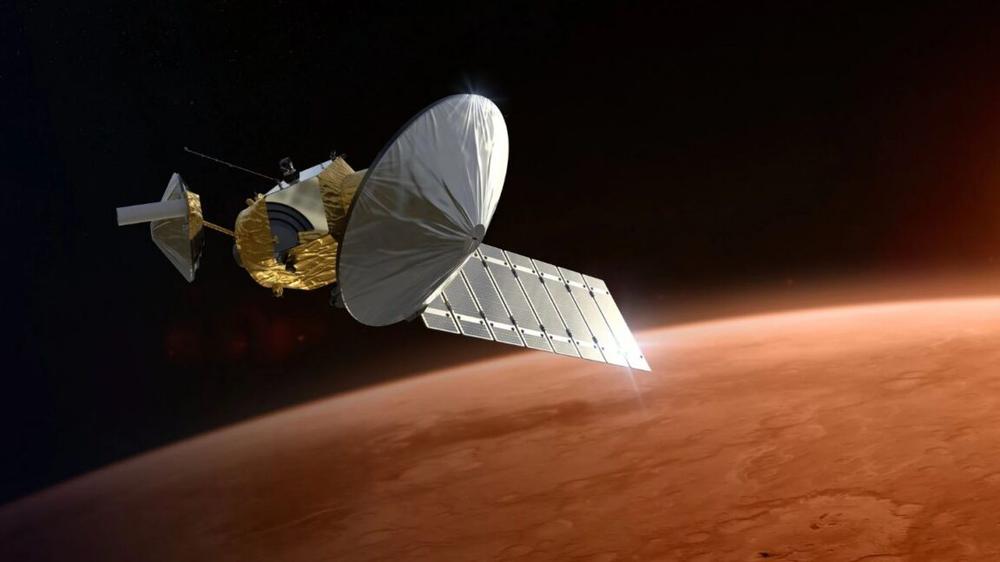
The US space agency has released a “pre-solicitation” for what is expected to be a hotly contested contract to develop a spacecraft to orbit Mars and relay communications from the red planet back to Earth.
Ars covered the intrigue surrounding the spacecraft in late January, which was initiated by US Senator Ted Cruz, R-Texas, as part of the “One Big Beautiful Bill” legislation in the summer of 2025. The bill provided $700 million for NASA to develop the orbiter and specified funding had to be awarded “not later than fiscal year 2026,” which ends September 30, 2026. This legislation was seemingly crafted by Cruz’s office to favor a single contractor, Rocket Lab. However, multiple sources have told Ars it was poorly written and therefore the competition is more open than intended.
The pre-solicitation released this week is not a request for proposals from industry—it states that a draft Request for Proposals is forthcoming. Rather, it seeks feedback from industry and interested stakeholders about an “objectives and requirements” document that outlines the goals of the Mars mission.
This 24-page objectives and requirements document was not publicly released, and it is listed as “controlled” on the government procurement website. However, according to a copy obtained by Ars, there are four top-level objectives outlined in the document:
- Provide communication and data exchange between assets in the Mars vicinity, the Mars surface, and Earth anticipated to operate at Mars through 2035.
- Provide Doppler, range, and time transfer to support positioning, navigation, and timing for assets anticipated to operate at Mars through 2035.
- Provide communications services to existing operational missions.
- Provide communications, Doppler, range, and time transfer services to the Entry, Descent, and Landing demonstration missions anticipated to operate at Mars through 2035.
NASA also has changed the name of the spacecraft: What once was known as the Mars Telecommunications Orbiter is now called the Mars Telecommunications Network.
What about science?
Beyond the top-level objectives, the non-public document includes 14 different “ground rules and assumptions.” The last of these touches on one of the biggest questions surrounding the spacecraft: science. It is due to launch no earlier than late 2028. As such, it is the only large spacecraft that NASA can possibly launch to Mars during the Trump presidency and may be NASA’s only major Mars mission for the rest of the decade.
For this reason there has been pressure from the science community to add scientific payloads to the spacecraft. Given the available funding—which is more than a reasonably capable communications spacecraft should cost—a number of people within the agency are pressing to include scientific instruments on the orbiter. Three good instruments could be added for about $200 million, a science official said. Ideas include everything from a high-resolution camera, a space weather payload, a magnetometer to understand Mars’ remnant magnetic field, or a spectrometer to look for near-surface water ice.
In the new document, the 14th and final ground rule states, “SMD payload is not precluded, and schedule risk is critically important.”
Here “SMD” refers to NASA’s Science Mission Directorate, which leads the agency’s scientific endeavors. The overall language is significant, however. By using the word “precluded” the document indicates that while a bidder could include a scientific payload on the spacecraft (i.e. it is not precluded) it is not necessary. Moreover, it warns that NASA will carefully screen any scientific proposal for risks to launching on time.
The way this document is written suggests that when NASA scores bidders for the Mars Telecommunications Network, the addition of a camera or other scientific payloads won’t be a net positive. However, if they pose an overall risk to the mission, they would be a net negative.
New award to Rocket Lab may complicate things
One of the other intriguing parts of this mission is that it sets up a battle royale of sorts for some of NASA’s most prominent contractors. Rocket Lab and Blue Origin have both waged very public campaigns that tout their solutions to NASA’s needs. SpaceX is also interested in winning a Mars mission for its Starship launch system. Then there are traditional contractors, such as Lockheed Martin, which have a long and storied history of building robust (if costly) Mars missions.
If NASA is going to launch the Mars Telecommunications Network by late 2028 to make the next “window” to the red planet, it must move quickly with this solicitation. In particular, industry protests after a decision is made could hold up the project for months and would almost certainly doom NASA’s hopes of making the 2028 launch opportunity.
On Monday the space agency awarded a $390,936 contract to Rocket Lab to study “Mars End-to-End Communication Service Architectures.” The award is not significant monetarily, but it does indicate that NASA is interested in Rocket Lab’s ideas for improving communications between Earth and Mars, and potentially a Mars Sample Return mission down the road. However, one source suggested to Ars that the award is a potential conflict of interest.
The contracting office for the Rocket Lab award is Goddard Space Flight Center, which is also responsible for managing the Mars Telecommunications Network. That Rocket Lab, alone, received an award like this from the NASA center that will also decide on the orbiting spacecraft—coterminous when such a decision will be made—is surely to be the basis of one or more protests should Rocket Lab win the Mars Telecommunications Network contract, the source told Ars.
 Aston Martin appesa a un filo: addio all'elettrico e tagli al personale