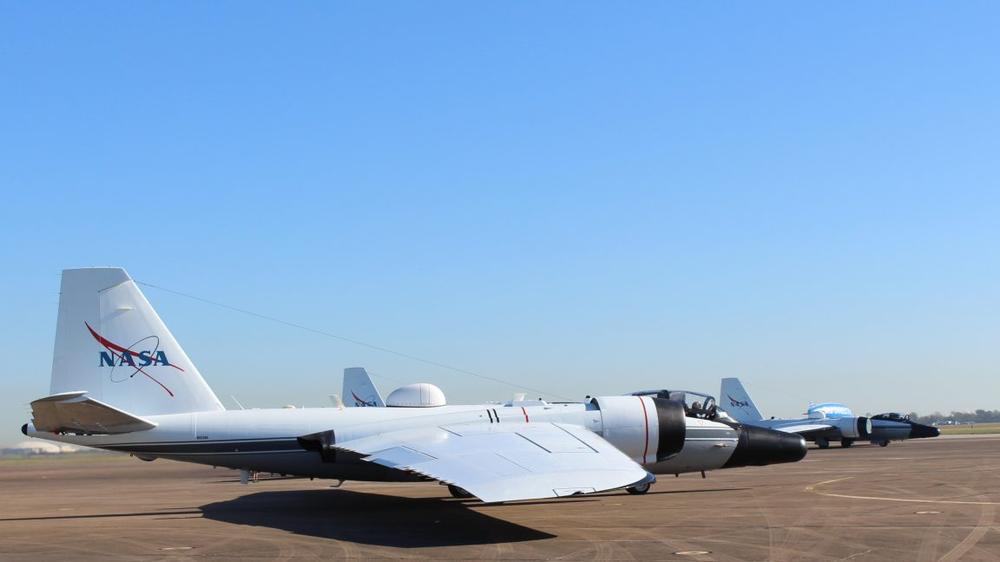
One of NASA’s three large WB-57 aircraft made an emergency landing at Ellington Field on Tuesday morning in southeastern Houston.
Video captured by KHOU 11 television showed the aircraft touching down on the runway without its landing gear extended. The pilot then maintains control of the vehicle as it slides down the runway, slowing the aircraft through friction. The crew was not harmed, NASA spokesperson Bethany Stevens said.
“Today, a mechanical issue with one of NASA’s WB-57s resulted in a gear-up landing at Ellington Field,” she said. “Response to the incident is ongoing, and all crew are safe at this time. As with any incident, a thorough investigation will be conducted by NASA into the cause. NASA will transparently update the public as we gather more information.”
The B-57 line of aircraft dates back to 1944, when the English Electric Company began developing the plane. After the Royal Air Force showcased the B-57 in 1951 by crossing the Atlantic in a record four hours and 40 minutes and becoming the first jet-powered aircraft to span the Atlantic without refueling, the United States Air Force began buying them to replace its aging Douglas B-26 Invader.
Now used for science
The aircraft performed bombing missions in Vietnam and other military campaigns, and a variant that later became the WB-57 was designed with longer wings that could fly even higher, up to 62,000 feet. This proved useful for weather reconnaissance and, around the world, to sample the upper atmosphere for evidence of nuclear debris where US officials suspected the atmospheric testing of nuclear weapons.
Although their utility for military purposes has faded, NASA has flown WB-57s as part of a broad-ranging science mission since 1972. The aircraft have flown above hurricanes, and missions as varied as collecting cosmic dust samples from comets and asteroids in Earth’s upper atmosphere, investigating clouds, and studying the environmental effect of plumes from the Titan, Space Shuttle, Delta, Atlas, and Athena rockets on the stratosphere. More recently, they have been used to observe launches of SpaceX’s Starship rocket and were due to be used in a similar manner for the Artemis II lunar mission.
After acquiring two of the aircraft earlier, NASA found a third one in the “boneyard” at Davis-Monthan Air Force Base in Arizona in 2013. After this one was restored, the space agency flew all three simultaneously in 2015, an event attended by Ars.
It was not immediately clear whether the damage to the WB-57 on Tuesday was repairable, nor what impact this might have on plans to observe the launch of the Artemis II mission and reentry of the Orion spacecraft after its journey around the Moon.
 “Bootleggers not bootlickers”: NASCAR’s apolitical meme sub just accidentally outed its leftist side with an anti-ICE meme