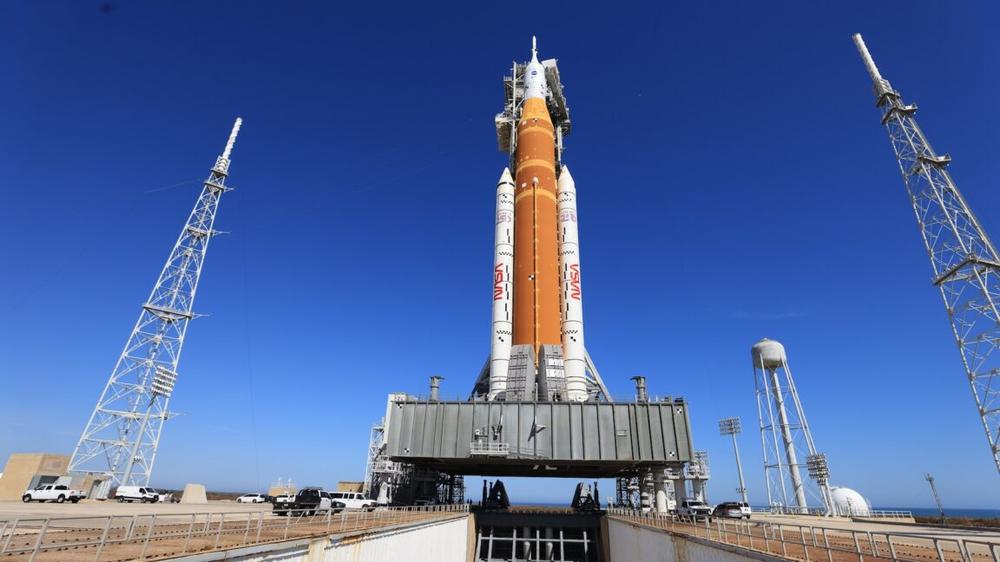
A second fueling test on NASA’s Space Launch System rocket ended Thursday night, giving senior managers enough confidence to move forward with plans to launch four astronauts around the Moon as soon as March 6.
Unlike the first attempt to load propellants into the SLS rocket on February 2, there were no major leaks during Thursday’s practice countdown at Kennedy Space Center in Florida. Technicians swapped seals at the launch pad after hydrogen gas leaked from the rocket’s main fueling line earlier this month. This time, the seals held.
“For the most part, those fixes all performed pretty well yesterday,” said Lori Glaze, acting associate administrator for NASA’s exploration programs. “We were able to fully fuel the SLS rocket within the planned timeline.”
The results keep the Artemis II mission on track for liftoff as soon as next month. NASA gave up on a series of February launch opportunities after encountering a persistent hydrogen leak during the first Wet Dress Rehearsal (WDR).
“We’re now targeting March 6 as our earliest launch attempt,” Glaze said. “I am going to caveat that. I want to be open, transparent with all of you that there is still pending work. There’s work, a lot of forward work, that remains.”
If teams complete all of that work, liftoff of the Artemis II mission could occur within a two-hour window opening at 8:29 pm EST on March 6 (01:29 UTC on March 7). NASA has other launch dates available on March 7, 8, 9, and 11, but the mission may have to wait until April. There are approximately five days per month that the mission can depart the Earth after accounting for the position of the Moon in its orbit, the flight’s trajectory, and thermal and lighting constraints.
The Artemis II mission will last between nine and 10 days, taking NASA’s Orion spacecraft with commander Reid Wiseman, pilot Victor Glover, and mission specialists Christina Koch and Jeremy Hansen around the far side of the Moon before returning to Earth for splashdown in the Pacific Ocean. Wiseman’s crew will set the record for the farthest humans have ever traveled from Earth, and will become the first people to fly to the vicinity of the Moon since 1972.
Artemis II is a precursor for follow-in missions that will target landings at the Moon’s south pole. NASA aims to land the first Artemis mission on the Moon by 2028, but the schedule comes with uncertainties, such as the readiness of a human-rated lander, spacesuits, and the SLS rocket and Orion spacecraft. A successful Artemis II mission would help demonstrate that the SLS rocket and Orion will be ready.
“The excitement for Artemis II is really, really starting to build,” Glaze said. “We can really start to feel it. It’s coming.”
“A good day for us”
But getting to launch day for Artemis II has not been smooth sailing for NASA. The mission’s first fueling test ran several hours behind schedule on February 2. The launch team paused loading propellant into the rocket after identifying a leak in the connection where supercold liquid hydrogen flows from the launch platform into the SLS core stage.
Sensors near the connection detected hydrogen concentrations exceeding NASA’s safety limit of 16 percent during the first countdown rehearsal. The launch team temporarily contained the leak within limits by stopping and restarting the flow of hydrogen, but the hydrogen leak again tripped the safety threshold as the core stage fuel tank began to pressurize in the final 10 minutes of the countdown.
NASA called an end to the test, drained propellants from the rocket, and ordered workers to replace seals on the fueling umbilical, setting up for the second WDR this week. This time, the hydrogen sensors topped out at 1.6 percent, about one-tenth of NASA’s limit.
Charlie Blackwell-Thompson, NASA’s Artemis II launch director, said her team saw “very good performance” from the hydrogen seals on Thursday. The countdown ran close to the planned schedule, allowing the launch team to complete two runs through the final 10-minute terminal countdown sequence before ending the test at T-minus 29 seconds.
“When we wrapped all that up, we still had launch window remaining,” Blackwell-Thompson said. “So, very successful day. I’m very proud of this team and all that they accomplished to get us to yesterday and then to go execute with such precision.”
Engineers will spend the next few days examining all the data from Thursday’s countdown. Several other issues popped up during the test. The launch team overcame a communications problem and briefly paused the countdown to assess a potential issue with a booster avionics system. Blackwell-Thompson said engineers will continue assessing the avionics system to ensure it is ready for launch.
“So far, we don’t have any indications of anything that we’re worried about, but we’re just getting started [with the data review],” said John Honeycutt, NASA’s chair of the Artemis II Mission Management Team. “So, we’ll go through that and see what the teams come up with and address those as needed, but overall, it was a good day for us.”
“Forward work”
There is no guarantee, of course, that the hydrogen seals will work as well the next time NASA fuels the SLS rocket. The seals, made of Teflon, have a history of fickleness. NASA encountered persistent hydrogen leaks ahead of the launch of the first SLS rocket on the Artemis I mission 2022.
But the seals worked better on Thursday than they did during any of the prior fueling operations. There are no plans to go in and replace them again before launch. “I’ve got a pretty high level of confidence in the configuration that we’re in right now,” Honeycutt said.
The “forward work” ahead for the Artemis II team includes a Flight Readiness Review late next week, when senior agency leaders will convene to formally certify the SLS rocket and Orion spacecraft for flight. Over the next few days, technicians at Kennedy Space Center will retest the rocket’s range safety destruct system.
The Artemis II astronauts entered NASA’s standard two-week-long preflight medical quarantine on Friday at their home base in Houston. Wiseman and his crewmates will fly to Florida about five to seven days before launch.
 Ukraine liberates 300 square kilometers in southern counteroffensive, Zelensky tells AFP