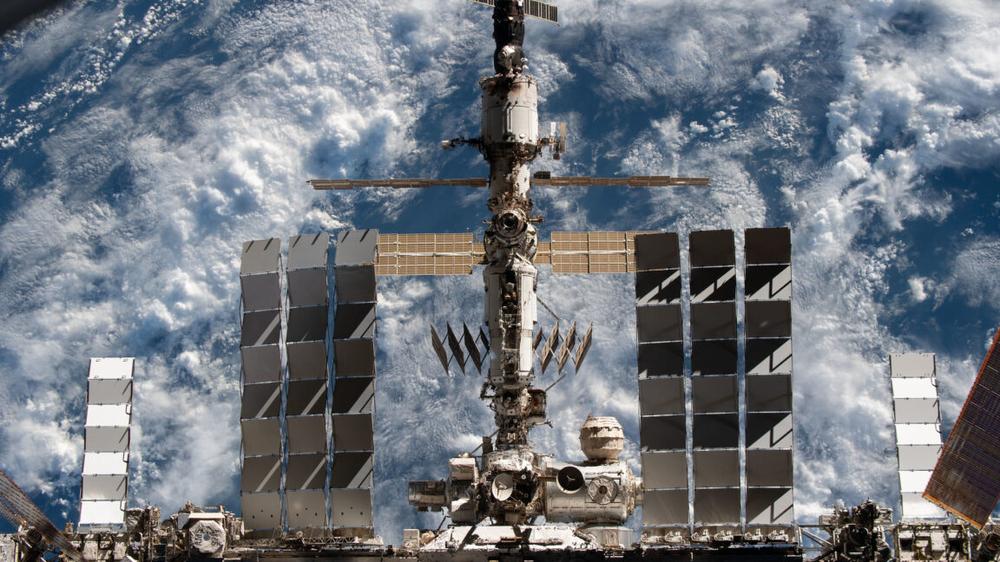
A small section of the International Space Station that has experienced persistent leaks for years appears to have stopped venting atmosphere into space.
The leaks were caused by microscopic structural cracks are inside the small PrK module on the Russian segment of the space station, which lies between a Progress spacecraft airlock and the Zvezda module. The problem has been a long-running worry for Russian and US operators of the station, especially after the rate of leakage doubled in 2024. This prompted NASA officials to label the leak as a “high likelihood” and “high consequence” risk.
However, recently two sources indicated that the leaks have stopped. And NASA has now confirmed this.
“Holding steady”
“Following additional inspections and sealing activities, the pressure in the transfer tunnel attached to the Zvezda Service Module of the International Space Station, known as the PrK, is holding steady in a stable configuration,” a space agency spokesman, Josh Finch, told Ars. “NASA and Roscosmos continue to monitor and investigate the previously observed cracks for any future changes that may occur.”
For the better part of half a decade, Russian cosmonauts have been searching for the small leaks like a proverbial needle in a haystack. They would periodically close the hatch leading to the PrK module and then, upon re-opening it, look for tiny accumulations of dust to indicate the leak sites.
Then the Russian cosmonauts would apply a sealant known as Germetall-1 (which has now been patented) to the cracks. They would close the hatch again, monitor the pressure inside the PrK module, and begin the search anew for additional leaks. This process went on for years.
Their success with the long-running leak problem probably will not prevent new leaks from developing in the decades-old hardware. The Zvezda module was launched a quarter of a century ago, in July 2000, on a Russian Proton rocket. The cracking issue first appeared in 2019 and despite the long-running investigations its precise cause remains unknown. But this is a nice win in space for both Russia and NASA.
NASA appears confident in pad repairs, too
There is other potential good news on the horizon with regard to Russia’s civil space program. This involves the country’s primary launch pad for getting people and cargo to the International Space Station.
The problems there occurred when a Soyuz rocket launched Roscosmos cosmonauts Sergei Kud-Sverchkov and Sergei Mikayev, as well as NASA astronaut Christopher Williams, on an eight-month mission to the International Space Station in late November. The rocket had no difficulties, but a large mobile platform below the rocket was not properly secured prior to the launch and crashed into the flame trench below, taking the pad offline.
It has not been clear when the pad, Site 31 at the Baikonur Cosmodrome in Kazakhstan, will come back online.
Russia had been targeting a return to flight mission in March 2026. NASA now appears to believe that. The US space agency’s internal schedule, which was recently updated, has the next Progress spacecraft launch set for March 22, followed by another Progress mission on April 26. The next Soyuz crewed mission, MS-29, remains scheduled for July 14th. This flight will carry NASA astronaut Anil Menon to the space station.
 “This is so sad”: Mom points out error on 5-year-old’s grammar homework. Teachers rush to defend it