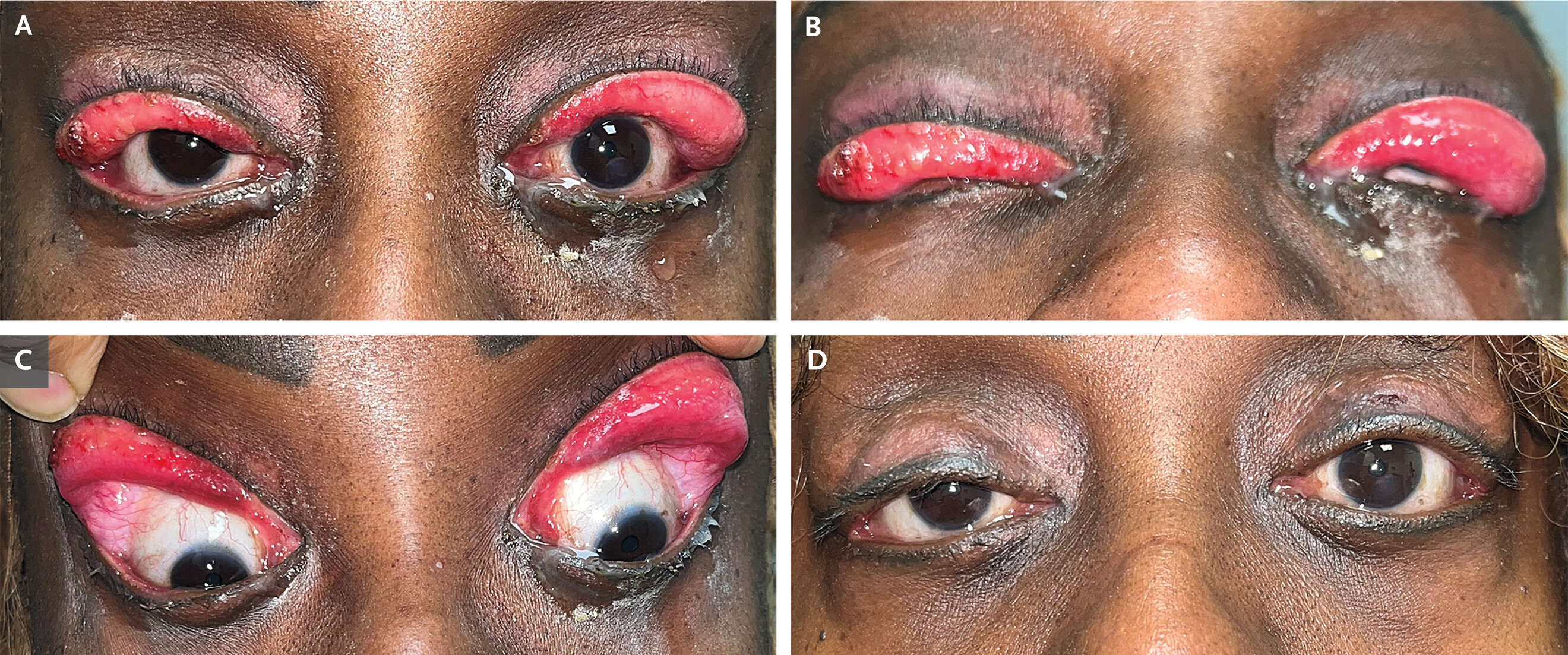
A poor night’s sleep might leave you feeling like your eyelids have filled with lead—and keeping them open is the ultimate dead lift. But for some, bad sleep brings on eyelids so droopy and floppy that they can do curl ups on their own.
That was the unfortunate case for a 39-year-old woman who sought care at an ophthalmology clinic in Brooklyn, New York. She told the doctors that for six weeks she felt like she had something in her eyes, and they were watery. By the time of her appointment, her eyelids had rolled up, flipping inside-out on their own—and were staying that way. In the latest issue of the New England Journal of Medicine, doctors report her eye-opening case—and its unexpected solution.
(You can see images of her eyelids—flipped and recovered—here. The images may seem graphic to some, but they are not much worse than that kid in elementary school who would flip their eyelids just to freak everyone out for laughs. You know the one.)
In an initial exam, the doctors noted that her eyes were also bloodshot and that she was unable to fully close them. When the doctors gently tried to manually pull her eyelids upward, they were remarkably limp and curled up more.
The doctors also considered another problem the woman spoke of: She had trouble sleeping. She reported snoring at night and being tired during the day. Her eye symptoms were at their worst when she first woke up. They also noted that she had obesity.
Altogether, the doctors not only had their diagnosis, but they also had the likely culprit. The woman had floppy eyelid syndrome, which is basically exactly what it sounds like. But, despite the straightforward name, it offers a clear explanation; the condition is strongly associated with obstructive sleep apnea (OSA), which is also a condition more likely to affect people with excess weight.
Exhausted elastin
As such, the correct next step for addressing her floppy eyelids wasn’t eye surgery or medication—it was a referral for a sleep test.
The patient did the test, which found that while she was sleeping, she stopped breathing 27 times per hour. On the apnea–hypopnea index, that yields a diagnosis of moderate-level OSA.
With this finding, the woman started using a continuous positive airway pressure (CPAP) machine, which delivers continuous air into the airway during sleep, preventing it from closing up. Along with some eye lubricants, nighttime eye patches, and a weight-loss plan, the woman’s condition rapidly improved. After two weeks, her eyelids were no longer inside out, and she could properly close her eyes. She was also sleeping better and no longer had daytime drowsiness.
Doctors don’t entirely understand the underlying mechanisms that cause floppy eyelid syndrome, and not all cases are linked to OSA. Researchers have hypothesized that genetic predispositions or anatomical anomalies may contribute to the condition. Some studies have found links to underlying connective tissue disorders. Tissue studies have clearly pointed to decreased amounts or abnormalities in the elastin fibers of the tarsal plate, the dense connective tissue in the eyelids.
For people with OSA, researchers speculate that the sleep disorder leads to hypoxic conditions (a lack of oxygen) in their tissue. This, in turn, could increase oxidative stress and reactive oxygen species in the tissue, which can spur the production of enzymes that break down elastin in the eyelid. Thus, the eyelids become lax and limp, allowing them to get into weird positions (such as inside out) and leading to chronic irritation of the eye surface.
The good news is that most people with floppy eye syndrome can manage the condition with conservative measures, such as CPAP for those with OSA, as did the woman in New York. But some may end up needing corrective surgery.
 Elon Musk is getting serious about orbital data centers