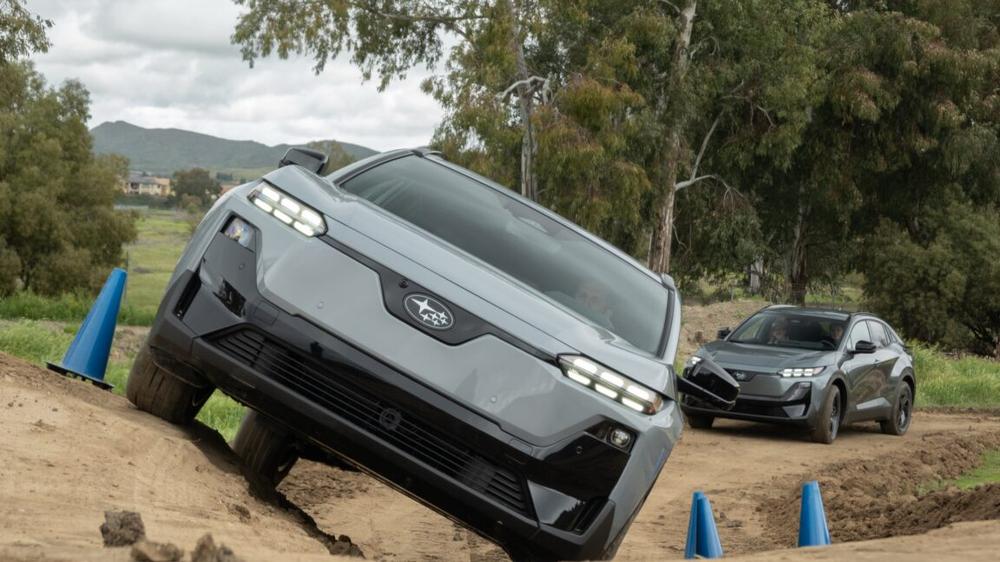
Much of the Subaru Uncharted makes very little sense. The “new” EV clearly resembles the Solterra, upon which Toyota and Subaru jointly developed the Uncharted and the bZ Woodland as a continuation of a partnership that stretches back to 2012 with the FR-S/BRZ/86. This time, a fifth sibling joins the platform: the Subaru Trailseeker, which arrives simultaneously with slightly more power, capability, and a larger rear canopy (but you have to wait until March 2 to read more about that one).
Most surprisingly, the Uncharted is the first front-wheel-drive Subaru sold in the United States since the Impreza switched to all-wheel-drive for model year 1997. The base FWD Uncharted will therefore offer a class-leading range estimate of 308 miles (496 km), while the Sport AWD trim can do 287 miles (462 km). Subaru has reportedly partnered with Panasonic to develop solid-state batteries for a Solterra replacement, but that project is still in development.
Does the above make the Uncharted a bad car? Not at all. Instead of throwing money and resources at more kWh during this liminal phase of EV adoption, sticking with the Solterra’s 104-cell 74.7 kWh battery helps keep the starting price for a FWD Uncharted at $34,995 while also avoiding the vicious cycle of compounding mass by reducing the curb weight. A Premium FWD weighs just 4,145 lbs (1,880 kg), and stepping up to AWD adds fewer than 300 lbs (136 kg). And as with the Solterra for 2026, the Uncharted features a NACS charging port to allow access to more than 25,000 Tesla Superchargers—revealing that, at the very least, Subaru and Toyota can accept the reality of the situation.
That relative lack of mass compared to many other EVs comes into play on the road, where the Uncharted drives less like a typical bloated EV and more like a hybrid. The steering and suspension make driving easy, and, as expected, acceleration far exceeds any internal combustion engine or hybrid model in the rest of the Subaru lineup. An official estimate pegs the 0–60 mph (0–97 km/h) time at 4.7 seconds, so this little crossover manages to provide pep without ever getting truly punchy.
Then again, at Subaru’s media drive program in Southern California, I piloted only the dual-motor Uncharted, which had 338 hp (252 kW) on tap. The single-motor version seemed more important to experience, if only to understand whether a single 221 hp (165 kw) motor could manage real-world driving—and whether FWD throws off the handling dynamics. Either way, AWD fits more into the quintessential Subaru aspirational-adventure aesthetic, so we needed some time in the dirt to test the dual motors’ software programming and that best-in-class 8.2 inches (208 mm) of ground clearance.
Getting dirty
On a little makeshift track, the Uncharted traversed a series of inclines and descents, elephant tracks, off-camber corners, and articulation areas without too many complaints. This was despite the day’s inclement weather, which turned the dirt into slippery mud that challenged the all-season Toyo Open Country tires. It also tested the electronic control unit’s X-Mode and Grip Control settings (the former adjusts traction intervention, while the latter acts as something like off-road cruise control—the same as Toyota’s Crawl Control).
Throughout it all, I felt the Uncharted’s computer processing doing its work. Any time a wheel came up in the air, the independent suspension reached full droop almost immediately—which looks cool in photos but won’t help with traction when you’re trying to get through an obstacle. I felt the rest of the tires stop for a second, then a faint buzz and clicking from the electric motors signaled power ramping up, while a light chatter from the brake-based traction control managed torque delivery.
Grip Control worked on and off, as did Subaru’s 360-degree off-road camera mode, though engineers attributed some mild glitchiness to the cars being pre-production units. I’m not sure that makes much sense given that the updated Solterra, revived C-HR, and new bZ (including an off-roady Woodland package) all use the same powertrain and technology.
In reality, much of life with the Uncharted reminded me of Toyota. Subaru may have programmed the AWD system’s power delivery or tuned the suspension, but the large 14-inch multimedia touchscreen features far more advanced software than a 2026 Crosstrek or Forester. All the plastics inside, the dash texture, the nifty shift knob, the dual smartphone charging pads, the minimalist gauge cluster screen—these are a bunch of classic (modern) Toyota parts. In fact, under the hood, almost everything bore Toyota stickers, right down to the 12 V battery.
Toyota will build the Uncharted, and deliveries should begin this spring shortly after C-HR customers begin to receive cars. From a stylistic standpoint, telling the two apart will require a close eye. The Subaru has a bulkier front end with more unpainted plastics but a slightly cleaner rear that better displays the branding (written out, no more Pleiades logo). The advantages of EV powertrain packaging come into play, even if the more angular design departs somewhat from the Solterra (and certainly from the gas-powered lineup).
Overall, the Uncharted measures 1.4 inches (35.5 mm) longer than a Crosstrek but offers about 10 percent more cargo volume—great for transporting gear to the trail.
Subaru also quoted a survey that reported 35 percent of current owners might consider an EV for their next car purchase. Will that percentage overlap with the 25 percent who take their Subarus off-roading? It seems more likely to fit into the 50 percent who highlight range as their most important consideration when buying an EV.
In this light, the FWD Uncharted, which provides a few more miles and a lower price tag, seems better for the urban Subaru owner. Leave the adventures to the gas-powered and hybrid models with symmetric AWD—after all, the Uncharted’s rear motor acts more like a helper than a truly balanced powertrain.
The fact that Toyota decided against building a FWD version of the C-HR, leaving that lower price point and improved range to Subaru, may well come into play. Subaru’s reps seemed generally surprised by the decision, which appears to stem from Toyota’s reluctance to impinge on a more significant FWD hybrid lineup. So the return of FWD may end up being the defining detail that sets the otherwise competent (if not outstanding) Uncharted apart in a crowded market segment.
 Stellantis potrebbe utilizzare la tecnologia EV di Leapmotor per Fiat, Opel e Peugeot