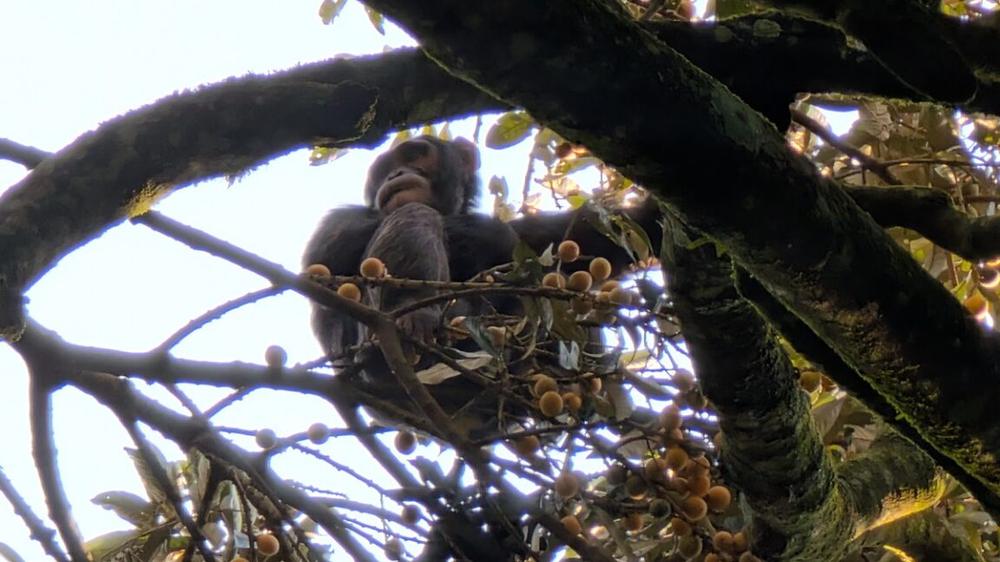
The urine of chimpanzees contains high levels of alcohol byproduct, most likely because the chimps regularly gorge themselves on fermented fruit, according to a new paper published in the journal Biology Letters. It’s the latest evidence in support of a hotly debated theory regarding the evolutionary origins of human fondness for alcohol.
As previously reported, in 2014, University of California, Berkeley (UCB) biologist Robert Dudley wrote a book called The Drunken Monkey: Why We Drink and Abuse Alcohol. His controversial “drunken monkey hypothesis” proposed that the human attraction to alcohol goes back about 18 million years, to the origin of the great apes, and that social communication and sharing food evolved to better identify the presence of fruit from a distance. At the time, skeptical scientists insisted that this was unlikely because chimpanzees and other primates just don’t eat fermented fruit or nectar.
But reports of primates doing just that have grown over the ensuing two decades. Earlier this year, we reported that researchers had caught wild chimpanzees on camera engaging in what appears to be sharing fermented African breadfruit with measurable alcoholic content. That observational data was the first evidence of the sharing of alcoholic foods among nonhuman great apes in the wild. The authors measured the alcohol content of the fruit with a handy portable breathalyzer and found almost all of the fallen fruit (90 percent) contained some ethanol, with the ripest containing the highest levels—the equivalent of 0.61 percent ABV (alcohol by volume).
And last September, Dudley co-authored a paper reporting the first measurements of the ethanol content of fruits favored by chimps in the Ivory Coast and Uganda, finding that chimps consume 14 grams of alcohol per day, the equivalent of a standard alcoholic drink in the US. After adjusting for the chimps’ lower body mass, the authors concluded the chimps are consuming nearly two drinks per day.
A thankless task
The next step was to sample the chimps’ urine to see if it contains any alcohol metabolites, as was found in a 2022 study on spider monkeys. This would further refine estimates for how much ethanol-laden fruit the chimps eat every day. That thankless task fell to Aleksey Maro, a UCB graduate student who spent last summer in Ngogo, sleeping in trees—protected from the constant streams by an umbrella—to collect urine samples. Sharifah Namaganda, a Ugandan graduate student at the University of Michigan, showed him how to make shallow bowls out of plastic bags hung on forked twigs for more efficient collection. He also collected samples from puddles of urine on the forest floor.
The authors tested the samples using immunoassay test strips similar to those used to measure alcohol levels in humans. The result: most of the urine samples (16 out of 20) contained significant levels of ethyl glucuronide, a byproduct of alcohol—above the 500 ng/ml that is roughly equivalent to one or two drinks for humans. And that is a conservative estimate. Once again, the most likely source is the fermented fruit the chimps consume in such large quantities.
In short, “We find widespread physiological evidence of the consumption of alcohol by chimpanzees,” Maro said. “If there’s any doubt about the drunken monkey hypothesis—that there’s enough alcohol in the environment for animals to experience alcohol in a way analogous to humans—it’s been cleared up. Food and alcohol evolutionarily are, as it turns out, very much connected, especially in the lives of chimpanzees.”
Those abstaining were females in estrus and juveniles, so future research will explore how dietary ethanol might affect the physiology and behavior of chimps over time. For instance, consuming fermented fruit may affect the timing of female fertility. And the phenomenon likely extends to other species; Maro’s camera traps caught several animals also eating large quantities of the fruit. A colleague is sampling fruit bat urine in Madagascar to confirm this.
Granted, there are still gaps to be filled for the hypothesis to be fully confirmed. “The final link here with the drunken monkey hypothesis remains to be shown: that the chimps are selectively consuming fruits with higher ethanol content,” Dudley said. “That hasn’t really been demonstrated for any taxon in the wild. So that would be the next future direction on this—to definitively prove the universal hypothesis of attraction to alcohol.”
Biology Letters, 2026. DOI: 10.1098/rsbl.2025.0740 (About DOIs).
 Apple’s touchscreen MacBooks might also have a Dynamic Island