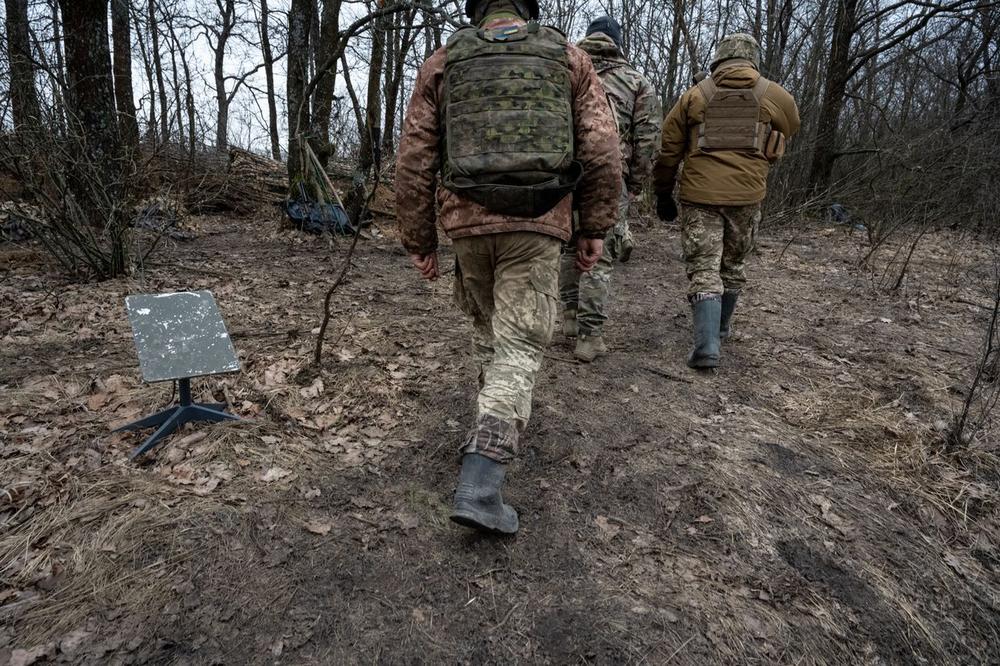
A new "white list" from SpaceX is shutting off Russia's illicit access to Starlink's satellite internet across the front line.
At shortly before 3:00 a.m. Kyiv time on Feb. 5, Elon Musk retweeted a new guide from Ukraine's Digital Transformation Ministry for registering a Starlink terminal within Ukraine.
Subsequently, a series of alarmed Russian social media posts indicate that Starlink terminals were disconnecting en masse along the front.
Three Ukrainian commanders, speaking to the Kyiv Independent on the condition of anonymity, reported intercepting messages from Russian forces complaining about Starlink terminals failing in large numbers.
"The enemy at the front doesn't have a problem, the enemy has a catastrophe," wrote Serhiy "Flash" Bezkrestnov, a longtime commentator on electronic warfare more recently appointed as advisor to Defense Minister Mykhaylo Fedorov.
"Among our soldiers it came to light that there had been problems among those who hadn't filed their lists of private Starlinks. The process is ongoing."
"This will hit harder than anywhere at our front line assault groups, for example in Kupiansk," a a popular Russian propaganda channel wrote. "They will be deprived of any chance of connection with the wider world, alas."
Another pro-Russian milblogger noted that "all along the front, Starlinks have 'lain down,'" though they said that Ukrainian forces were having the same experience.
The degree to which the change has impacted Ukrainian forces remains unclear.
Fedorov, who was recently reappointed from leading the Digital Transformation Ministry, said on Feb. 1 that Ukraine and SpaceX were working to block Russian access to Starlink service within Ukraine using what amounted to a mass registration scheme that would block out unauthorized access to the Starlink satellite.
Starlink service is formally blocked within Russia itself, but remains active in a fair stretch of occupied territory, partly at Ukraine's request. The satellite internet service has firmly entrenched itself into Ukraine's military, with the frontlines remaining dependent on continuous access to high-speed internet.
 European officials warn Russian veterans could play a role in Moscow’s shadow war