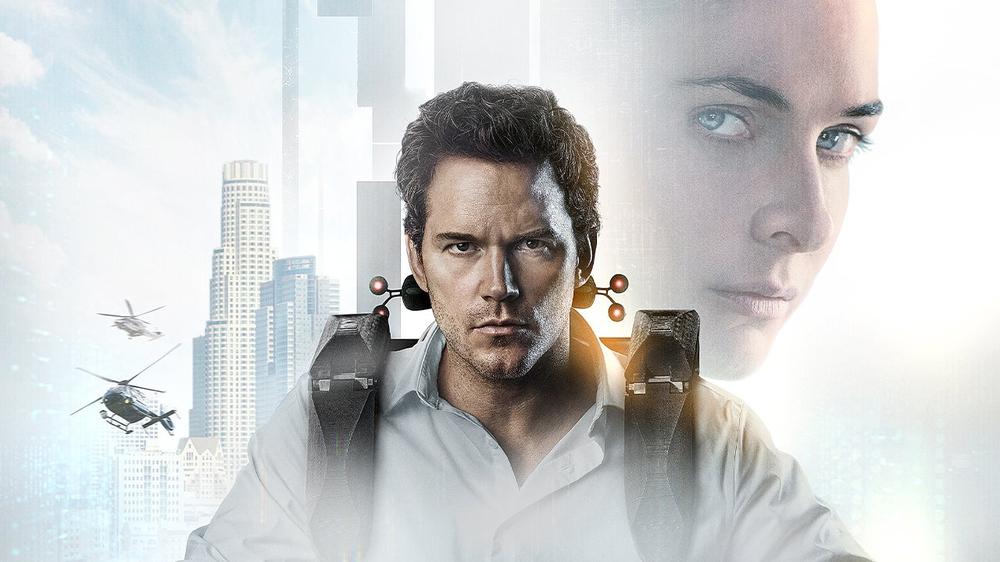
Chris Pratt’s breakthrough film role was in director Timur Bekmambetov’s 2008 action romp Wanted. Now, nearly two decades later, Pratt reunites with Bekmambetov for the upcoming sci-fi thriller Mercy, where he plays Chris Raven, an LAPD homicide detective who finds himself in the literal hot seat when he’s accused of killing his wife.
In a near-future Los Angeles, justice is meted out by an artificial intelligence dubbed the Mercy Program, a system Raven himself championed until he wakes up strapped to an execution chair. Raven only has 90 minutes – played out in real time, making Mercy a literal ticking clock story – to prove his innocence to his AI judge (played by Rebecca Ferguson) or he will be executed.
Although he played (Andy Dwyer’s alter ego) FBI agent Burt Macklin for laughs on Parks and Recreation, “I've never played a serious detective before. And so this was a departure for me, something different for me to try,” Pratt told me when I moderated the panel for Mercy at New York Comic Con last October.
Chris Raven, Pratt explained, “is a part of this special new Mercy Program that they've designed, essentially using AI to modify their court system, to be more efficient and to face the rise in capital crime in this version of Los Angeles. They just want to get these murderers off the street and send a message. And so my character has put eight people in this chair, each of whom were found guilty and immediately executed. And I find myself now on the receiving end of justice.”
The hungover Raven has to not only serve as his own defense counsel but also the detective investigating his wife’s homicide and his own actions preceding the murder. His alcoholism, violent temper, and strained relationship with his wife all point to him being her killer – and the Mercy Program proving its lethal efficiency at dispensing justice. “You're really peeling back the onion of not only what happened that night, but who this person is,” Pratt said. “The deeper you go, the more you realize this is a man who may have committed this crime.”
Enjoy this exclusive scene from Mercy:
The Mercy Program’s AI grants defendants access to anything in its jurisdiction with a camera installed – from doorbells and traffic lights to cell phones and social media – to search for evidence to aid their defense. The court’s AI can also access any digital information a defendant has sent or received via text or email.
“All the evidence that's being presented to us [in court] is there at any moment, sometimes up to a thousand screens in front of me of my life, this character's digital life over the past 10 years, and that's being used as evidence against me,” Pratt said.
“So we had to shoot me in the chair, but we [also] had to shoot every bit of that stuff that would then be put in post-production and provided as me yelling at my wife on my daughter's Instagram, her secret Instagram page that I find out she had, or various FaceTime calls that were stored in the Cloud that is used as evidenced against me, all my friends, all my family, the things that they've said, security footage, all of the stuff that is the evidence being used to find me guilty. Or innocent.”
The Mercy Court chamber’s displays of visual information from multiple sources made the movie an ideal candidate for Bekmambetov’s Screenlife style, a film format he helped pioneer with Unfriended (2015), Searching 2018), and Profile (2021).
During the Mercy panel at NYCC, Bekmambetov reflected on how much of life people, including himself, spend in front of screens, speculating it’s as much as half of their time in the real world and the other half in a digital one.
“It means half of events, [the] most important events of my life happening, not in [the] physical world now, it's happening [virtually]. I'm saying, ‘I love you, sorry, you're fired,' whatever, it's all happening now in [the] digital world.”
For the director, Mercy then is not just about entertaining audiences as a Screenlife movie, but also, as he put it in the film’s production notes, exploring “how we behave and interact with technology.”
The many screens used in the Mercy Court ultimately make Mercy, which was filmed for IMAX and will play in 3D theaters, an Augmented Reality theatrical experience for audiences. “It'll be like an AR movie because it's not about three-dimensional faces,” Bekmambetov promised. “It's more about screens flying in the theater. Literally in the theater, you will see how the screens [are] surrounding you.”
Producer Charles Roven was also on hand at NYCC, where he recounted the “very complicated” task of shooting Mercy as a Screenlife movie experience.
“All of these screens are making a different point in terms of the trial. And I had never experienced anything like that. Watching it go from shooting each individual screen to bringing all those screens together in the courtroom and then having the screens come at you was complicated, very complicated. I had never done anything like it before. And even watching Timur's [other] Screenlife movies, he may have had one or two screens, but not 15 at this exact same time coming at you.”
Roven added, “That 3D experience will give you a kind of real-life sense of what Chris [Raven] is experiencing in the chair, because those screens will not just come at you in a 2D way. They'll almost look like they're coming at you out of the motion picture screen into the audience.”
Mercy opens in IMAX and 3D theaters on January 23.
Editor’s note: These interview quotes were edited for clarity.
 “It’s AI slop, too”: The “Stardew Valley” fandom pushes back after White House “whole milk” meme