Listen to this line from the musical Wicked.
Or click anywhere to begin
This same melody repeats three times during the show, each at a pivotal moment for the main character, Elphaba.
🎧 Click play and see if you can hear how the melody is the same in each clip.
This sort of thing happens in lots of art forms, from film scores to standup sets. Depending on the medium, you might call it a theme or a callback. In music, the word motif describes a short, distinctive musical idea that recurs in a salient way.
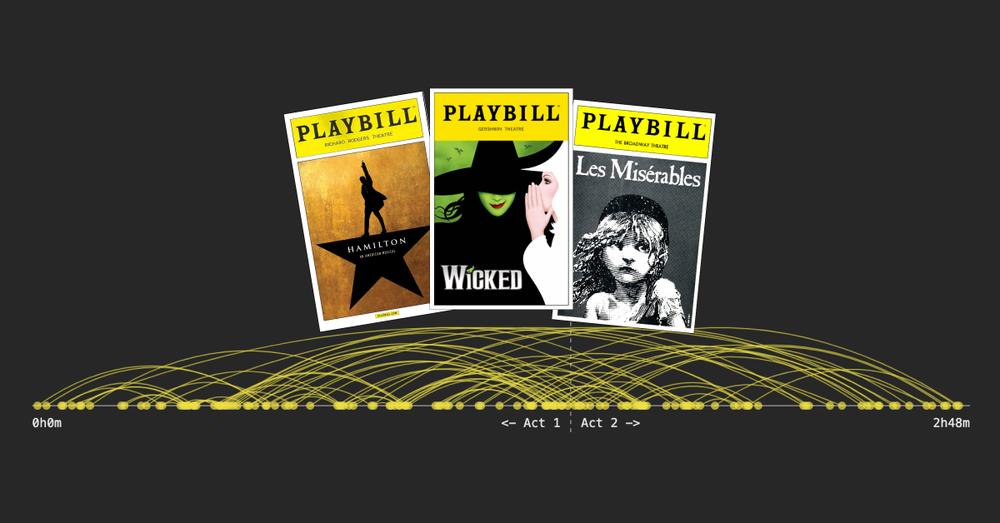
Here are all of the motifs in Wicked.
How did you define a motif?This piece focuses on melodic motifs that are sung, leaving out those occurring just in the orchestra (which are plentiful, just harder to capture reliably). I drew the line there because these are the easiest to hear and recognize. To qualify, a motif must recur at least twice across multiple songs. Each chart shows one instance of each motif per song, though many reappear several times within a single song.
To detect the motifs, I listened to these musicals a bunch of times, and noted occurrences by hand, while consulting some outside sources.
Hear a motif that we missed? Reach out at michelle@pudding.cool.
Musicals put motifs on display in a unique way.
Music is always telling a story, but here that is quite literal. This is especially true in musicals like Les Misérables or Hamilton where the entire story is told through song, with little to no dialogue. These musicals rely on motifs to create structure and meaning, to help tell the story.
Musicals like these are an excellent ground for observing the power and function of motifs – what exactly are they doing for the stories they are a part of? Let’s break that down, using examples from these sung-through musicals, but with patterns you’ll also spot across film, TV, and beyond.
Common Threads
Visualizing how musicals use motifs to tell stories
Composers have been using repetition for forever. Think Beethoven’s Symphony No. 5, where da-da-da-DUM repeats and reappears throughout the piece.
In the 19th century, German composers started formalizing the idea of attaching a motif to a person, place, or idea within a story (these are called leitmotifs). Think Peter and the Wolf, where different instruments and melodies represent different animals in the woods. Or the theme in Up, which captures the idea of Carl and Ellie’s shared life together.
So a motif doesn’t just exist, it represents something.
This creates a musical storytelling shortcut: when the audience hears a motif, that something is evoked. The audience can feel this information even if they can’t consciously perceive how it’s being delivered.
This technique has been embraced in many mediums — from opera to video game music to modern musical theater.
Let’s look at some examples of story and emotional information being conveyed through musical motifs.
Representing a character
One of the most straightforward uses of a motif is to represent a character in the story. These motifs can help cue the audience that a character is present, like Darth Vader or someone from the Fire Nation in Avatar the Last Airbender. A change in the motif’s instrumentation or tone can signal a change in that character.
In Hamilton, there are often literal introductions of characters to a consistent melody or rhythm.
Representing an idea
More often, motifs are a marker for something more abstract – love, heartbreak, adventure – and not always owned by a specific character. Like this Star Wars theme that embodies the concept of The Force, calling in ideas around destiny, hope, the struggle between good and evil.
Creating emotional layers
Why does that scene from Up make everyone cry? It establishes a simple melodic motif that comes to represent Carl & Ellie’s adventure together. But the real emotional weight comes from the fact that we hear it both in moments of joy and in moments of loss and heartbreak, each appearance carrying the previous memories with it. We feel the weight of the past layered onto the present moment, which makes it hit even harder.
The following motifs repeat, but with drastically different emotions across the show.
Weaving everything together
Both Les Misérables and Hamilton have a song at the end of the first act where many of the motifs introduced so far all come together. The audience is reminded of everything we’ve learned and seen so far, and the most important threads of the story collide and are woven together.
There’s something else hidden within that “Unlimited” motif from Wicked. It’s actually the same notes as “Somewhere Over The Rainbow”, a nod to the musical’s original source material.
Across generations, these pieces speak to each other — the threads connect. From the subtle to the more overt, connections like these shape how we feel and what sticks with us.
Most of us don’t consciously notice this force at work in the moment. Luckily, we don’t have to understand it to feel it.
Explore all the motifs we found in Hamilton, Les Misérables, and Wicked.
Choose a musical Filter by Song Filter by Character Sort by 🤷♂️ how does a Sung by Aaron Burr, narrating and introducing a new part of the story. 💰 alexander hamilton The main guy! 🤩 just you wait Hamilton proving himself is a big theme throughout the musical. 🎩 aaron burr sir An exchange, usually between Burr and Hamilton. 🤫 talk less A piece of advice Burr gives Hamilton (which he ignores), that demonstrates the difference between them. 🏀 my shot One of Hamilton's main motifs. 💭 i imagine death Hamilton contemplating his mortality and legacy. 🍻 raise a glass Like the motif in Les Misérables, this theme captures the camaraderie and idealism of young revolutionaries. 📜 angelica Each Schyuler sister gets their own name motif. 🕯️ eliza Each Schyuler sister gets their own name motif. 👩👧👦 schuyler sisters This one comes back very subtly in Act 2. 😎 summer in the city “Someone in a rush” changes to “someone under stress” later on. 👀 look around This motif repeats lyrically in “Non-Stop” and melodically in “Schuyler Defeated.” 🇬🇧 you'll be back These 3 songs, all sung by King George, are basically identical and musically distinct from the rest of the show. 😍 helpless Eliza sings this motif as she falls head over heels for Hamilton. ⏳ flashback “Satisfied” is a flashback of “Helpless,” and this motif helps place us in time as we experience the same events from a different angle. 💞 my sister Angelica demonstrating her sisterly love for Eliza. 👍🏽 satisfied This motif was borrowed from a letter from Angelica to Hamilton, where she writes: “You are happy my dear friend to find consolation in ‘words and thoughts.’ I cannot be so easily satisfied.” 💀 doesn't discriminate Burr contemplating two forces that are beyond his control, love and death. 🛑 wait for it Burr's main motif, representing his cautious, measured approach to life. 9️⃣ counting This count is usually used in the context of a duel, but also in “Take a Break” for Phillip's piano lesson (some sad foreshadowing). 📏 duel rules These two songs are basically identical. 🔫 aim no higher The final rule, which recurs for each of the three duels in the show. 🥺 that would be enough One of Eliza's main motifs, representing her love and devotion to Hamilton and their family. 🥺 that would be enough B The second section of Eliza’s motif. 👨✈️ asking me to lead Washington's motif representing duty and leadership. 🗺️ history has its eyes One of the core messages of the show, this motif represents the weight of legacy. 🤍 who tells your story These are the final words we hear in the show. ⏰ running out of time This motif is sung by other people about Hamilton and his relentless sense of urgency. 😇 phillip rap Phillip performs this rap for his parents as a 9-year old, and then again to himself when he's grown up, and feeling nervous before a duel. 📝 room where it happens Burr feels left out, even though his passiveness has put him there. 😏 on your side Hamilton seems to be Washington’s favorite, and Burr, Jefferson, and Madison jealously sing about it. ⚖️ equal opposite One of Jefferson’s only motifs! ✌🏽 say goodbye Washington’s goodbye echoes in Hamilton’s final words. 💔 quiet uptown Hamilton calls back to the previous song about grieving the loss of his son while everyone around him in “The Election of 1800” is focused on politics.Notes
This piece focuses on melodic motifs that are sung, leaving out those occurring just in the orchestra (which are plentiful, just harder to capture reliably). I drew the line there because these are the easiest to hear and recognize. To qualify, a motif must recur at least twice across multiple songs. Each chart shows one instance of each motif per song, though many reappear several times within a single song.
To detect the motifs, I listened to these musicals a bunch of times, and noted occurrences by hand, while consulting some outside sources.
Hear a motif that we missed? Reach out at michelle@pudding.cool.
 Calo della natalità da record. Babbo Natale scopre che i bambini italiani non esistono