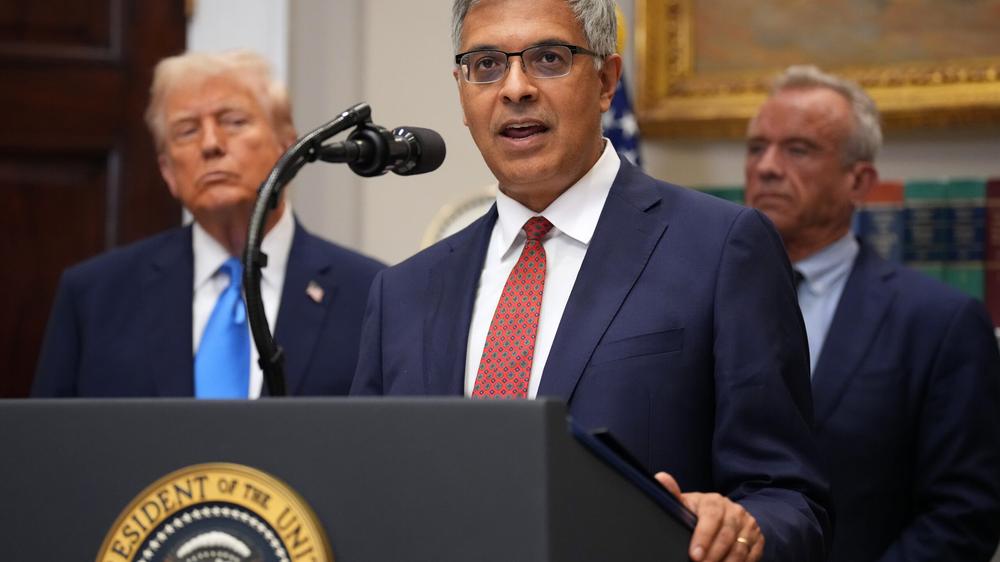
Jay Bhattacharya, the director of the National Institutes of Health, is now also the acting director of the Centers for Disease Control and Prevention, an unusual arrangement that has drawn swift criticism from researchers and public health experts.
Bhattacharya’s new role comes amid a leadership shakeup in the Department of Health and Human Services under anti-vaccine Health Secretary Robert F. Kennedy Jr. It also marks the third leader for the beleaguered public health agency under Kennedy.
Susan Monarez, a microbiologist and long-time federal health official, held the position of acting director before becoming the first Senate-confirmed CDC director at the end of July. But she was in the role just shy of a month before Kennedy ousted her for—according to Monarez—refusing to rubber-stamp changes to vaccine recommendations made by Kennedy’s hand-picked advisors, who are overwhelmingly anti-vaccine themselves.
Jim O’Neill was then named acting director. At the time, O’Neill was the deputy secretary of HHS but had previously worked as a Silicon Valley investor and entrepreneur who became a close ally of Peter Thiel. As acting director of the CDC, he signed off on a dramatic overhaul of the CDC’s childhood vaccine recommendations.
Now, amid Kennedy’s shake-up, O’Neill is out of the CDC and, according to media reports, will be nominated to run the National Science Foundation, which is currently without a director or deputy director. As a health economist with a medical degree, Bhattacharya has more qualifications to temporarily run the CDC than O’Neill, but researchers and public health experts were quick to blast his apparent lack of leadership skills.
Under Bhattacharya’s watch, the NIH terminated or froze hundreds of millions of dollars for research grants, including $561 million in grants to research the four leading causes of death in America, according to a Senate report released earlier this month. At least 304 clinical trials were defunded. Of the NIH’s 27 institutes and centers, 16 are currently without directors, an unprecedented number of vacancies.
Insiders report that, as NIH director, Bhattacharya delegates most of his responsibilities for running the $47 billion agency to two top officials. Instead of a hands-on leader, Bhattacharya has become known for his many public interviews, earning him the nickname “Podcast Jay.”
“Malpractice”
Researchers expect that Bhattacharya will perform similarly at the helm of the CDC. Jenna Norton, an NIH program officer who spoke to the Guardian in her personal capacity, commented that Bhattacharya “won’t actually run the CDC. Just as he doesn’t actually run NIH.” His role for the administration, she added, “is largely as a propagandist.”
Jeremy Berg, former director of the National Institute of General Medical Sciences, echoed the sentiment to the Guardian. “Now, rather than largely ignoring the actual operations of one agency, he can largely ignore the actual operations of two,” he said.
Kayla Hancock, director of Public Health Watch, a nonprofit advocacy group, went further in a public statement, saying, “Jay Bhattacharya has overseen the most chaotic and rudderless era in NIH history, and for RFK Jr. to give him even more responsibility at the CDC is malpractice against the public health.”
Like other commenters, Hancock noted his apparent lack of involvement at the NIH and put it in the context of the current state of US public health. “This is the last person who should be overseeing the CDC at a time when preventable diseases like measles are roaring back under RFK Jr.’s deadly anti-vax agenda,” she said.
It is widely expected that Bhattacharya will, like O’Neill, act as a rubber-stamp for Kennedy’s relentless anti-vaccine agenda items. When Kennedy dramatically overhauled the CDC’s childhood vaccine schedule, slashing recommended vaccinations from 17 to 11 without scientific evidence, Bhattacharya was among the officials who signed off on the unprecedented change.
Ultimately, Bhattacharya will only be in the role for a short time, at least officially. The role of CDC director became a Senate-confirmed position in 2023, and, as such, an acting director can serve only 210 days from the date the role became vacant. That deadline comes up on March 25. President Trump has not nominated anyone to fill the director role.
 Apple’s iOS 26.4 arrives in public beta with AI music playlists, video podcasts, and more