It seems that tech giants eyeing rural zones for data center development have underestimated how attached American farmers have grown to their lands in the decades they’ve been nurturing them.
Across the country, several farmers have firmly rejected eye-popping offers—sometimes in the tens of millions. These offers dwarf the value of their properties, but farmers have refused to put a price on the lands that they love most.
In a report on Monday, The Guardian highlighted a handful of cases nationwide where farmers’ refusals have frustrated plans to build data centers in areas long deemed rural.
It’s unclear how many farmers have received such offers, but rural lands have been increasingly targeted as demand for data centers to power AI has grown—most recently projected to increase by 165 percent by 2030. Globally, 40,000 acres are needed to support data center growth over the next five years, Hines Research estimated.
For “Silicon Valley executives,” rural areas are likely attractive due to “weak zoning protections, cheap power, and abundant water,” The Guardian reported.
It likely doesn’t help to sell the farmers these deals when they tend to come out of nowhere, following a knock on the door from a middleman who doesn’t make it clear who wants to buy the land or how the land would be used.
One 82-year-old Kentucky woman, Ida Huddleston, turned away a “Fortune 500 company” offering $33 million for 650 acres. NBC News reported that several of her neighbors received similar offers. Huddleston joined at least five other residents in the county who refused to move forward after learning they’d have to sign a non-disclosure agreement just to find out who they would be dealing with. Ultimately, Huddleston had to search public records to figure out that a data center was even being planned in the area, The Guardian reported. The lack of transparency is a problem, farmers have said, because what buyers want to do with the land matters.
“You don’t have enough to buy me out,” Huddleston told the company representatives when rejecting the deal. “I’m not for sale. Leave me alone, I’m satisfied.”
Notably, one resident in Huddleston’s county who received an offer, 75-year-old Timothy Grosser, even declined a proposal to “name your price” when a tech company sought to buy his 250-acre farm, The Guardian reported.
“There is none,” Grosser said.
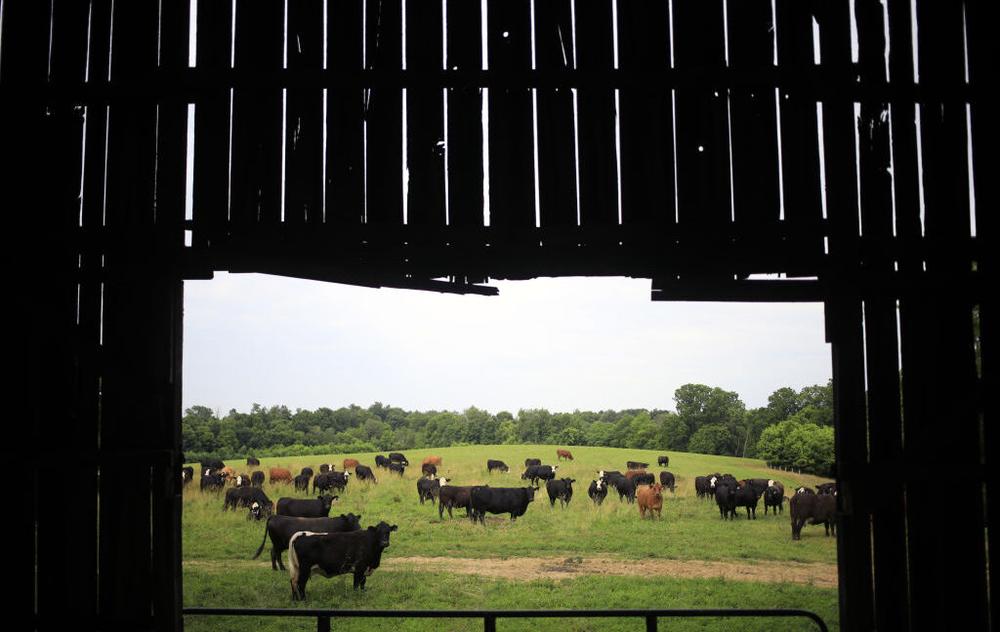
The farm is where he “lives, hunts, and raises cattle” and where his grandson hunts a turkey every Christmas for the family feast.
“The money’s not worth giving up your lifestyle,” Grosser said.
Another farmer in Wisconsin, Anthony Barta, reportedly fretted about what would happen to his neighbors if he took a deal he was offered—showing the deep bonds of people whose farms have bordered each other for years. In his community, another farmer was offered between $70 million and $80 million for 6,000 acres.
“Me and my family, we own the farm and run close to 1,000 animals,” Barta said. “What would that do if that’s next to it? Can they even be there? You know, that’s our livelihood—the farm. We’re just concerned what, if it would go through, what would happen to us and our neighbors and farms and our community? What would happen to that?”
Some tech companies are apparently not taking “no” for an answer. At least one farmer who spent 51 years milking cows in Pennsylvania prior to the AI boom described tech companies as “relentless.”
Eighty-six-year-old Mervin Raudabaugh, Jr., found a creative solution to end the pressure to sell two contiguous farms. He reportedly staved off developers by turning to “a farmland preservation program dedicating taxpayer dollars toward protecting agricultural resources.”
By working with the program, Raudabaugh will only receive about one-eighth of what the developers were offering. But he said it’s worth it to know his land would be preserved for farming purposes and out of reach of persistent tech companies.
“These people have hounded the living daylights out of me,” Raudabaugh said.
Data center deals come amid fragile farm economy
For people in rural communities, data center fights go beyond concerns about water and electricity consumption—although those are concerns, too. Communities are defending the character of the land, which they don’t want to see suddenly disrupted by extensive construction, data center noise pollution, or untold environmental impacts from massive operations.
There are also public health concerns, as an attorney with environmental nonprofit Earthjustice, Jonathan Kalmuss-Katz, told The Guardian that the pollution new data centers will emit could possibly proliferate “forever chemicals” known as polyfluoroalkyl substances (PFAS).
“We know there are PFAS in these centers, and all of that has to go somewhere,” Kalmuss-Katz said. “This issue has been dangerously understudied as we have been building out data centers, and there’s not adequate information on what the long term impacts will be.”
Some rural communities are fighting to block rezoning requests that would allow developers to build data centers in areas previously zoned only for agricultural lands. But those fights are seemingly hard-won. At least one Michigan community sought to settle after a developer firm working for an unnamed tech company reportedly sued to push through a construction project on farmland.
For farmers, the data center deals come at a particularly difficult time financially. On Friday, the National Farmers Union issued a statement after the Supreme Court blocked the majority of Trump’s tariffs. In it, NFU President Rob Larew confirmed that “many family farmers and ranchers have already felt the consequences” of Trump’s tariffs, which have raised costs, disrupted sales, and triggered retaliations impacting US agricultural goods.
“In an already fragile farm economy, uncertainty has hit family operations hardest,” Larew said.
The deals also arrived at a time when the number of US farms is shrinking, continuing “a long-lasting trend of declining farm numbers,” Farm Journal reported this month. In total, the US lost about 15,000 farms in 2025, with no state reporting an increase in farms.
So far, not much farmland has been ceded to data centers, the report seemed to indicate, perhaps due to farmers who dig their heels in when developer representatives come knocking.
Perhaps particularly in this dire climate—where farms are shrinking and existing farms are cash-strapped from unpredictable tariffs—it seems notable that farmers are not being swayed by developers’ offers of what the Guardian described as “unimaginable riches.”
But Huddleston made it sound easy to turn down $33 million, because her ties to the land run deep. She told The Guardian that “four generations of the Huddleston family have watched the world change from the same fields,” while raising cattle and living off the land.
“My whole entire life is nothing but the land,” Huddleston said. “It’s provided me with anything and everything that I’ve needed for 82 years.”
 With AI, investor loyalty is (almost) dead: at least a dozen OpenAI VCs now also back Anthropic