When dinosaur fossils surface at a site, it is often not possible to tell how many millions of years ago their bones were buried. While the different strata of sedimentary rock represent periods of geologic history frozen in time, accurately dating them or the fossils trapped within them has frequently proven to be frustrating.
Fossilized bones and teeth have been dated with some success before, but that success is inconsistent and depends on the specimens. Both fossilization and the process of sediment turning to rock can alter the bone in ways that interfere with accuracy. While uranium-lead dating is among the most widely used methods for dating materials, it is just an emerging technology when applied to directly dating fossils.
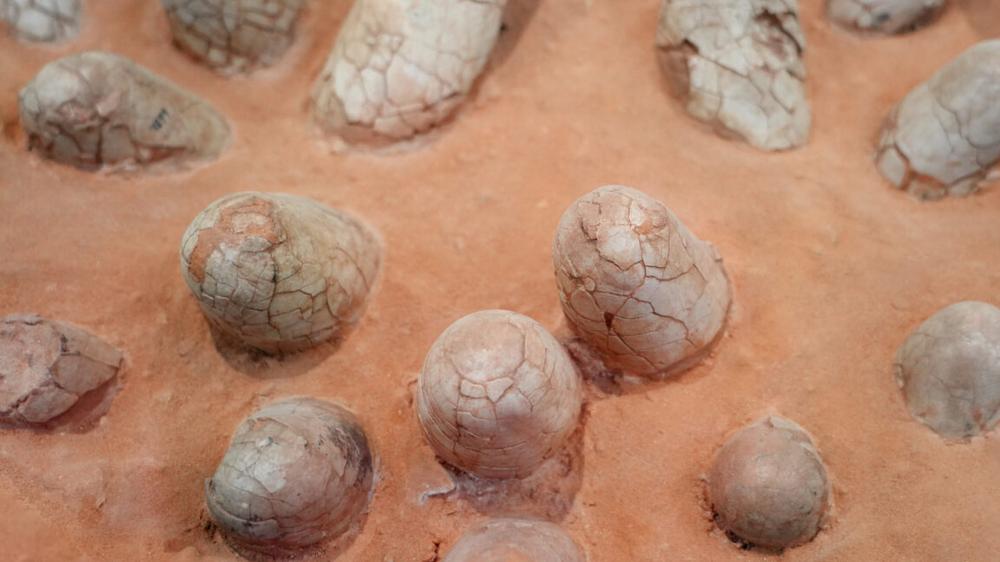
Dinosaur eggshells might have finally cracked a way to date surrounding rocks and fossils. Led by paleontologist Ryan Tucker of Stellenbosch University, a team of researchers has devised a method of dating eggshells that reveals how long ago they were covered in what was once sand, mud, or other sediments. That information will give the burial time of any other fossils embedded in the same layer of rock.
“If validated, this approach could greatly expand the range of continental sedimentary successions amenable to radioisotopic dating,” Tucker said in a study recently published in Nature Communications Earth & Environment.
This goes way back
Vertebrates have been laying calcified eggs for hundreds of millions of years (although the first dinosaur eggs had soft shells). What makes fossil eggshells so useful for figuring out the age of other fossils is the unique microstructure of calcium carbonate found in them. The way its crystals are arranged capture a record of diagenetic changes, or physical and chemical changes that occurred during fossilization. These can include water damage, along with breaks and fissures caused by being compacted between layers of sediment. This makes it easier to screen for these signs when trying to determine how old they are.
Eggs from two different Cretaceous sites were sampled. The first came from the Deep Eddy site in the Cedar Mountain Formation of Utah, which is surrounded by beds of petrified volcanic ash that had already been dated. The second group of samples came from egg clutches that had more recently been unearthed from the Teen Ulaan Chaltsai region of Mongolia’s Eastern Gobi Basin. The age of these eggs and the site they emerged from had previously been estimated but remained unknown.
Tucker and his team used uranium-lead radioisotopic dating on both sets of samples. This method can accurately date rocks that are anywhere from 1 million years old to those as ancient as the Earth itself, going back about 4.5 billion years.
Eggshells and other carbonate materials trap isotopes of lead and uranium. Uranium isotopes are unstable. Over time, they go through radioactive decay, releasing energy and losing protons and neutrons. One particular isotope decays via a pathway that ends with a lead isotope that is much more stable. The amount of lead keeps increasing in a way that’s proportional to the gradual decay of uranium. Finding out the relative amounts of these isotopes and taking their half-lives into account yields a sample’s age.
Old is an understatement
The eggs from Utah are thought to have been laid by a species of oviraptor, likely Macroelongatoolithus carlylei, while the Mongolian eggs were possibly laid by a Mongolian microtroodontid dinosaur—small, birdlike theropods that have been found to share ancestry with extant birds.
Trace element analysis showed that, despite being found on opposite sides of the planet, the structure of both eggshell samples was amazingly well preserved. There were only a few microfractures caused by the pressure of sedimentary layers packed above them as they fossilized.
After they determined an age for both shell samples by dating them directly, the researchers compared them. Zircons in the sediments of the Deep Eddy site had already established its age. It turned out that the nest site where the clutch of dinosaur eggs had been trapped between strata of volcanic rock dated as slightly older than the eggshells, which this method determined were 95 million years old. As expected, the rock found beneath the clutch was older, while the rock above was younger. The researchers think it is possible that fractures on these eggs may have resulted in slight inaccuracies.
As for the Mongolian eggs, the age from uranium-lead dating was also extremely close to that of the bedrock.
An analysis of trace elements in the Teen Ulaan Chaltsai eggs also turned up a surprise: A meteor had probably fallen to Earth around the time they were buried 99 million years ago. If there had been no meteor impact at the time, there must have already been meteor dust in the sediment that covered them.
“This study demonstrates that eggshell biocalcite from non-avian dinosaurs, birds, and other egg-laying vertebrates has the potential to serve as a reliable geochronometer in Mesozoic and Cenozoic terrestrial sedimentary basins,” Tucker said.
Next time a fossil site of indeterminate age confounds paleontologists, they need only look for dinosaur eggs.
Communications Earth and Environment, 2025. DOI: 10.1038/s43247-025-02895-w
 Stellantis is in a crisis of its own making