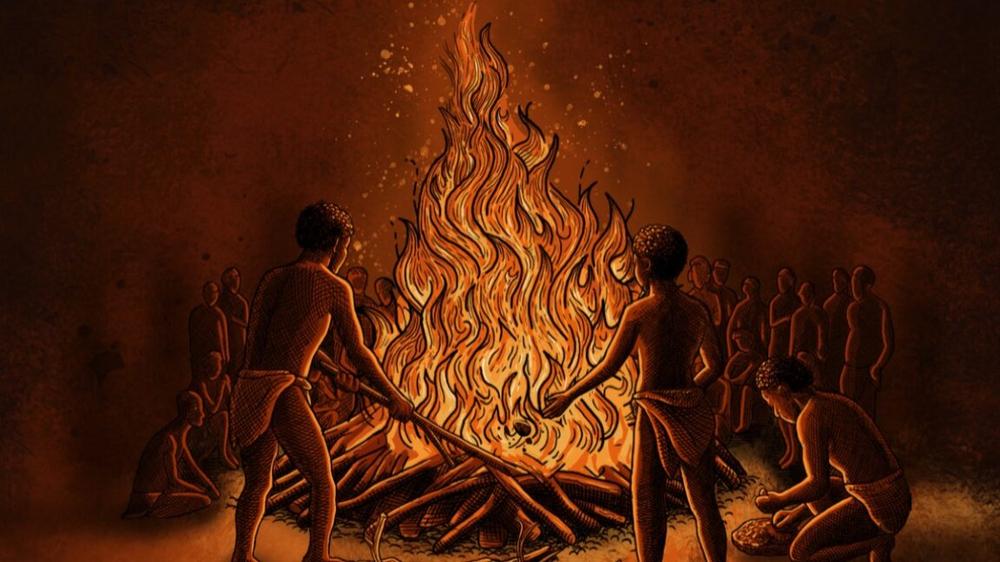
Archaeologists have discovered Africa’s oldest known cremation pyre at the base of Mount Hora in Malawi. According to a paper published in the journal Science Advances, radiocarbon testing dates the site to about 9,500 years ago, prompting a rethinking of group labor and ritual in such ancient hunter-gatherer communities.
Many cultures have practiced some form of cremation. There is a Viking cremation site known as Kalvestene on the small island of Hjarnø in Denmark, for instance. And back in 2023, we reported on an unusual Roman burial site where cremated remains had not been transported to a separate final resting place but remained in place, covered in brick tiles and a layer of lime and surrounded by several dozen bent and twisted nails—possibly an attempt to prevent the deceased from rising from the grave to haunt the living.)
But the practice was extremely rare among hunter-gatherer societies, since building a pyre is labor-intensive and requires a great deal of communal resources. There is very little evidence of cremation predating the mid-Holocene (between 5,000 and 7,000 years ago). According to the authors of this latest paper, the earliest known concentration of burnt human remains was found at Lake Mungo in Australia and dates back 40,000 years, but there is no evidence of a pyre, making it challenging to determine specific details.
The oldest pyre discovered thus far is the Xaasaa Na’ site in Alaska, dating to around 11,500 years ago and containing the remains of a 3-year-old child. There is evidence of burned human remains in Egypt dating around 7,500 years ago, but the earliest confirmed cremations in that region only date back 3,300 years.
That’s what makes the discovery of an intact hunter-gatherer cremation pyre with the remains of an adult woman at the Hora-1 site so significant. Situated under an overhang at the base of a granite hill, Hora-1 was first excavated in the 1950s. Archaeologists determined that it had been a burial ground between 8,000 and 16,000 years ago, with the interment of several intact (uncremated) bodies. The pyre is unique: an ash bed containing 170 bone fragments, mostly from arms and legs. It’s the only example of cremation at the site.
A bed of ash
Examination of the remains found at the pyre site revealed that they belonged to an adult woman, 18 to 60 years old, who was likely cremated within a few days of her death. The team also found distinctive cut marks on several bones, suggesting that the bones had been skinned before the cremation. Given the absence of teeth or a skull in the pyre, it seems whoever cremated the woman also removed the head. The body was likely positioned with arms and legs flexed, based on the distribution of the limbs.
The disarticulation was unlikely to be due to scavengers, per the authors. “These hands-on manipulations, cutting flesh from the bones and removing the skull, sound very gruesome, but there are many reasons people may have done this associated with remembrance, social memory, and ancestral veneration,” said co-author Jessica Cerezo-Román of the University of Oklahoma. “There is growing evidence among ancient hunter-gatherers in Malawi for mortuary rituals that include posthumous removal, curation, and secondary reburial of body parts, perhaps as tokens.”
The authors also analyzed the layers of pyre sediment using microscopic and spectroscopic techniques and subjected charcoal samples to radiocarbon dating. Those collective results enabled the researchers to reconstruct the sequence of events of the cremation. The pyre was probably built by collecting and assembling at least 30 kilograms of deadwood and grass, which would have required considerable community effort. And since it takes temperatures of 500° C or more to cremate a body, the pyre would have been carefully tended to keep adding fuel to the fire.
There was also evidence of flintknapping activity around the pyre, including several stone points concentrated within the burning remains, suggesting they had been intentionally placed there. And while this is the only evidence of a cremation pyre, it’s clear that people continued to build fires at the site in the same exact spot for the next several hundred years, suggesting the cremation was tied to “a deep rooted tradition of repeatedly using and revisiting the site, intricately linked to memory-making and the establishment of a ‘persistent place,’” the authors concluded, thereby challenging “traditional assumptions about community-scale operations and place-making in tropical hunter-gatherer societies.”
One mystery in particular still remains. “Why was this one woman cremated when the other burials at the site were not treated that way?” said co-author Jessica Thompson of Yale University. “There must have been something specific about her that warranted special treatment.”
Science Advances, 2025. DOI: 10.1126/sciadv.adz9554 (About DOIs).
 Slavoj Zizek: Welcome to the age of corridors