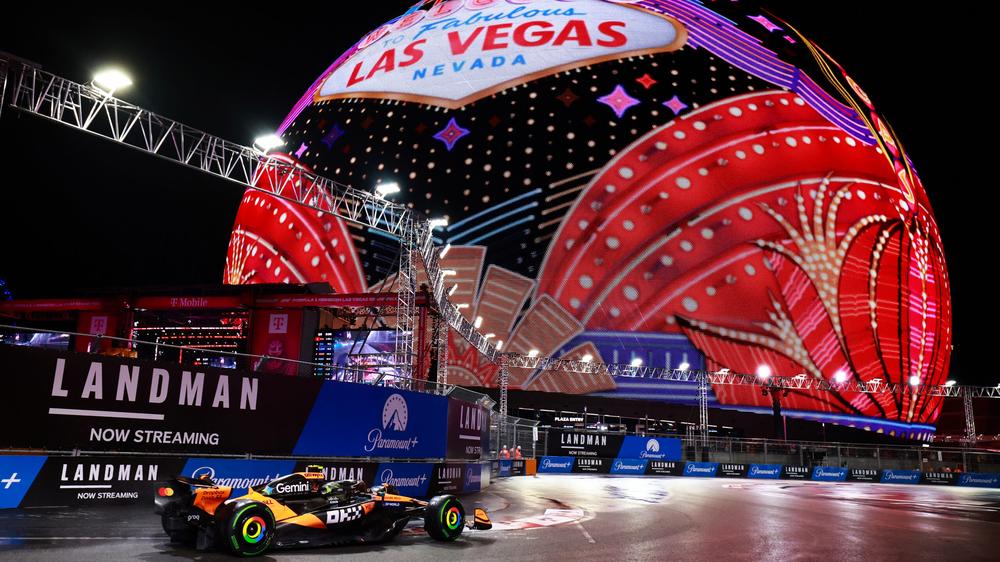
LAS VEGAS—Formula 1 held the third annual Las Vegas Grand Prix this past weekend in the Nevada city. The race is an outlier in so many ways, and a divisive one at that. Some love the bright lights that make it appear to be set in Mega-City One or F-Zero. Others resent the rampant commercialism of F1 at its most excessive. And this time, Ars was on the ground, making one of our periodic visits to the series. The race we saw was something of a damp squib, seemingly leaving McLaren’s Lando Norris in control of the championship.
At least that’s how it looked when I left the track on Saturday night. Within a few hours, Norris and his teammate (and one of his two title rivals) Oscar Piastri were both disqualified for having worn away too much of the “legality plank” underneath the car—more on that in a while.
Emblematic of the new F1
Unlike most Grands Prix, Liberty Media promotes this one itself. It spent half a billion dollars to get ready for the 2023 event, some of that on the pit lane and paddock complex, yet more on resurfacing the roads to the standards preferred by these thoroughbred racing cars. The track layout—which looks like a pig on its back—is typical of North American street circuits.
In other words, mostly long straights joined by slow, 90-degree corners. There are a couple of exceptions; technically turn 17 is the fastest corner in the series. Cars negotiate this bend at more than 210 mph (337 km/h) in the dry, although the drivers scarcely register it as a corner in such conditions. In the wet it’s a different story, and this year we got to see what that was like as heavy rain deluged the city in the days leading up to the race.
With so many slow corners, and a very long run down Las Vegas Boulevard from turn 12 to turn 14, the cars run in the same specification as at Monza, wearing low-profile wings and generating as little downforce as possible. The track surface doesn’t generate much mechanical grip from the tires at first—as the race weekend progresses, there is a significant amount of “track evolution” as daily road grime gets replaced with a layer of rubber deposited by the Pirelli racing tires.
Then there’s the temperatures. The desert gets quite chilly in November without the sun shining on things, and the track surface gets down to just 11° C (52° F); by contrast at the recent Singapore GP, also at night, the track temperature was more like 36° C (97° F).
So, low aero and mechanical grip, an unusual layout compared to most F1 tracks, and very cold temperatures all combine to create potential surprises, shaking up the usual running order.
We saw this last year, where the Mercedes shined in the cold, able to keep their tires in the right operating window, something the team wasn’t able to do at hotter races. But it was hard to tell much from Thursday’s two practice sessions, one of which was interrupted due to problems with a maintenance hatch, albeit not as serious as when one damaged a Ferrari in 2023. The cars looked impressively fast going through turn 17, and the hybrid power units are a little louder than I remember them, even if they’re not a patch on the naturally aspirated engines of old.
Very little of any use was learned by any of the teams for qualifying on Friday night, which took place in at times damp, at times wet conditions—so wet that the Pirelli intermediate tire wasn’t grooved enough, pushing teams to use the full wet-weather spec rubber. Norris took pole from Red Bull’s Max Verstappen, with Williams’ Carlos Sainz making best use of the opportunity to grab third. Piastri would start 5th, behind the Mercedes of last year’s winner, George Russell.
If the race is boring, the off-track action won’t be
Race night was a little windy, but dry. And the race itself was rather boring—Norris tried to defend pole position going into Turn 1 but ran wide, and Verstappen slipped into the lead, never looking back. Norris followed him home in second, with Piastri fourth, leaving Norris 30 points ahead of Piastri and 42 points ahead of Verstappen with two more race weekends and 58 points left on offer.
Then, a few hours later, drama struck. Some of F1’s appeal is as a high-speed soap opera, particularly if the actual racing itself is boring (which it often has been in the past), and this weekend was no exception.
Both McLarens were disqualified in the post-race technical inspection for showing illegal amounts of wear to the legality plank that every F1 car is mandated to carry on its floor. The planks were first introduced in 1994 in the wake of Ayrton Senna’s and Roland Ratzenberger’s deaths as a way to prevent teams from running their cars too low to the ground. At the end of the race, the 10 mm-thick planks are allowed to show no more than 1 mm of wear—any more than that and you’re out.
But they’re not wood. When the planks were first introduced they were made of an engineered wood composite called Jabroc, but more recently the sport switched to a glass-fiber composite called Permaglass.
Both Norris’ and Piastri’s cars were worn beyond 1 mm, although not very much more than that. It’s not the first time this has happened to a car this season—Ferrari’s Lewis Hamilton suffered the same fate at the Chinese Grand Prix. That leaves Norris still leading the championship, still on 390 points, with the same 24 point gap back to Piastri as before.
But now Verstappen is level-pegged with Piastri on 366 points. You get 25 for a win in F1, and another eight if you can win the sprint, so another bad weekend for Norris coupled with a win for either of his rivals would make things very interesting at the final round in Abu Dhabi. One thing’s for certain though; if you wanted to script a dazzling championship comeback with as much drama as possible, setting up for an explosive season finale, this is probably how you’d do it.
 Steam owner Valve generates staggering $50 million per employee – report