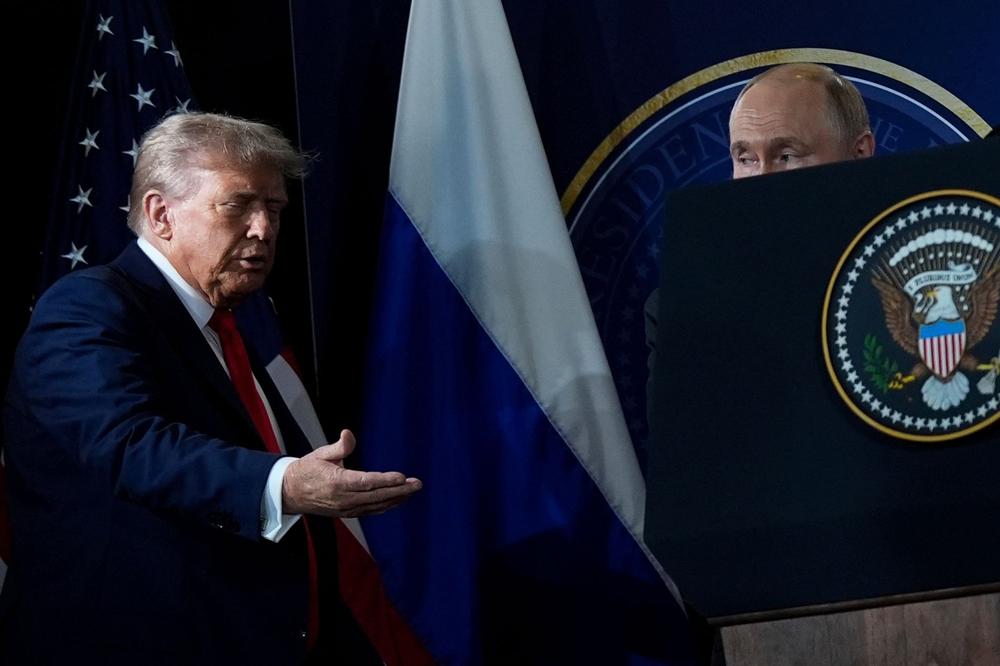
On the fourth anniversary of Russia's full-scale invasion, Moscow accused France and the U.K. of seeking to provide Ukraine with nuclear arms.
Offering no evidence, Russia's Foreign Intelligence Service (SVR) claimed on Feb. 24 that the "British and French elite" are helping Kyiv acquire nuclear weapons technology and delivery systems to secure "more favorable terms" in peace talks.
Experts and officials who spoke to the Kyiv Independent dismissed the claims, framing them as an attempt to divert attention from the anniversary of the all-out war and to blame Kyiv for stalled peace talks.
"It's obviously hogwash," said John Foreman, a security expert and a former U.K. defense attache in Moscow and Kyiv, pointing out that Russia has "made a series of outlandish accusations" in the past – for example, that Ukraine is developing a "dirty bomb."
"There is no truth in this," a U.K. defense official told the Kyiv Independent. "Four years into a war he thought he would win in a week, this is a desperate attempt by (Russian President Vladimir) Putin to distract from his failures."
Ukraine, which has relinquished Soviet-era nuclear arms stationed on its territory in accordance with the 1994 Budapest Memorandum, dismissed the accusations as "absurd."
Russia's accusation
Russia's intelligence claimed that the U.K. and France — NATO's only two European nuclear powers – moved to provide Ukraine with nuclear weapons technology after concluding that Kyiv cannot defeat Russia on the battlefield.
"Kyiv will be able to secure more favorable terms for ending the fighting if it possesses a nuclear bomb or at least a so-called 'dirty bomb'," the agency claimed. The SVR alleged that the delivery of a French TN75 small-size warhead from the M51.1 submarine-launched ballistic missile is under consideration.
Other Russian officials were quick to amplify the claim. Kremlin spokesperson Dmitry Peskov called the alleged plot a "flagrant violation" of international law — a charge that rings hollow given Russia's own nuclear threats and its violations of Ukraine's sovereignty and war crimes.
Dmitry Medvedev, Russia's former president known for his inflammatory rhetoric, warned that Moscow could launch nuclear strikes against Ukraine, the U.K., and France if such a transfer occurs.
The accusation was further disseminated on social media by accounts known for peddling pro-Russian narratives, including Chay Bowes or Diana Panchenko.
A disinformation monitoring team at the LetsData tech company said malign actors broadly spread the claim on Russian-language Telegram channels, framing U.K. and French leaders as reckless and desperate while seeking to evoke fears of a nuclear war and global instability.
Distraction from the war anniversary
Foreman said the timing of the latest claim was no coincidence. The expert called it a "counterblast" to the fourth anniversary of Russia's full-scale invasion, aimed at distracting from Moscow's responsibility by flooding the space with disinformation.
The claim also aims at domestic Russian audiences, casting Ukraine as a "dangerous proxy of the West" and thus justifying the ongoing war, the expert added.
As Ukraine enters the fifth year of Russia's full-scale war, the Kremlin has acknowledged that its objectives remain unmet — a contrast to the early expectations of Russian officials and many Western experts who predicted a swift Russian victory.
Since late 2022, Russian forces have moved at an incremental pace on the battlefield while sustaining at least 200,000 killed and hundreds of thousands more wounded, the highest casualty rate Russia has suffered since World War II.
"Five years into its 'three-day war', Russia would really prefer you focus on French and British nukes," the French government said on social media.
Stalling peace talks, dividing the West
As U.S. President Donald Trump's year-long effort to broker peace in Ukraine has failed to achieve a breakthrough, observers link Russia's latest allegations to the stalled negotiations.
Marek Kohv, a security expert at the Tallinn-based International Center for Defense and Security (ICDS) think tank, said the narrative aims primarily to "influence the already relatively pro-Russian segment of opinion in the White House, so that Washington puts even more pressure on Ukraine in peace negotiations."
Yuri Ushakov, a top Kremlin aide, has warned that the alleged weapons transfer plans would influence Moscow's position in peace talks and that Russia would brief Washington on the matter.
Russia has previously attempted to derail peace talks by blaming Ukraine for escalation — for example, by accusing Ukrainian forces of striking one of Putin's residences in December.
Also on Feb. 24, Putin alleged that Moscow has intelligence about possible attempts to sabotage the TurkStream and Blue Stream gas pipelines in the Black Sea, warning such actions could derail peace talks.
According to Kohv, Russia may also be seeking to sway Washington against London and Paris. Trump has often accused European allies of disrupting his peace efforts by rejecting Russia's maximalist demands and calling for increased military support for Kyiv.
"At the same time, it is entirely clear that neither the United Kingdom nor France wants to provide nuclear weapons to Ukraine at this stage of the war," the expert stressed.
Chris York has contributed reporting in the article.
Editor's note: This article was published as part of the Fighting Against Conspiracy and Trolls (FACT) project, an independent, non-partisan hub launched in mid-2025 under the umbrella of the EU Digital Media Observatory (EDMO). Click here to follow the latest stories from our hub on disinformation.
Note from the author:
Hi, this is Martin Fornusek. I hope you enjoyed this article. At the Kyiv Independent, our team strives to bring you insights into Russian disinformation, propaganda, and its ongoing aggression in Ukraine.
 Russian strike temporarily delayed Flamingo missile production, Zelensky says