Instead of kind of floating in microgravity and moving your mass around with your hands and your arms, now we’re ambulating. We’re walking with our legs. You’re going to have more strain on your knees and your hips. Your hamstrings, your calves, and your glutes are going to come more into play.
I think, overall, it may be a better fit for humans physically because if you ask somebody to do a task, I’m going to be much better at a task if I can use my legs and I’m ambulating. Then I have to pull myself along with my arms… We’re not really built to do that, but we are built to run and to go long distances. Our legs are just such a powerful force.
So I think there are a lot of things lining up that are going to make the physiology easier. Then there are things that are going to be different because we’re we’re now in a partial gravity environment. We’re going to be bending, we’re going to be twisting, we’re going to be doing different things.
It’s an incredibly hard engineering challenge. You have to keep a human alive in absolute vacuum, warm at temperatures that you know in the polar regions could go as far down as 40 Kelvin (minus 388° Fahrenheit). We haven’t sent humans anywhere that cold before. They are also going to be very hot. They’re going to be baking in the sunshine. You’ve got radiation. If you put all that together, that’s a huge amount of suit material just to keep the human physiology and the human body intact.
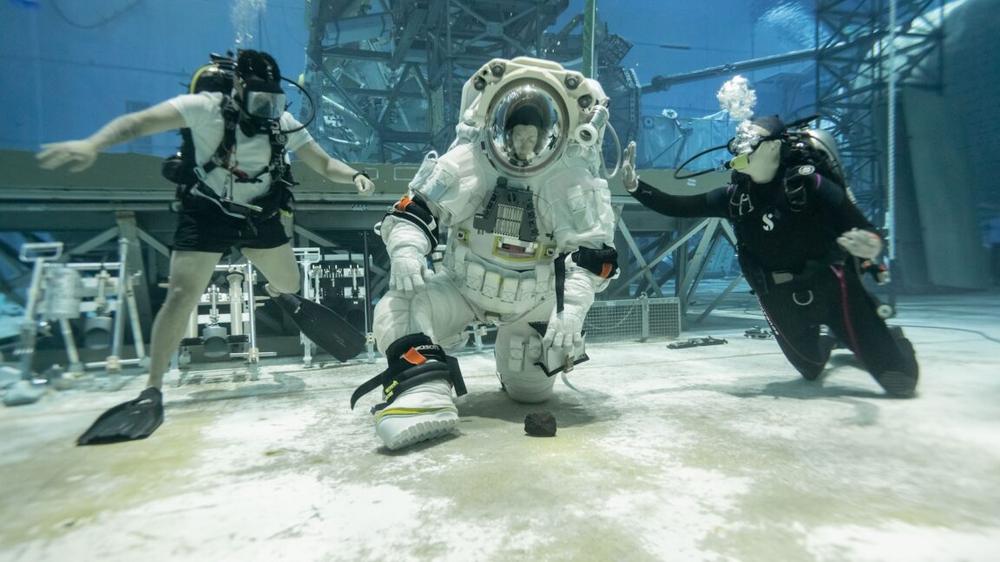
Then our challenge is ‘how do you make that mobile?’ It’s very difficult to bend down and pick up a rock. You have to manage that center of gravity because you’re wearing that big life support system on your back, a big pack that has a lot of mass in it, so that brings your center of gravity higher than you’re used to on Earth and a little bit farther backward.
When you move around, it’s like wearing a really, really heavy backpack that has mass but no weight, so it’s going to kind of tip you back. You can do some things with putting weights on the front of the suit to try to move that center of gravity forward, but it’s still higher, and it’s not exactly at your center of mass that you’re used to on the Earth. On the Earth, we have a center of our mass related to gravity, and nobody ever thinks about it, and you don’t think about it until it moves somewhere else, and then it makes all of your natural motion seem very difficult.
Former astronaut on lunar spacesuits: "I don't think they're great right now"
Stephen Clark
Jan 26, 2026 ·
2 mins read
Share this
features
science
space
artemis
axiom space
commercial space
human spaceflight
kate rubins
mike barratt
nasa
spacesuits
 Multe stradali in Italia, in 5 anni pagati 8,5 miliardi: 142 euro a testa. Chi ha incassato di più?