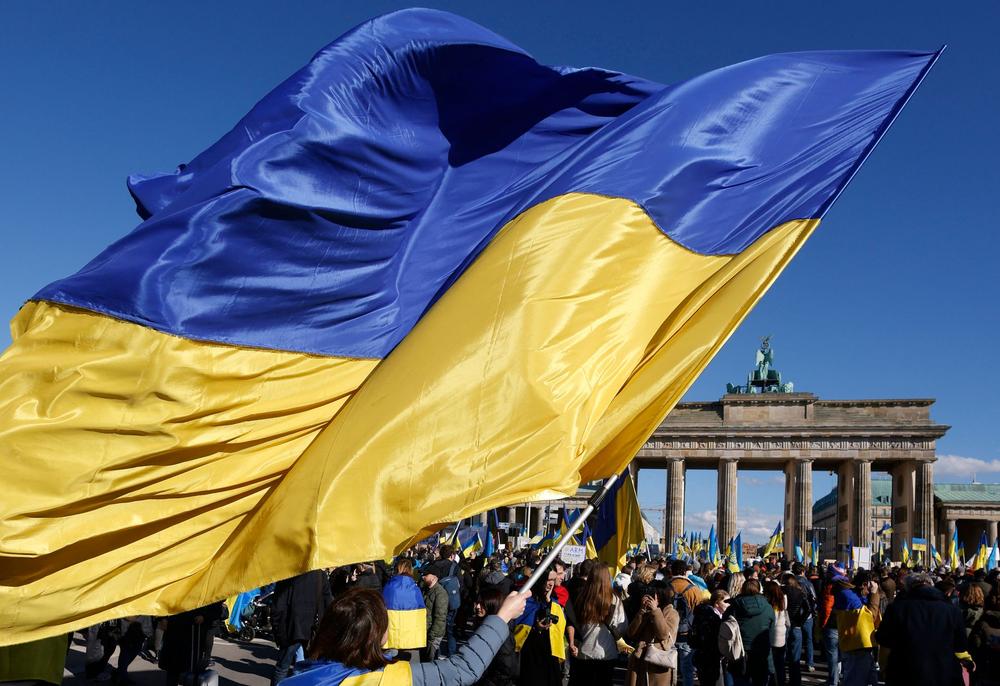
After years of bravery and sacrifice for freedom, democracy, and the European way of life, there can be no question that Ukraine is European.
Raising this question is no longer a valid contribution to any debate on Ukraine's future, it is merely deliberate and hypocritical sabotage of millions of people's struggle to achieve what we in the rest of Europe take for granted.
By any measure, Ukraine is the world's leading advocate for justice and lasting peace based on the European values that we, Europeans, hold to be self-evident. There is no better ambassador for the Enlightenment principles of life, liberty, human rights, and rule of law than President Volodymyr Zelensky.
Ukraine is writing this century's instruction manual on how to defend these European values when they come into conflict with the interests of an aggressive, unenlightened enemy.
Ukraine has demonstrated the powerful human ability to passionately defend what it holds dear, to remain optimistic and defiant, even in the face of "insurmountable" odds.
We should probably stop trying to calculate those "odds" because Ukraine's spirit is repeatedly confounding and embarrassing our best and brightest actuaries.
There is a reason that the catchphrase "Be brave like Ukraine" sticks so well, whereas the slogan "Be cautiously realistic like Europe" will never inspire any human to exceed themselves in any endeavour. It is very bad branding for a continent full of people, money, technology, talent, and the descendants of those who fought on the beaches.
I will never forget the day when, just before the 2023 NATO Summit in Vilnius, President Zelensky came to visit us.
As the then Foreign Minister of Lithuania, I had the great privilege of presenting him with our diplomatic achievements. We had been striving, more than most, to bring Ukraine closer to NATO, but our group of supporters was shrinking. The biggest doubters were actively trying to persuade us not to make any bold statements during the Summit.
After explaining the situation to President Zelensky, I said, "I can't say that I am a 'glass half empty' person anymore. It feels like the glass is completely dry." Hearing this, Zelensky opened his bottle of water, leaned forward with a smile, and suggested: "Would you like me to pour you some of mine?"
For a moment, he made my world stop spinning, and I caught a glimpse of the absurdity of all the endless calculations, estimates, and "cautious realism" that was being touted by many at the Summit. With a few words, he embedded within me a resolve to fight ten times as hard, whatever the cost.
I don't know how to quantify the power of hope in a risk assessment spreadsheet, but I think it might have more influence on reality than that of all the "realists" put together.
Even seeing all the carnage, the maimed and exhausted defenders, the lost territories, the flattened maternity hospitals and burning villages — Ukrainians still had more hope than I did for the future. With deep humility, at that moment, it became clear to me that whenever anything seems like it's all over, it's a mathematical impossibility, and there's nothing else that can be done — we should just be brave like Ukraine and get back to work.
In Ukraine's case, the "work" has been to completely rethink battlefield tactics, civil defense, and strategic communication. This is essential hard work that Europe needed to do a long time ago, but always found a reason to postpone until the next election cycle.
Necessity being the mother of invention, Ukraine invented everything we pretended not to need.
And now, Europe very much needs all of it. While we tediously debate the viability of Europe defending itself without the U.S., we ignore a far more answerable question: Can Europe defend itself without Ukraine?
The answer is "probably not" for the simple reason that if we lose Ukraine as a friend, and Ukrainians lose their freedom, we don't just lose some kind of theoretical battle for abstract values; we don't just betray innocent freedom-loving people, we abandon arguably the most effective armed forces and weapons industry in the world.
Our enemies would quickly gain all of Ukraine's territory, fertile land, natural resources, and vast accumulated knowledge about the future of war. They would also score the propaganda victory of their dreams, proving that decadent, degenerate, "woke" Europe has folded, taunting us with the justifiable conclusion that cynical European politicians never intended to fight for "as long as it takes".
However, if the question is "can we defend Europe together with Ukraine," the answer becomes a very obvious "yes." Again, raising this question has become a deliberate act of demotivation rather than an honest calculation.
Ukraine, despite getting only a fraction of what Europe can produce both financially and militarily, pushed Russia back and held them back. Russia — despite switching to a war economy, despite throwing millions of conscripts into a meat grinder, despite receiving huge technical and financial support from a country as huge as China, despite having absolutely no restrictions of international law or rules of engagement — failed to hold anything more than small towns.
Europe — even after insisting that disaster would inevitably follow the end of weapons deliveries from the U.S. — picked up the slack, at least partially, and Ukraine kept going, because Ukraine will always keep going. So if we can keep Russia out of EU territory with Ukraine's help, why couldn't we push Russia out of Ukraine with EU help? I understand why this wasn't our first choice, but what if it's our only choice now?
The recently and repeatedly announced 90 billion euros ($106 billion) won't pick up the slack forever, but it certainly is not the last possible EU consignment scraped out of the bottom of an empty barrel.
Discussions of capabilities and logistics ignore the fact that the most powerful weapon in politics and war is willpower. We should remember that several megatons of hope can be inspired by deploying one smile and one bottle of water.
Editor's note: The opinions expressed in the op-ed section are those of the authors and do not purport to reflect the views of the Kyiv Independent.
 Medvedev threatens UK, France with nuclear strikes after Russia's Ukraine arms transfer allegations