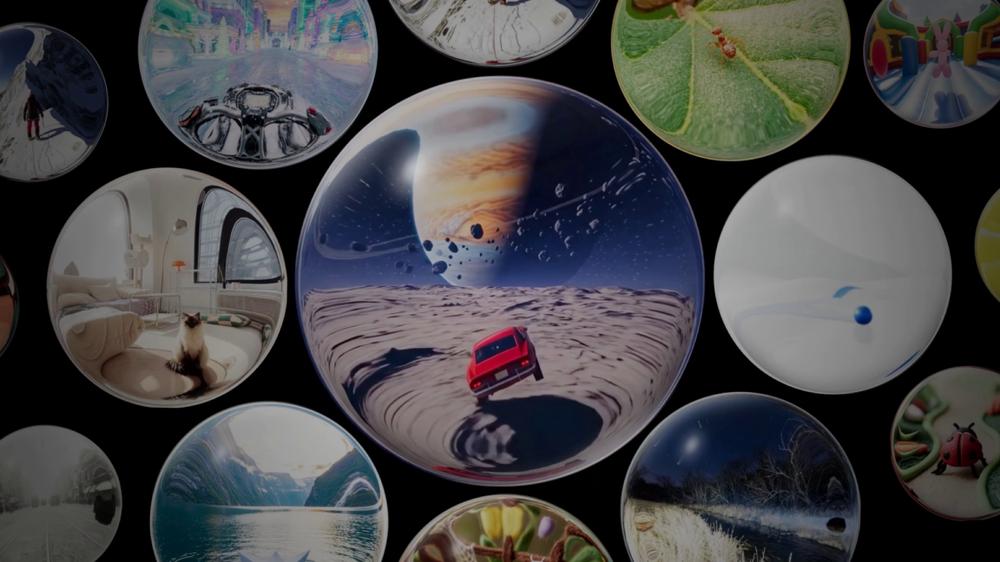
Last year, Google showed off Genie 3, an updated version of its AI world model with impressive long-term memory that allowed it to create interactive worlds from a simple text prompt. At the time, Google only provided Genie to a small group of trusted testers. Now, it’s available more widely as Project Genie, but only for those paying for Google’s most expensive AI subscription.
World models are exactly what they sound like—an AI that generates a dynamic environment on the fly. They’re not technically 3D worlds, though. World models like Genie 3 create a video that responds to your control inputs, allowing you to explore the simulation as if it were a real virtual world. Genie 3 was a breakthrough in world models because it could remember details of the world it was creating for a much longer time. But in this context, a “long time” is a couple of minutes.
Project Genie is essentially a cleaned-up version of Genie 3, which plugs into updated AI models like Nano Banana Pro and Gemini 3. Google has a number of pre-built worlds available in Project Genie, but it’s the ability to create new things that makes it interesting. You can provide an image for reference or simply tell Genie what you want from the environment and the character.
The system first generates a still image, and from that you can generate the world. This is what Google calls “world sketching.” If you don’t like the reference image created by Nano Banana Pro, you can make changes before handing it off to Genie.
The resulting video is 720p, rendering at around 24 frames per second. As you move your character around with WASD, Genie renders the path ahead in something approaching real time.
If that 60-second jaunt into the AI world isn’t enough, you can just run the prompt again. Because this is generative AI, the results will be a little different each time. Google also lets you “remix” its pre-built worlds with new characters and visual styles. The video generated of your exploration is available for download as well.
Still an experiment
Google stresses that Project Genie is still just a research prototype, and there are, therefore, some notable limitations. As anyone who has used Google Veo or OpenAI Sora to create AI videos will know, it takes a few seconds to create even a short clip. So, it’s impressive that Genie can make it feel interactive at all. However, there will be some input lag, and you can only explore each world for 60 seconds. In addition, the promotable events feature previously demoed for Genie 3, which allows inserting new elements into a running simulation, is not available yet.
While Google has talked up Genie’s ability to accurately model physics, the company notes that testers will probably see examples of worlds that don’t look or behave quite right. Testers may also see changing restrictions on content. The Verge was able to test Project Genie, and initially, it was happy to generate knock-offs of Nintendo games like Super Mario and The Legend of Zelda. By the end of the test, The Verge reports that some of those prompts were being blocked due to “interests of third-party content providers.”
Project Genie is only accessible from a dedicated web app—it won’t be plugged into the Gemini app or website. You can only access this tool for the time being with an AI Ultra subscription, which runs $250 per month. Generating all this AI video is expensive, so it makes sense to start with the higher tier. Google says its goal is to open up access to Project Genie over time.
 ‘Noobini Pizzanini 6-7’ – Story Kitchen’s Next Video Game Adaptation Is a Movie Based on Roblox’s Steal a Brainrot