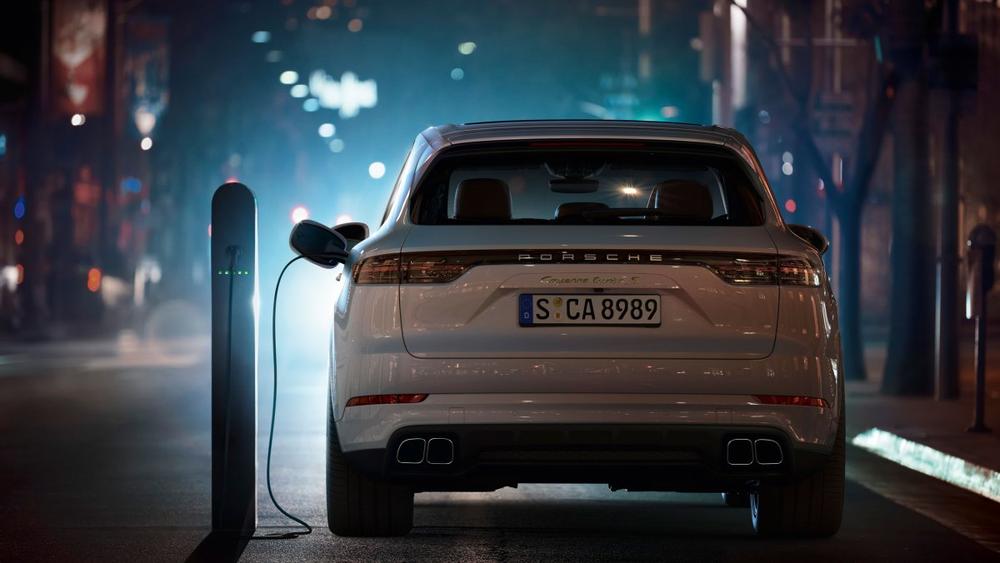
Plug-in hybrid vehicles are often touted as a bridge to battery-electric vehicles, promising to slash emissions by operating as EVs for short trips while relying on fossil fuels for longer ones.
They only deliver on that promise if they’re regularly charged. Real-world data drawn from the vehicles’ onboard computers shows that’s often not the case.
Using that data, the Fraunhofer Institute could determine how much of that energy came from charging when plugged in. It found that less than a third of 1 million PHEVs in Germany plugged in either occasionally or not at all.
U.S. automakers that are pushing future PHEV models as appealing alternatives for American drivers should take note. By blending gas with electricity, these automakers hope to boost fleet-wide efficiency without a wide rollout of EVs.
“We’re looking to make CO2 reductions across our lineup, but we’re doing it in a very efficient way,” Ford CEO Jim Farley said this month in an earnings call.
Yet the new study shows that PHEVs seldom deliver on their efficiency promises.
At best, Toyota drivers used electricity for 44% of the energy used for driving, suggesting they plugged in the most frequently. The worst? Porsche drivers, at just 0.8%, an average of 7 kilowatt-hours over two years. In other words, the average Porsche PHEV driver charged their battery less than 50% of its capacity — once.
Studies have previously shown that PHEVs produce about 3.5 times more emissions than their official ratings would suggest. This new study explains why since it directly assesses how much electricity the vehicles gained from charging. (PHEVs, like all hybrids, can operate in a mixed mode, using both gas and electricity. The study used data straight off the vehicles to disentangle the two.)
One of PHEV’s many shortcomings are their anemic batteries, capable of powering the vehicle for short distances. Some can only traverse a handful of miles, while many sold in recent years can operate on battery power for about 20 to30 miles. Regulators in Europe and automakers have been proposing longer ranges for future models, hoping that a more capable battery will encourage people to charge their batteries more frequently.
That’s not guaranteed, though. The vehicles are likely to remain compromised when driving on electrons. That’s because most PHEVs are based on fossil fuel platforms — the electric motors and power electronics aren’t capable of delivering 100% of the vehicle’s power needs. When a driver floors it, the gas engine has to kick in. In other vehicles, the engine turns on in cold weather to heat the cabin. When that happens, “why bother plugging in” is apparently a question most PHEV drivers have asked themselves.
Which raises another question: why bother with PHEVs at all?
PHEVs have been touted as a way to ease cautious consumers into full EVs. The argument goes something like this: Drivers will become habituated with plugging in while EV charging networks are built out. By the time they’re ready for their next vehicle, the networks will be ready and customers can ease into an EV.
But if nobody is plugging in their PHEVs, they’re definitely not developing the habit. Without full charges, the electric drivetrain isn’t benefitting anyone. The public still suffer from worse air pollution; and drivers are carting around hundreds of pounds of weight and enduring more recalls and costlier service visits as a result of the complex drivetrain.
Tweaking the PHEV formula to make them more reliant on batteries could help. The interim solution is called an extended-range electric vehicle (EREV), and it’s designed to run on battery power until the charge is depleted, at which point the fossil fuel engine recharges it. So far, no EREV has required the owner to plug in — they could easily drive the vehicle for its lifetime on gas. BMW used to make an EREV in the i3, but it stopped production years ago. Ford and Stellantis have both announced EREV pickup trucks, which have yet to go on sale.
Meanwhile, EV charging networks continue to expand. It’s possible that by the time automakers are making PHEVs and EREVs in large quantities, drivers will no longer need a comfort blanket in the form of a gas engine. (My household came to that conclusion two years ago. After a decade split between a BMW i3 EREV and a Chrysler Pacifica Hybrid PHEV, we traded up for a Kia EV9.)
Legacy automakers, which have second guessed their electrification strategies more times than I care to count, could be forced to change tacks once more.
PHEVs might have been a nifty solution on paper, but they’ve failed to deliver in the real world.
 Monarch: Legacy of Monsters Season 2 Review (No Spoilers)