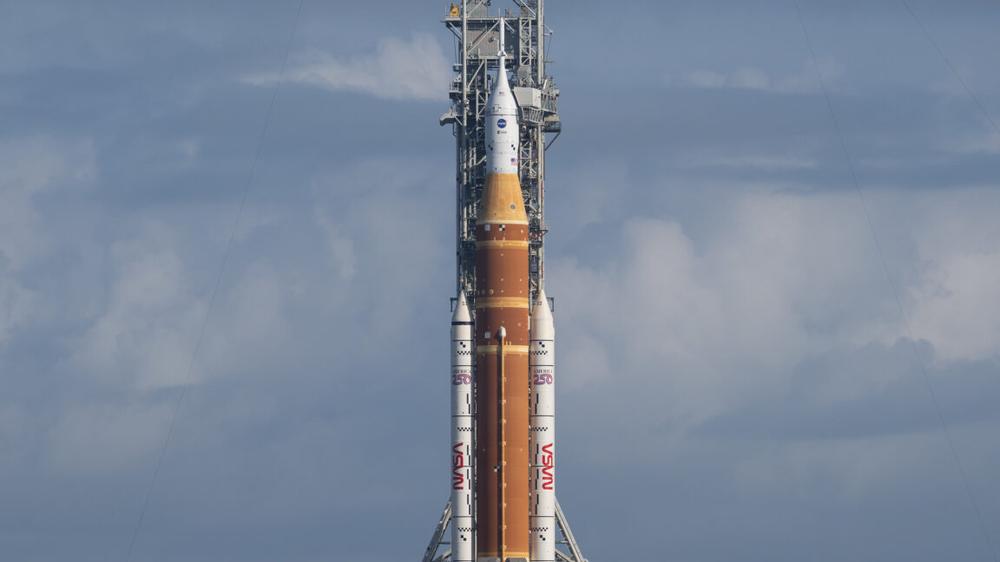
If all goes according to plan Monday, NASA’s launch team at Kennedy Space Center in Florida will load 755,000 gallons of super-cold propellants into the rocket built to send the Artemis II mission toward the Moon.
The fuel loading is part of a simulated countdown for the Space Launch System rocket, a final opportunity for engineers to rehearse for the day NASA will send four astronauts on a nearly 10-day voyage around the far side of the Moon and back to Earth. The Artemis II mission will send humans farther from Earth than ever before. The astronauts will be the first to launch on NASA’s SLS rocket and the first people to travel to the vicinity of the Moon in more than 53 years.
Charlie Blackwell-Thompson, NASA’s launch director for the Artemis II mission, will supervise the practice countdown from a firing room inside the Launch Control Center a few miles away from the SLS rocket at Kennedy Space Center. In a recent briefing with reporters, she called the Wet Dress Rehearsal—"wet” refers to the loading of liquid propellants—the “best risk reduction test” for verifying all is ready to proceed into the real countdown.
NASA delayed the rehearsal two days to avoid performing the test amid a spell of unusually cold freezing temperatures in Central Florida. Although the fueling test could have safely gone ahead, the temperatures would have violated cold weather restrictions for launching the Artemis II mission. A NASA spokesperson told Ars that officials wanted to run the countdown simulation in more realistic conditions they might actually see on launch day.
No astronauts will be aboard the Orion spacecraft mounted on top of the SLS rocket for the simulated countdown. Much of everything else will have the feeling of launch day. A successful fuel loading and smooth countdown would clear the way for launch of the Artemis II mission as soon as next Sunday, February 8.
If things do not go so well, NASA’s chances for launching Artemis II this month will likely wither away. NASA only has a handful of launch opportunities each month where everything lines up for Artemis II’s flight around the Moon. The first two of this month’s launch dates, February 6 and 7, are no longer an option after NASA ordered the two-day delay in this week’s practice countdown. Here are the three launch opportunities still available this month, each with a two-hour launch window:
- February 8 at 11:20 pm EST
- February 10 at 12:06 am EST
- February 11 at 1:05 am EST
If NASA misses this month’s launch opportunities, the next chance to send Artemis II to the Moon will be March 6. NASA has released this chart showing all available Artemis II launch dates through the end of April.
“Wet dress is the driver to launch. We need to get through wet dress,” Blackwell-Thompson said. “We need to see what lessons that we learn as a result of that, and that will ultimately lay out the path toward launch.”
The fix is in
The Artemis II mission comes more than two years after NASA launched Artemis I, the first unpiloted test flight of the Space Launch System rocket.
It took four tries for NASA to fully load propellants onto the first SLS rocket during a series of Wet Dress Rehearsals (WDRs) in 2022. None of the practice runs were free of problems. The list of technical snags included difficulties supplying gaseous nitrogen to the launch pad, problems keeping liquid oxygen at the proper temperature, and a series of valve and seal failures that led to persistent leaks of hydrogen fuel.
Molecular hydrogen is notoriously difficult to wrangle. It is highly flammable, and the molecule’s fantastically low mass and tiny dimension make it hard to contain. The cryogenic temperature of the liquified form of hydrogen is an additional complication. Liquid hydrogen must be kept at temperatures around minus 423° Fahrenheit (minus 253° Celsius), cold enough to freeze solid any gas it comes in contact with except for helium.
When liquid hydrogen hits seals and gaskets, the materials can change their shape and size, creating leak paths that escape detection at ambient temperatures. That happened repeatedly during multiple countdowns preceding the Artemis I launch, unseating seals in the hydrogen fueling line between the SLS core stage and its ground launch platform.
Finally, engineers devised what they called a “kinder, gentler” approach to ramping up pressures and hydrogen flow rates into the SLS rocket. The revised procedure wasn’t perfect, and it added some time to the fueling timeline, but it worked well enough to allow NASA to successfully launch the Artemis I mission in November 2022.
NASA will use the same fueling procedure for Artemis II. “We believe that issue has been put to bed,” Blackwell-Thompson said.
“Artemis I was a test flight, and we learned a lot during that campaign, getting to launch,” she said. “And the things that we’ve learned relative to how to go load this vehicle, how to load LOX (liquid oxygen), how to load hydrogen, have all been rolled in to the way in which we intend to go load the Artemis II vehicle.”
An all-day test
There are more changes to the launch countdown sequence for Artemis II because the astronauts will need to board the Orion spacecraft after the rocket is fully fueled. The crew will not be present Monday, but the rehearsal will include a built-in pause when the astronauts would climb into the spacecraft on launch day.
The additional time adds to what was already a lengthy countdown. The WDR officially kicked off Saturday night with the start of a two-day countdown clock, but the most critical moments will begin Monday morning.
The clock is ticking toward a simulated launch time of 9:00 pm EST Monday (02:00 UTC Tuesday). Preparations for filling the rocket with propellant will begin about 10 hours before then, around 11:00 am EST, with thermal conditioning of the core stage tanks to receive their cryogenic contents.
Once the tanks are properly chilled down to cryogenic temperatures, liquid hydrogen should start flowing into the core stage at around 11:35 am EST, followed 15 minutes later by the start of liquid oxygen loading. The launch team will ramp up flow rates to “fast fill” mode on both tanks sometime around 12:00 pm EST. This will be one of the most critical phases of Monday’s test, when engineers watch for buildups of hydrogen around the fueling connector near the bottom of the rocket.
NASA is streaming a live view of the 322-foot-tall (98-meter) rocket on its launch pad in Florida, but the agency is not planning to provide realtime commentary on the video feed Monday. Officials said they will release updates throughout the day on social media.
It will take about three hours to fill both tanks on the SLS core stage. Liquid hydrogen and liquid oxygen will begin pumping into the rocket’s upper stage soon after the start of core stage loading. If the countdown remains on track, the rocket should be fully fueled soon after 4:00 pm EST. That’s when NASA will dispatch the closeout crew to the launch pad to close the hatch to the Orion spacecraft, just as they will on launch day. Throughout it all, the rocket will slowly be replenished with propellant as the super-cold liquids boil off.
Once the pad crew evacuates to a safe distance, Blackwell-Thompson will poll her team for authorization to commence the final 10 minutes of the countdown. The automated countdown sequencer will oversee final steps to put the SLS rocket and Orion spacecraft into launch configuration, including the retraction of the crew access arm, transition from ground power to internal power supplies, and pressurization of the rocket’s propellant tanks.
The countdown will pause at T-minus 90 seconds for up to three minutes to verify the team’s ability to hold the clock in the final moments before liftoff. Then, the clock will tick down to T-minus 33 seconds before the countdown computer orders an automatic abort. During a real launch attempt, that is when control of the countdown would transition from a ground sequencer to the rocket’s onboard computer.
Mission managers plan to reset the clock at T-minus 10 minutes and commence a second run through the final countdown. The second run will give the launch team a chance to rehearse how they can recover from a last-minute abort and try to launch again on the same day.
All told, NASA says Monday night’s mock countdown may not be over until after midnight. At the end of the test, the launch team will drain the rocket of propellant and review the test’s results before setting an official target launch date for Artemis II, according to NASA.
Priority: Artemis II
More eyes than just those of NASA’s Artemis team will be closely watching the progress of Monday’s mock countdown. A few miles away from the Artemis launch pad, a separate team is preparing a SpaceX Crew Dragon spacecraft and Falcon 9 rocket to ferry the next long-duration crew to the International Space Station.
There’s some urgency in getting the next mission to the station after the early departure of the last crew due to a medical issue with one of the astronauts. That mission, designated Crew-11, undocked from the station and successfully splashed down in the Pacific Ocean on January 15, leaving the complex short-staffed with just one US astronaut and two Russian cosmonauts.
The four-person Crew-12 mission is next in line, with SpaceX and NASA aiming for a launch date as soon as February 11 from Space Launch Complex-40 at Cape Canaveral, Florida. The schedule for Crew-12 will ultimately hinge on when Artemis II flies.
Steve Stich, NASA’s commercial crew program manager, laid out the possibilities in a press conference Friday. NASA does not want to launch Crew-12 when Artemis II is in space for several reasons. The same group of Air Force pararescue personnel will be on standby to retrieve each astronaut crew in the event of an emergency during launch, and the flight paths of each mission require some of the units to stage in different locations. Both missions will also use the same fleet of NASA communications satellites for tracking and data relay services.
Artemis II will get first dibs on launch dates in early to mid February, Stich said. If NASA comes out of Monday’s rehearsal with a decision to move forward with Artemis II’s launch next Sunday, Crew-12 will stand down from the February 11 launch opportunity. If Artemis II gets off the ground Sunday, Crew-12 would wait until the Artemis astronauts are back on Earth. Assuming a full-duration mission, that would put the Crew-12 launch date around February 19, Stich said.
If NASA tries to launch Artemis II next Sunday but runs into a problem that grounds the mission, Crew-12 could be ready to go around February 13.
The convergence of the Artemis II and Crew-12 launch schedules adds another layer of importance to Monday’s countdown test at Kennedy Space Center. For the first time since the 1960s, NASA has separate astronaut crews simultaneously in preflight quarantine, a routine measure to prevent crew members from flying to space with an illness.
“We’ve laid out all the timelines relative to crew quarantine, when SpaceX will move their hardware to Pad 40, when we get into [our own rehearsals],” Stich said. “I would say those timelines will be a little dynamic, because in particular, if we get out to the launch pad and we’re trying to static fire around Artemis operations, we will work around Artemis in all those scenarios.”
 Helldivers 2 Set to Celebrate Second Anniversary With Some 'Surprises,' Including This Fantastic BTS Look at How John Helldiver Was Born