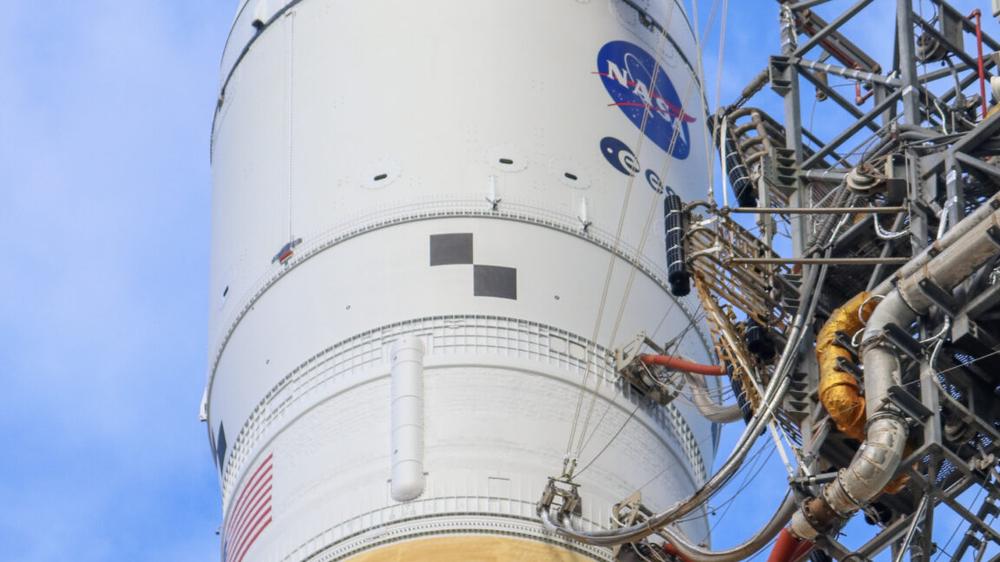
A day after NASA officials expressed optimism that they could be ready to launch the Artemis II mission around the Moon next month, the space agency’s administrator announced Saturday that a new problem will require the removal of the rocket from its launch pad in Florida.
The latest issue appeared Friday evening, when data showed an interruption in helium flow into the upper stage of the Space Launch System rocket, NASA Administrator Jared Isaacman wrote in a post on X. Isaacman posted a more thorough update Saturday, writing that engineers are still examining the potential cause of the problem, but any fixes must take place inside the Vehicle Assembly Building.
That means NASA and contractor ground teams will immediately begin preparing to roll the 322-foot-tall (98-meter) SLS rocket off of Launch Complex 39B and back to the VAB. The rocket and its mobile launch platform will ride NASA’s crawler-transporter for the 4-mile journey.
“Regardless of the potential fault, accessing and remediating any of these issues can only be performed in the VAB,” Isaacman wrote. “As mentioned previously, we will begin preparations for rollback, and this will take the March launch window out of consideration. I understand people are disappointed by this development. That disappointment is felt most by the team at NASA, who have been working tirelessly to prepare for this great endeavor.”
NASA officials were eyeing a launch attempt for Artemis II as soon as March 6, the first of five launch opportunities available in March. There are approximately five days per month that the mission can depart the Earth after accounting for the position of the Moon in its orbit, the flight’s trajectory, and thermal and lighting constraints. The next series of launch dates begin April 1.
The space agency bypassed launch opportunities earlier this month after a fueling test on the SLS rocket revealed a hydrogen leak. After replacing seals in the fueling line leading into the SLS core stage, NASA completed a second fueling test Thursday with no significant leaks, raising hopes the mission could take off next month. With the discovery of the helium issue Friday night, the March launch dates are now off the table.
The helium system on the SLS upper stage—officially known as the Interim Cryogenic Propulsion Stage (ICPS)—performed well during both of the Artemis II countdown rehearsals. “Last evening, the team was unable to get helium flow through the vehicle. This occurred during a routine operation to repressurize the system,” Isaacman wrote.
Another molecule, another problem
Helium is used to purge the upper stage engine and pressurize its propellant tanks. The rocket is in a “safe configuration,” with a backup system providing purge air to the upper stage, NASA said in a statement.
NASA encountered a similar failure signature during preparations for launch of the first SLS rocket on the Artemis I mission in 2022. On Artemis I, engineers traced the problem to a failed check valve on the upper stage that needed replacement. NASA officials are not sure yet whether the helium issue Friday was caused by a similar valve failure, a problem with an umbilical interface between the rocket and the launch tower, or a fault with a filter, according to Isaacman.
In any case, technicians are unable to reach the problem area with the rocket at the launch pad. Inside the VAB, ground teams will extend work platforms around the rocket to provide physical access to the upper stage and its associated umbilical connections.
NASA said moving into preparations for rollback now will allow managers to potentially preserve the April launch window, “pending the outcome of data findings, repair efforts, and how the schedule comes to fruition in the coming days and weeks.”
It’s not clear if NASA will perform another fueling test on the SLS rocket after it returns to Launch Pad 39B, or whether technicians will do any more work on the delicate hydrogen umbilical near the bottom of the rocket responsible for recurring leaks during the Artemis I and Artemis II launch campaigns. Managers were pleased with the performance of newly-installed seals during Thursday’s countdown demonstration, but NASA officials have previously said vibrations from transporting the rocket to and from the pad could damage the seals.
“That rollout environment is very complicated,” said Amit Kshatriya, NASA’s associate administrator, earlier this month. “We think that’s a contributor.”
NASA is also expected to replace batteries on the rocket’s flight termination system inside the VAB. The destruct system batteries currently on the rocket will expire next month.
Artemis II will be the first human spaceflight mission to the vicinity of the Moon since 1972, and also marks the first time astronauts will fly aboard NASA’s SLS rocket and Orion spacecraft. Astronaut Reid Wiseman, pilot Victor Glover, and mission specialists Christina Koch and Jeremy Hansen entered NASA’s standard preflight medical quarantine Friday. Now, they will be released to resume normal training activities.
Artemis II is a precursor for follow-on missions that will target landings at the Moon’s south pole. NASA aims to land the first Artemis mission on the Moon by 2028, but the schedule comes with uncertainties, such as the availability of a human-rated lander, spacesuits, and the SLS rocket and Orion spacecraft. A successful, and timely, Artemis II mission would help demonstrate that the SLS rocket and Orion will be ready.
With questions about the readiness of nearly every element of the Artemis program for a Moon landing mission, Isaacman teased a “more extensive briefing” on Artemis II and NASA’s broader lunar program later this week.
 Russia kills 4 in northeastern Ukraine, strikes ambulance carrying minor hospitalized in blast, targets Mondelez factory