Since the 1990s, physicists have pondered the tantalizing possibility of an exotic fourth type of neutrino, dubbed the “sterile” neutrino, that doesn’t interact with regular matter at all, apart from its fellow neutrinos, perhaps. But definitive experimental evidence for sterile neutrinos has remained elusive. Now it looks like the latest results from Fermilab’s MiniBooNE experiment have ruled out the sterile neutrino entirely, according to a paper published in the journal Nature.
How did the possibility of sterile neutrinos even become a thing? It all dates back to the so-called “solar neutrino problem.” Physicists detected the first solar neutrinos from the Sun in 1966. The only problem was that there were far fewer solar neutrinos being detected than predicted by theory, a conundrum that became known as the solar neutrino problem. In 1962, physicists discovered a second type (“flavor”) of neutrino, the muon neutrino. This was followed by the discovery of a third flavor, the tau neutrino, in 2000.
Physicists already suspected that neutrinos might be able to switch from one flavor to another. In 2002, scientists at the Sudbury Neutrino Observatory (or SNO) announced that they had solved the solar neutrino problem. The missing solar (electron) neutrinos were just in disguise, having changed into a different flavor on the long journey between the Sun and the Earth. If neutrinos oscillate, then they must have a teensy bit of mass after all. That posed another knotty neutrino-related problem. There are three neutrino flavors, but none of them has a well-defined mass. Rather, different kinds of “mass states” mix together in various ways to produce electron, muon, and tau neutrinos. That’s quantum weirdness for you.
And there was another conundrum, thanks to results from Los Alamos’s LSND experiment and Fermilab’s MiniBooNE (MicroBooNE’s predecessor). Both found evidence of muon neutrinos oscillating into electron neutrinos in a way that shouldn’t be possible if there were just three neutrino flavors. So physicists suggested there might be a fourth flavor: the sterile neutrino, so named because unlike the other three, it does not couple to a charged counterpart via the electroweak force. Its existence would also have big implications for the nature of dark matter. But despite the odd tantalizing hint, sterile neutrinos have proven to be maddeningly elusive.
Enter MicroBooNE
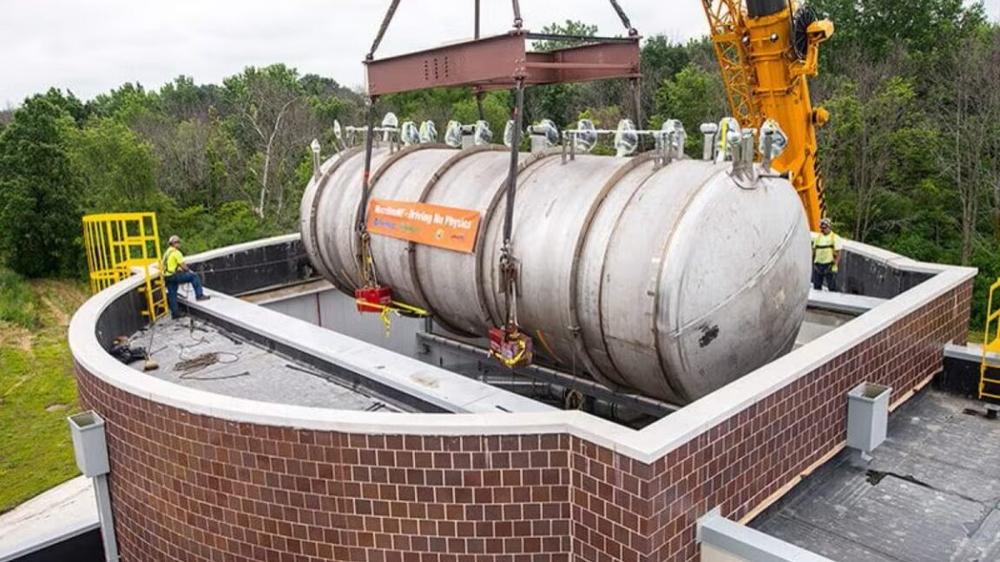
To probe the mystery further, Fermilab built MicroBooNE, which employs two beams pumping neutrinos into a liquid-argon time projection chamber. When neutrinos interact with liquid argon particles, this triggers a decay process that should produce muon neutrinos. If electron neutrinos showed up in the data, that would suggest the existence of sterile neutrinos.
Earlier this year, MicroBooNE published the first measurements from all five years (2015–2021) of the data collected, concluding that a sterile neutrino is not the cause of its predecessor’s anomalous results—i.e., a null result. This latest paper follows up on that initial analysis and confirms the findings: The data is consistent with no oscillations into a sterile neutrino, effectively ruling out its existence.
Attention now turns to alternative explanations for those earlier anomalies and new experiments, such as Fermilab’s Short-Baseline Neutrino (SBN) program, which uses a near detector and a far detector—both of which have already begun collecting data. There is also the Deep Underground Neutrino Experiment (DUNE) currently under construction in South Dakota, designed to receive high-energy neutron beams traveling 800 miles underground from Fermilab.
“MicroBooNE is big—it’s the size of a school bus,” said co-author David Caratelli of the University of California, Santa Barbara, and a member of both MicroBooNE and DUNE. “But DUNE is football field-scale. One of the key things that MicroBooNE did was give us all confidence and teach us how to use this technology to measure neutrinos with high precision. What we learned with MicroBooNE on how to analyze the data that comes to the detector all directly applies to DUNE.”
DOI: Nature, 2025. 10.1038/s41586-025-09757-7 (About DOIs).
 Debut Supergirl Trailer Has Big Guardians of the Galaxy Vibes — and a Very Brief Look at Jason Momoa's Lobo