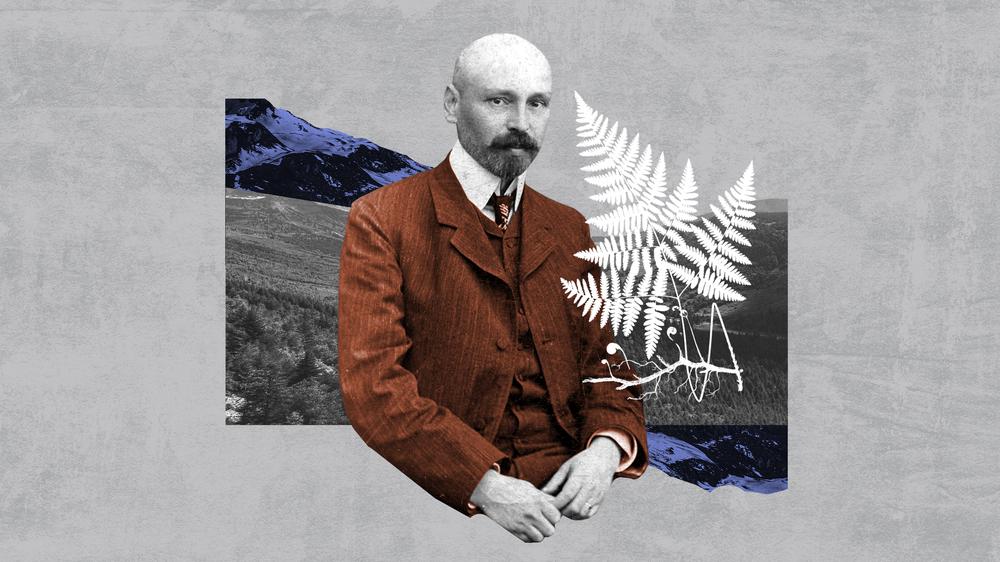
Editor's Note: This story is part of the "Hidden Canon" – a special series celebrating Ukrainian classic literature and aiming to bring it to a wider international audience. The series is supported by the Ukrainian Institute.
In an age where minds rarely know rest, the craving for true stillness feels almost radical.
Long before smartphones and social feeds, Ukrainian writer Mykhailo Kotsiubynskyi sensed this human need with startling clarity.
More than a century ago, he created a literary masterpiece that feels uncannily modern—a quiet refuge on the page, offering a powerful antidote to the overstimulation of contemporary life.
“Life relentlessly and inexorably comes at me like a wave on the shore. Not only my own life, but the lives of others as well. And ultimately, how do I know where my own life ends and another’s begins? I feel other people’s existence entering mine, like air through windows and doors, like tributary waters into a river,” Kotsiubynskyi laments at the start of his 1908 novella “Intermezzo.”
“I cannot pass by a person without being affected. I cannot be alone. I admit it, I envy the planets: they have their own orbits, and nothing stands in their way. Whereas on my own path, I meet people everywhere, all the time.”
The narrator, a stand-in for Kotsiubynskyi himself, lists among the story's main characters “my fatigue,” “human sorrow,” and “fields in June.” From the outset, we understand that this is not just a journey through landscape, but through the inner terrain of exhaustion and renewal. He heads off to the countryside in search of release from the unrelenting demands of city life, and upon his arrival, he describes a quietness that “filled the entire yard, hid in the trees, spread across deep blue spaces.” The stillness is not merely observed — it envelops him. It is so immersive that it makes him “ashamed” of the sound of his own heart beating.
The passage into the countryside is rendered as an almost frantic bid to escape “the iron hand of the city,” hurling the narrator into a state of disorientation: “Some green chaos whirled around me and grabbed the carriage by all its wheels, while the sky was so vast that my eyes drowned in it like in a sea and searched for something to cling to.”
However, he gradually surrenders to the countryside’s embrace, finding it not only restorative but life-affirming.
“You are precious to me,” the narrator proclaims in gratitude to the sun. “I drink your warm, healing drink, as a child drinks milk from its mother’s breast, just as warm and dear. Even when you burn — I gladly drink your fiery potion and become intoxicated by it.”
Kotsiubynskyi’s “Intermezzo” occupies a key place in both Ukrainian and wider European turn-of-the-century literature, marking a decisive shift away from traditional realism toward the emerging currents of modernism and symbolism. Instead of relying on conventional plot structures or external action, Kotsiubynskyi and his contemporaries turned inward, probing the fragile, flickering landscape of human consciousness. In doing so, they reshaped fiction itself, transforming it from a mirror of society into a resonant chamber of the mind.
However, Kotsiubynskyi’s crowning literary achievement is widely considered to be the novel “Shadows of Our Forgotten Ancestors” (1911), which later inspired Sergei Parajanov’s acclaimed 1965 film adaptation. Set against the dramatic backdrop of the Carpathian Mountains, it follows Ivan and Marichka, two young Ukrainian Hutsuls. The fate of their love is bound in tragedy from the start, as Ivan’s father was previously killed by Marichka’s father.
Kotsiubynskyi’s prose in “Shadows of Our Forgotten Ancestors” brings Carpathian folk traditions to life, blending landscape, ritual, and emotion into a unified, enveloping experience. His writing conveys the essence of these customs and the ties people have to the land they call home.
“Marichka knew countless songs. Where they came from, she could not say. They seemed to have rocked with her in the cradle, splashed in the bath, born in her chest, like wildflowers springing up in hayfields, like spruces growing in the mountains,” Kotsiubynskyi writes.
“Whatever the eye fell upon, whatever happened in the world — whether a lamb was lost, a young man fell in love, a girl betrayed, a cow grew weak, a spruce rustled — it all poured into the song, light and simple, like the mountains in their ancient, primeval life.”
Kotsiubynskyi imbues the natural world in “Shadows of Our Forgotten Ancestors,” like in “Intermezzo,” with a sense of agency and even its own personality, making it inseparable from the emotional and spiritual lives of his characters. The transition from winter to spring is rendered almost mythic, with lines like “the God-sun rose and laid its head upon the earth” and “spruces breathed green spirit, the grasses laughed in green joy — in the whole world there were only two colors: green for the earth, blue for the sky.”
When Marichka tragically dies in a flood, Ivan is consumed with grief and disappears into the wilderness, believed lost to the mountains. Years later, he returns and remarries, but finds himself plagued by jealousy and suspicion when his new wife grows close to a local molfar, or a spiritual practitioner, whom Ivan suspects of using dark sorcery against him.
Ivan’s world grows increasingly haunted: he is visited by visions of Marichka as a mavka, a forest nymph, and encounters the mysterious Chuhaister, a spirit of the woods. Drawn ever deeper into the supernatural realm by Marichka’s voice, Ivan ultimately plunges into a ravine, suffering fatal injuries. His funeral exemplifies Hutsul ritual, filled with song, dance, and the lamenting sound of the trembita, blurring the line between the living and the spirit world.
This pull of nature and the quest for freedom came from Kotsiubynskyi’s wider engagement with pressing social issues. Born in 1864 in Ukraine’s central region of Vynnytsia, which was then under the control of the Russian Empire, he was interested in the hardships and injustices suffered by Ukrainian peasants. His commitment to writing in Ukrainian also placed him firmly within a longstanding tradition of authors who, despite the pervasive forces of Russification, asserted the value and dignity of their native language.
Kotsiubynskyi lived and worked at a time when Ukrainian cultural expression was often viewed with suspicion by imperial authorities. At points throughout his life, he endured surveillance by Tsarist officials. Yet, as contemporary Ukrainian author and literary scholar Khrystia Vengryniuk observes, Kotsiubynskyi was not overtly political “in the classical sense.”
“He enlightened readers through refined taste and intellectual depth. He also took part in various (intellectual) societies — as a member of the elite, a creator, a thought leader — which in turn had a far greater impact than overt political engagement,” Vengryniuk added.
Neither failing health nor chronic financial strain broke his resolve throughout his life. On the contrary, such pressures seemed only to deepen his artistic commitment. He continued to write with moral clarity and emotional intensity, pushing his literary voice further as he grappled with enduring questions of identity, justice, and deliverance.
These concerns were born in the turbulence of his own time, but they feel uncannily present today. That is because Kotsiubynsky was never simply recording events or reflecting a single historical moment. Like all enduring literature, his prose reaches deeper — into questions of conscience, identity, suffering, and hope — speaking to something fundamentally human that does not expire with changing borders or the passage of time.
“Kotsiubynskyi was a profound intellectual and an aesthete. He was ahead of the era in which he created,” Vengryniuk said. “He remains — and will long remain — relevant and not yet fully read, because his works can be endlessly explored and interpreted.”
Kotsiubynskyi’s true measure also lies in the transformative effect he had on the trajectory of Ukrainian literature itself and in establishing it more firmly in the larger framework of European literature. His prose did not simply add to an existing tradition — it redefined the possibilities of literature, expanding its aesthetic range. According to Vengryniuk, his influence was foundational rather than incremental.
“It is hard to imagine how and in what direction Ukrainian literature might have developed had he not been part of it. He pointed the way forward for Ukrainian literature and, through his prose, elevated it to the world stage. His prose was truly international, and at times even stood ‘above’ European literature.”
read also
Editor's Note: This story is part of the "Hidden Canon" – a special series celebrating Ukrainian classic literature and aiming to bring it to a wider international audience. The series is supported by the Ukrainian Institute.
In an age where minds rarely know rest, the craving for true stillness feels almost radical.
Long before smartphones and social feeds, Ukrainian writer Mykhailo Kotsiubynskyi sensed this human need with startling clarity.
More than a century ago, he created a literary masterpiece that feels uncannily modern—a quiet refuge on the page, offering a powerful antidote to the overstimulation of contemporary life.
“Life relentlessly and inexorably comes at me like a wave on the shore. Not only my own life, but the lives of others as well. And ultimately, how do I know where my own life ends and another’s begins? I feel other people’s existence entering mine, like air through windows and doors, like tributary waters into a river,” Kotsiubynskyi laments at the start of his 1908 novella “Intermezzo.”
“I cannot pass by a person without being affected. I cannot be alone. I admit it, I envy the planets: they have their own orbits, and nothing stands in their way. Whereas on my own path, I meet people everywhere, all the time.”
The narrator, a stand-in for Kotsiubynskyi himself, lists among the story's main characters “my fatigue,” “human sorrow,” and “fields in June.” From the outset, we understand that this is not just a journey through landscape, but through the inner terrain of exhaustion and renewal. He heads off to the countryside in search of release from the unrelenting demands of city life, and upon his arrival, he describes a quietness that “filled the entire yard, hid in the trees, spread across deep blue spaces.” The stillness is not merely observed — it envelops him. It is so immersive that it makes him “ashamed” of the sound of his own heart beating.
The passage into the countryside is rendered as an almost frantic bid to escape “the iron hand of the city,” hurling the narrator into a state of disorientation: “Some green chaos whirled around me and grabbed the carriage by all its wheels, while the sky was so vast that my eyes drowned in it like in a sea and searched for something to cling to.”
However, he gradually surrenders to the countryside’s embrace, finding it not only restorative but life-affirming.
“You are precious to me,” the narrator proclaims in gratitude to the sun. “I drink your warm, healing drink, as a child drinks milk from its mother’s breast, just as warm and dear. Even when you burn — I gladly drink your fiery potion and become intoxicated by it.”
Kotsiubynskyi’s “Intermezzo” occupies a key place in both Ukrainian and wider European turn-of-the-century literature, marking a decisive shift away from traditional realism toward the emerging currents of modernism and symbolism. Instead of relying on conventional plot structures or external action, Kotsiubynskyi and his contemporaries turned inward, probing the fragile, flickering landscape of human consciousness. In doing so, they reshaped fiction itself, transforming it from a mirror of society into a resonant chamber of the mind.
However, Kotsiubynskyi’s crowning literary achievement is widely considered to be the novel “Shadows of Our Forgotten Ancestors” (1911), which later inspired Sergei Parajanov’s acclaimed 1965 film adaptation. Set against the dramatic backdrop of the Carpathian Mountains, it follows Ivan and Marichka, two young Ukrainian Hutsuls. The fate of their love is bound in tragedy from the start, as Ivan’s father was previously killed by Marichka’s father.
Kotsiubynskyi’s prose in “Shadows of Our Forgotten Ancestors” brings Carpathian folk traditions to life, blending landscape, ritual, and emotion into a unified, enveloping experience. His writing conveys the essence of these customs and the ties people have to the land they call home.
“Marichka knew countless songs. Where they came from, she could not say. They seemed to have rocked with her in the cradle, splashed in the bath, born in her chest, like wildflowers springing up in hayfields, like spruces growing in the mountains,” Kotsiubynskyi writes.
“Whatever the eye fell upon, whatever happened in the world — whether a lamb was lost, a young man fell in love, a girl betrayed, a cow grew weak, a spruce rustled — it all poured into the song, light and simple, like the mountains in their ancient, primeval life.”
Kotsiubynskyi imbues the natural world in “Shadows of Our Forgotten Ancestors,” like in “Intermezzo,” with a sense of agency and even its own personality, making it inseparable from the emotional and spiritual lives of his characters. The transition from winter to spring is rendered almost mythic, with lines like “the God-sun rose and laid its head upon the earth” and “spruces breathed green spirit, the grasses laughed in green joy — in the whole world there were only two colors: green for the earth, blue for the sky.”
When Marichka tragically dies in a flood, Ivan is consumed with grief and disappears into the wilderness, believed lost to the mountains. Years later, he returns and remarries, but finds himself plagued by jealousy and suspicion when his new wife grows close to a local molfar, or a spiritual practitioner, whom Ivan suspects of using dark sorcery against him.
Ivan’s world grows increasingly haunted: he is visited by visions of Marichka as a mavka, a forest nymph, and encounters the mysterious Chuhaister, a spirit of the woods. Drawn ever deeper into the supernatural realm by Marichka’s voice, Ivan ultimately plunges into a ravine, suffering fatal injuries. His funeral exemplifies Hutsul ritual, filled with song, dance, and the lamenting sound of the trembita, blurring the line between the living and the spirit world.
This pull of nature and the quest for freedom came from Kotsiubynskyi’s wider engagement with pressing social issues. Born in 1864 in Ukraine’s central region of Vynnytsia, which was then under the control of the Russian Empire, he was interested in the hardships and injustices suffered by Ukrainian peasants. His commitment to writing in Ukrainian also placed him firmly within a longstanding tradition of authors who, despite the pervasive forces of Russification, asserted the value and dignity of their native language.
Kotsiubynskyi lived and worked at a time when Ukrainian cultural expression was often viewed with suspicion by imperial authorities. At points throughout his life, he endured surveillance by Tsarist officials. Yet, as contemporary Ukrainian author and literary scholar Khrystia Vengryniuk observes, Kotsiubynskyi was not overtly political “in the classical sense.”
“He enlightened readers through refined taste and intellectual depth. He also took part in various (intellectual) societies — as a member of the elite, a creator, a thought leader — which in turn had a far greater impact than overt political engagement,” Vengryniuk added.
Neither failing health nor chronic financial strain broke his resolve throughout his life. On the contrary, such pressures seemed only to deepen his artistic commitment. He continued to write with moral clarity and emotional intensity, pushing his literary voice further as he grappled with enduring questions of identity, justice, and deliverance.
These concerns were born in the turbulence of his own time, but they feel uncannily present today. That is because Kotsiubynsky was never simply recording events or reflecting a single historical moment. Like all enduring literature, his prose reaches deeper — into questions of conscience, identity, suffering, and hope — speaking to something fundamentally human that does not expire with changing borders or the passage of time.
“Kotsiubynskyi was a profound intellectual and an aesthete. He was ahead of the era in which he created,” Vengryniuk said. “He remains — and will long remain — relevant and not yet fully read, because his works can be endlessly explored and interpreted.”
Kotsiubynskyi’s true measure also lies in the transformative effect he had on the trajectory of Ukrainian literature itself and in establishing it more firmly in the larger framework of European literature. His prose did not simply add to an existing tradition — it redefined the possibilities of literature, expanding its aesthetic range. According to Vengryniuk, his influence was foundational rather than incremental.
“It is hard to imagine how and in what direction Ukrainian literature might have developed had he not been part of it. He pointed the way forward for Ukrainian literature and, through his prose, elevated it to the world stage. His prose was truly international, and at times even stood ‘above’ European literature.”
 Samsung Galaxy S26 freschi di lancio. Su Amazon sconti immediati sul taglio da 512 GB