Despite the headline, this isn’t really a story about superconductivity—at least not the superconductivity that people care about, the stuff that doesn’t require exotic refrigeration to work. Instead, it’s a story about how superconductivity can be used as a test of some of the weirder consequences of quantum mechanics, one that involves non-existent particles of light that still act as if they exist.
Researchers have found a way to get these virtual photons to influence the behavior of a superconductor, ultimately making it worse. That may, in the end, tell us something useful about superconductivity, but it’ll probably take a little while.
Virtual reality
The story starts with quantum field theory, which is incredibly complex, but the simplified version is that even empty space is filled with fields that could govern the interactions of any quantum objects in or near that space. You can think of different particles as energetic excitements of these fields—so a photon is simply an energetic state of the quantum field.
Some of these particles have real existences we can track, like a photon emitted by a laser and absorbed by a detector some distance away. But the quantum field also allows for virtual photons, which simply act to transmit the electromagnetic force between particles. We can’t really directly detect these, but we can definitely track their effects.
One of the stranger consequences of this is that locations that have a strong electromagnetic field can be filled with virtual photons even when no real ones are present.
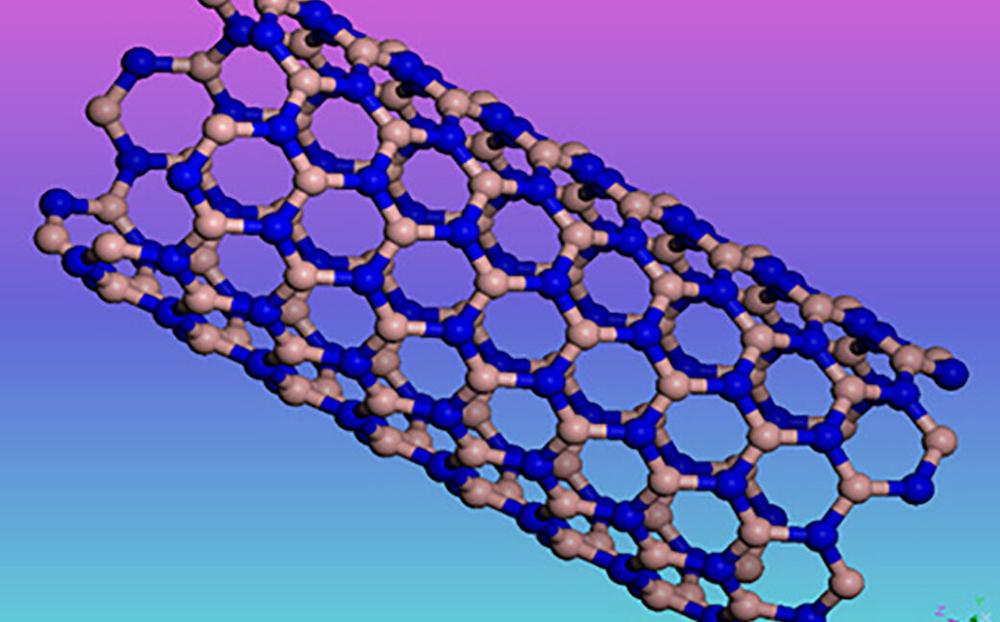
Which brings us to one of the materials central to the new work: boron nitride. Like the more famous graphene, boron nitride forms a series of interlinked hexagonal rings, extending out into macroscopic sheets. The bulk material is made of sheets layered onto sheets layered onto yet more sheets. This has an effect on light transiting through the material. In one direction, the light will simply slam into the material, getting absorbed or scattered. But if it’s oriented along the plane of the sheets, it’s possible for the light to travel in the space between the boron and nitrogen atoms.
But it’s not quite that simple. Because of the regular spacing of the atoms within individual sheets and the distance between those sheets, only certain wavelengths can transit smoothly.
In essence, hexagonal boron nitride forms a very distinct electromagnetic field, one that’s highly selective for a limited number of wavelengths. And that means that there are a lot of virtual photons at those wavelengths present in the material, even when no photons are around. And the new research relied on their presence to test an idea about an unusual form of superconductivity.
A bit less super
There’s an unusual superconductor called κ-(BEDT-TTF)2Cu[N(CN)2]Br (shortened to κ-ET) that’s a mix of copper and organic materials. It’s not a great superconductor—its critical temperature is just 12 Kelvin—but it doesn’t superconduct through the same mechanism that governs more conventional copper-based superconductors. There has been reason to expect that a carbon-carbon double bond is involved in the onset of superconductivity, but that has been difficult to test experimentally.
The researchers involved in the new work saw that the frequency of the stretching of this carbon-carbon bond matched the infrared wavelengths that could transmit through the boron nitride. That raised the possibility that sticking a lot of virtual photons nearby could influence the carbon-carbon vibrations, and thus the superconductivity. So, they built a device that had a piece of κ-ET superconductor and layered some boron nitride on top of it.
One feature of superconductors is that they expel magnetic fields. The research team found that the presence of boron nitride reduced the force needed to bring a magnet closer to the superconductor. Placing other materials on the surface showed no effect, suggesting that it’s something specific to the boron nitride. In a similar way, a related superconductor wasn’t affected by boron nitride. All of which suggests that there is something distinctive about the interaction between κ-ET and boron nitride. And, critically, this happens when there are no real photons transiting through the boron nitride.
Just to emphasize something from that: The boron nitride is suppressing superconductivity, not enhancing it. The researchers aren’t sure how deep into the superconductor the suppression penetrates, so they’ve not been able to determine whether this might reduce the critical temperature as well.
So, obviously, this particular interaction isn’t going to be a route to higher temperature superconductors. But it also may be a bit more than a clever demonstration of some weird physics. To begin with, boron nitride is helping us characterize what’s going on inside a superconductor in a way that can be difficult to accomplish via any other route. And there are plenty of other materials with the same sort of layered structure that might have resonances at different wavelengths, potentially allowing the development of a range of different probes.
More generally, this validates the idea that you can manipulate superconductivity in ways beyond the two levers we usually pull for that purpose: temperature and pressure. Some of the better-performing superconductors require temperature and/or pressure that’s never going to be very economical for general use. But the idea was that learning about them might help us find ways to achieve the same thing under more approachable conditions. But it hasn’t always been clear that there was any way to do so beyond changing the material’s chemistry. This new work suggests a potential alternative.
Nature, 2025. DOI: 10.1038/s41586-025-10062-6 (About DOIs).
 US lifts sanctions on Malian officials linked to Russian Wagner Group