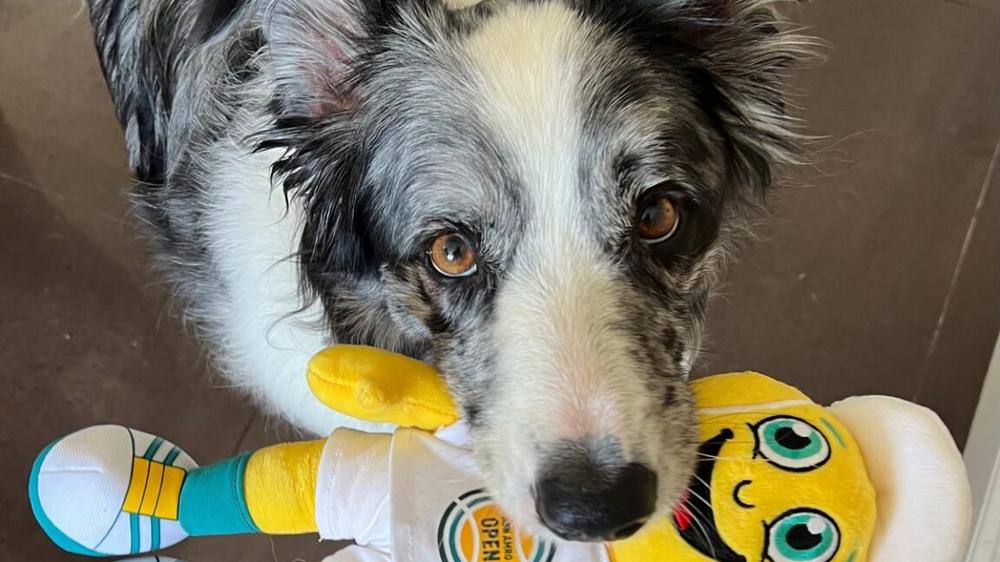
We love hearing about the latest findings coming out of an Eötvös Loránd University (ELU) research group focused on gifted word learner (GWL) dogs—if only for the pictures of adorable doggoes playing with their toys. Just last month, we learned that such dogs can learn the labels for new toys just by overhearing their owners talking about those toys. The group is back with yet another new paper, published in the journal Animal Cognition, presenting evidence that GWL dogs have a preference for novel toys and like to share them with their owners. That social interaction seems to be the key to the unique cognitive abilities of these rare dogs.
As previously reported, ELU co-author Claudia Fugazza has been studying canine behavior and cognition for several years as part of the Genius Dog Challenge. For instance, the group’s 2022 study discovered that dogs store key sensory features about their toys—notably what they look like and how they smell—and recall those features when searching for the named toy. Prior studies had suggested that dogs typically rely on vision, or a combination of sight and smell, to locate target objects. GWL dogs can also identify objects based on verbal labels.
Last fall, Fugazza’s group discovered that certain dogs can not only memorize the names of objects like their favorite toys, but also extend those labels to entirely new objects with a similar function, regardless of whether or not they are similar in appearance. It’s a cognitively advanced ability known as “label extension,” and for animals to acquire it usually involves years of intensive training in captivity. But the dogs in this new study developed the ability to classify their toys by function with no formal training, merely by playing naturally with their owners. It’s akin to a person calling a hammer and a rock by the same name, or a child understanding that “cup” can describe a mug, a glass, or a tumbler because they serve the same function.
This time around, the group recruited 10 GWL dogs and 21 non-GWL dogs, all border collies, since this the most common breed to fall into the GWL category. They compiled a list of eight toys: two labeled, two unlabeled, and four that were new to each dog.
What’s their motivation?
There was a two-week period where owners familiarized the dogs with the toys once a day for at least 10 minutes. Each toy was presented separately. For the labeled toys, owners moved the toy while crouched on the floor, repeatedly naming the toy (“Look at the [toy name]! Here is the [toy name]”). They did not name the unlabeled toys. Owners devoted an equal amount of time to all the toys. Novel toys were excluded from the familiarization phase.
After that period, each dog participated in two trials lasting 90 seconds each. The dogs were provided free access to the toys (washed with soap to control for odor cues). In the first trial, owners entered first and placed the labeled and unlabeled toys, plus two of the novel ones, on the floor and stood at a distance, passive and ignoring the dogs as the latter explored the toys. After a five-minute break, the test was repeated with the other two novel toys. All tests were recorded remotely and the footage subsequently analyzed.
Human babies are known to pay more attention to named objects, and the authors thought the GWL dogs would show a similar response, but that’s not what happened. All the dogs, whether they were GWL dogs or not, strongly preferred the new toys, and there were no significant differences between the two groups of dogs in terms of how much time they spent playing with labeled vs. unlabeled. So just hearing the names of toys does not automatically increase a dog’s attention.
However, the GWL dogs were much more likely to pick up a toy—particularly the new ones—and bring it to their owner, clearly attempting to get said owner to play with them. The typical dogs were more likely to opt for passive physical contact with their owners. The authors interpreted this as a difference in social style rather than curiosity, possibly mirroring the way human babies try to communicate with parents by pointing or showing objects to them.
“The way these dogs actively recruit humans into interactions around novel objects is intriguing,” said co-author Andrea Sommese of University of Veterinary Medicine in Vienna, Austria. “It raises the possibility that social motivation plays a role in why some dogs end up learning object names. Our results suggest that to understand why some dogs learn words, we may need to look less at the toys and more at the relationship. This opens new directions for studying how language-related skills can emerge in species that live so closely with humans.”
DOI: Animal Cognition, 2026. 10.1007/s10071-026-02047-3 (About DOIs).
 BMW X5 M Competition, il SUV da 625 CV che sfida la fisica