The western part of war-torn Ukraine lies in the space between normalcy and reality. More tourists, more construction, more skiing. Fewer air raids, fewer blackouts, fewer speeding khaki pickup trucks.
But no part of the country is immune to the effects of war.
A local library hangs photographs of young men and women killed in action. Graveyards fly blue and yellow. Brigades advertise jobs on large billboards lining the highway.
Driving past a small, unremarkable two-story building, my guide tells me it now houses a drone repair factory. Twenty people work there, she says, although it looks like it would fit half that.
"It’s the hardest winter in all four years of the war."
I traveled to Western Ukraine from Kyiv in late January, amid Russia’s attempt to systematically erase Ukraine’s power system. This part of the country had largely been spared from the consequences of Russian attacks on the energy grid, but since January, blackouts have become a daily nuisance. Two layers still suffice while indoors — unlike the four or five I have to wear at home in Kyiv.
On a mission to practice my Ukrainian, see the Carpathian Mountains, and catch up with some friends in Lviv, the opportunity to visit a local factory crops up. I ask whether I can write about it. They say yes — on the condition that I don't disclose the location, nor what they produce.
"We are in the most difficult situation we have ever been in," Vitaliy tells me in his office. A large fish tank bubbles in the background.
"It’s the hardest winter in all four years of the war."
He will be 76 in a few weeks and runs a factory that employs seven hundred people. Vitaliy is not his real name.
The factory manufactures a finished civilian product that has no military application, but that’s no consolation. Russian drones caused devastation to civilian enterprises in Lviv in a November attack, which looms large in the minds of businesses in the region.
While not targeted as frequently as Kyiv or other cities in eastern Ukraine, the Russian army regularly fires drones and cruise and hypersonic missiles at the western part of the country.
"Once, while walking my dog, a missile flew so low I thought it would hit me. It whistled, flying at very low altitude to avoid air defense detection," Vitaliy says.
In early January, Russia fired its most sophisticated missile at Lviv Oblast. It was the second time the intermediate-range ballistic missile Oreshnik had been used over the course of the war.
"It is genocide of the Ukrainian people," Vitaliy tells me, recalling the attack. He proudly describes Ukraine's heritage — the Kyvian Rus who settled in Kyiv over a thousand years ago, the Cossack warriors of the fifteenth century.
"Bohdan Khmelnytsky served the French king. He commanded a Cossack unit there."
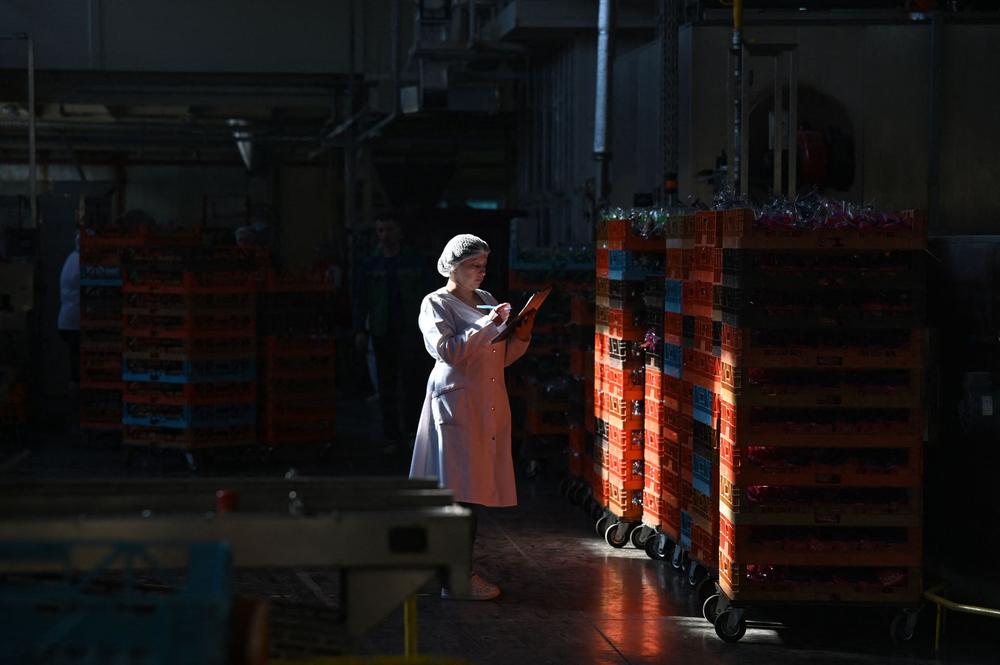
The factory has been operating since World War II. The assembly line is cartoonish; you can watch each step from raw material to the finished, packaged product by walking along the whirring conveyor belt.
Two weeks before I arrived, power cuts crippled production at the factory. Facing four hours of power cuts a day and inadequate heating, it was simply uneconomical to operate.
"It is heavy equipment. It has to be washed first, then heated, and only then can we launch," says Vitaliy.
"Even if the electricity is cut for 10 minutes, it takes us three hours to restart."
The factory now has constant power, but only because it imports 60% of its electricity needs from abroad — a threshold set by the Ukrainian government which, when crossed, exempts businesses from power cuts.
"Now we are buying electricity that is three times more expensive than before," Vitaliy says. 'But we do not stop. All these years, four years of war, we kept working."
A price surge of that magnitude would be catastrophic under normal circumstances. As the war enters its fifth year, such things in Ukraine are relegated to a trivial annoyance — another layer of sediment burying the world that existed before February 2022.
The factory's plight is one that I recognize. Businesses across the country, large and small, find expensive and cumbersome ways to keep the lights on. For Vitaliy, it's electricity imports. In Kyiv, it's generators — squat diesel engines humming outside restaurants, pharmacies, hair salons.
Walking through Kyiv, one must navigate ice, snow, and cables that snake out from these machines across the sidewalk. The air is heavy with exhaust fumes. I'm glad that a map of Kyiv's air quality can't be found in the weather app on my phone.
The air is fresher in the west, but a different kind of heaviness lingers — peace talks that few take seriously. Few here believe that Russia wants to end its war. The conventional wisdom is that Russia wants Ukraine.
As Putin throws countless Russians into Ukraine, the screws turn on Ukraine's manpower problem. For the Ukrainian armed forces and Vitaliy alike, finding workers is one of the hardest challenges.
"It has become very hard with people, because young people were mobilized into the army, taken away," he says.
After Russia invaded, Vitaliy was forced to ask former employees of the factory, who had retired, whether they could come back to work. Many of them agreed — although not all of them took up the same roles as before.
"Some professions that were considered purely male. We had to put women there, retrain them," he says.
Training women for traditionally male jobs is a topic often raised at business conferences in Kyiv. But it's the first time I've seen it in action.
A forklift driver goes by. "A man used to do that job." The lady chauffeur smiles as I shuffle out of the way.
The war has also meant a shortage of customers. Twenty percent of Ukraine's territory is now occupied by Russian forces, who continue to brutally nibble away at the country's sovereignty.
"We lost Donbas, Luhansk, Kherson, Zaporizhzhia, and Sumy. We had many customers there, but now the east has disappeared."
So they looked west, to Europe. And despite everything, production at the factory is actually expanding to serve the new markets where they have gained a foothold.
Therein lies the paradox of Ukraine's wartime economy. Free Ukraine shrinks, but the economy grows.
Some call it "resilience." But resilience isn't an abstraction. It's the pensioners lining the factory conveyor belt. Electricity for three times the cost. Generators that cost a thousand bucks. Newfound clients in the West. And of course, a heavy dose of grit and patriotism.
"I have the means to leave — but I am here. With my people. That's who we are."
 Trump caccia Anthropic dalla difesa americana. Ma OpenAI firma un accordo con le stesse tutele negate ad Anthropic