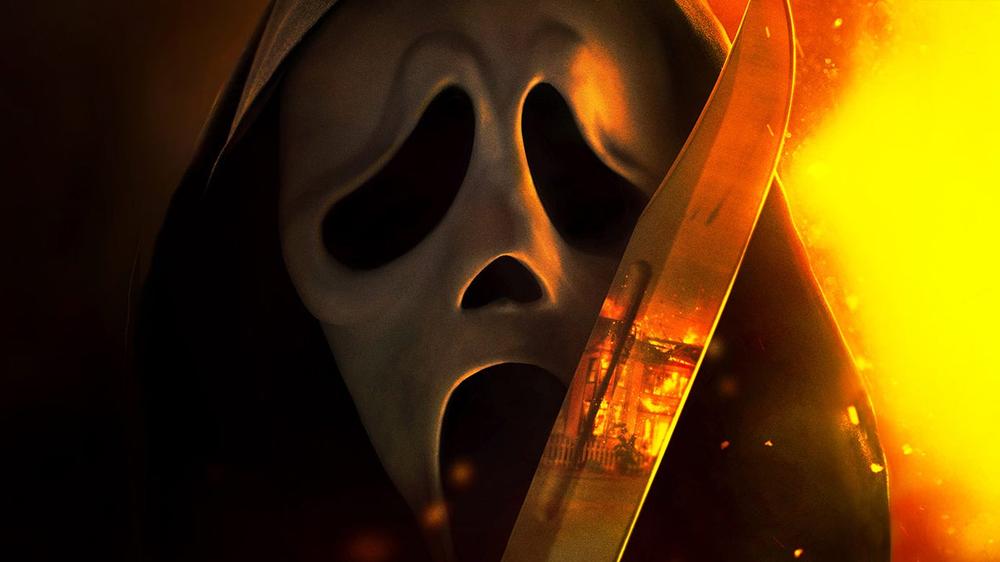
“Burn it all down.” For a tagline so front and center of Paramount’s marketing for Scream 7, it has very little relationship to the actual ethos of the movie. Instead, Scream 7 feels like a return to roots for the venerable meta-slasher franchise, far more interested in and effective at propping up the more playful tone of Scream’s early days than the increasingly deconstructive tendencies of the fourth, fifth, and sixth entries. It succeeds as a(nother) back-to-basics reset for Scream, but ironically for a story centered on how much a mother will let her trauma affect her daughter, living in the past in order to drive a franchise reset does keep Scream 7 from having an identity of its own.
The two Radio Silence-directed installments which precede Scream 7 felt like very intentional attempts to recontextualize the franchise into a more modern sensibility, something really hammered home by Scream 6’s move to a bustling New York City. Kevin Williamson takes over directing and writing duties (the latter shared with Scream 5 and 6 co-writer Guy Busick) for Scream 7 and, though he wrote the first, second, and fourth films in the franchise, it represents his first time in the director’s chair on a Scream movie and his first time directing a film since 1999’s Teaching Mrs. Tingle. Williamson’s approach veers hard back into more old-fashioned Scream territory, something communicated quickly by the opening scene set at the house of Stu Macher, the co-killer of the original Scream. Stu’s house is now being used as a “psycho killer BNB,” decorated with chalk cutouts of the various victims and killers who’ve died there, posters from the Stab movies, and even a motion-activated Ghostface which you can be damn sure is going to get used to some spine-tingly ends. That sequence may end with Stu’s house in flames but, as the rest of Scream 7 plainly demonstrates, some foundations are just unshakable.
That idea persists through Williamson’s choice to move the action back to a small town, not Woodsboro this time, but Pine Grove, Indiana. Sidney Prescott (Neve Campbell) has put down roots there with her police chief husband Mark (Joel McHale) and kids Tatum (Isabel May) and… the two younger ones conveniently visiting Mark’s parents out of town the week all the murder stuff kicks off.
Neve Campbell’s return as Sidney is a constant highlight of Scream 7. Campbell takes the comfort and confidence that comes with playing a character for 30 years and translates it into a performance that shifts believably from dead serious to tongue-in-cheek and back, often within the same scene but never in a way that rings false or tonally out of step with her circumstances. Sidney has to balance the normal anxieties of being parent to a teenager with how her bloody backstory is antagonizing her relationship with Tatum as news of the murders at Stu’s house reach them in Pine Grove. Even though much of how Scream 7 goes on to dig up the bones of the first movie winds up being to its detriment, Campbell’s performance as Sidney benefits from the constant resurfacing of the Woodsboro murders. It’s as if Kevin Williamson saw how hard David Gordon Green threw the “killing machine” lever in one direction for Laurie Strode in the recent Halloween sequels and said “I like it, but maybe 80% less.”
At 17, Tatum’s the same age Sidney was during the events of the first movie, which causes a ton of extra strife between the two once Ghostface comes a-calling again – that’s also what brings Courteney Cox’s Gale Weathers back into the fold, who’s mostly here to act as a sounding board for Sidney. Sidney can’t quite calibrate how much of her bloody past to share with Tatum, who’s grown to resent Sidney for sharing her story with the rest of the world through books and interviews, but never face-to-face with her. Isabel May is most at home in that tension in Tatum’s interactions with Sidney, doing a good job conveying the hurt associated with these feelings without straying into petulant territory. Petulant characters don’t do great in slashers most of the time.
But Tatum’s insecurity towards finding her place in the circle of life (and death) ends up translating into a character without much definition, something not helped by her being surrounded by trope-fuelled characters like “too-perfect boyfriend,” “popular blonde friend,” or my personal favorite, “weird kid.” Yes, Scream gets far more latitude than most other horror franchises when it comes to whipping these archetypes around like ill-fated marionettes, but Scream 7 rarely finds effective ways to use them in surprising ways, especially when we’ve already seen characters like these subverted again and again in this series.
Nostalgia is front and center from the opening scene set in Stu Macher’s house, where the finale of the first Scream took place – it’s even important enough to be the focus of a Mindy Meeks-Martin (Jasmine Savoy-Brown) breakdown on “the rules” for Tatum and her friends. It’s also the bedrock of much of Scream 7’s comedy, which is heavily rooted in, you guessed it, clowning on both Scream lore and horror history. But the more Scream 7 goes on, the more it feels like all that hearkening back to “where it all began” is designed to open the door for nods to the franchise’s past that don’t wind up feeling justified on their own merits. Scream 7 swings for the ‘member berries hardest in its climactic sequence, a mostly straightforward game of cat-and-mouse that builds nicely on the strength of Campbell and May’s intensity and teamwork and even ends with a satisfying bang. But the reveal of who’s behind Ghostface’s dastardly plot this time suffers greatly from the smoke and mirrors game the movie plays with that killer’s identity. By the time they’ve revealed themselves, it feels like Scream 7 has run out of time to flesh out their motives, or how those motives connect back to the movie’s nostalgic themes.
Scream 7 might be a little light on the deeper genre commentary that made the series famous, but as for how it functions as a pure slasher? The thing ticks like a clock. Williamson has a great sense of rhythm for building up, paying off, and cooling down from tension, which gives Scream 7 a lively pace that keeps many of its shortcomings from lingering long enough to feel fatal. The director has a clear affinity for the operatic when it comes to staging Ghostface kills, with a number of these sequences culminating in memorably grotesque tableaus. An early attack on one of Tatum’s friends leaving her dead body suspended above a stage, a long shot of a knife going through one character’s skull just long enough to really give you a secondhand migraine, and a kill involving a beer tap that feels like an instant classic moment for the series all point towards Williamson having put a lot of care into crafting each and every Ghostface encounter, even if one or two end a little too abruptly for their own good.
 Bumble adds AI-powered photo feedback and profile guidance tools