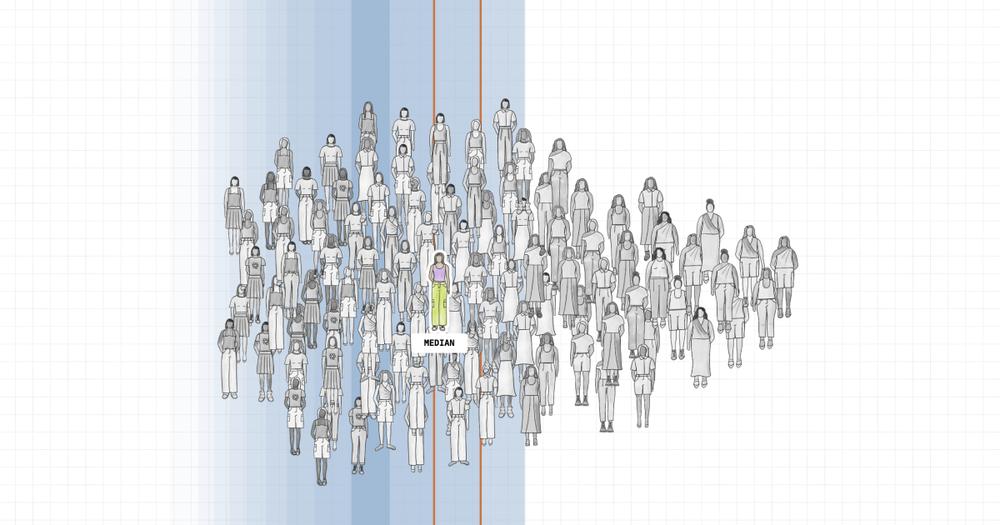
I remember once being that teen girl shopping in the women’s section for the first time. I took stacks upon stacks of jeans with me to the dressing room, searching in vain for that one pair that fit perfectly. Over 20 years later, my hunt for the ideal pair of jeans continues. But now as an adult, I’m stuck with the countless ways that women’s apparel is not made for the average person, like me.
Children’s clothing sizes are often tied to a kid’s age or stage of development. The idea is that as a young person grows older, her clothes will evolve with her. Youth styles tend to be boxy and oversized to allow room for kids to move and grow. By early adolescence, apparel for girls becomes more fitted. Junior’s styles have higher waistlines and less-pronounced curves compared to adult clothing lines. In short: clothes for tweens are made for tween bodies.
By the time most teenage girls can wear women’s clothes — around age 15 — their options are seemingly endless. But the evolution in clothing sizes that followed girls throughout childhood abruptly stops there.
This is reality I find myself reckoning with today: Women’s clothing — designed for adults — fits modern teen girls better.
To highlight the median body proportions of the adult women in the U.S., we relied on anthropometric reference data for children and adults that is regularly released by the National Center for Health Statistics within the U.S. Department of Health and Human Services.
For this story, we pulled data on the median waistline circumference of women and girls that was gathered between 2021-2023. For girls and women under 20 years old, measurements were recorded in two-year age ranges (ex: 10–11 years, 14–15 years), with a median of 141 participants per age range. For women over 20, measurements were recorded in nine-year age ranges (ex: 20–29 years, 30–39 years) and collectively for all women 20 and older. Each nine-year age range had a median of 465 participants. Overall, measurements were recorded for 3,121 women ages 20 and older. Those who were pregnant were excluded from the data.
HHS also provides a breakdown of measurements within set percentiles for each age range, which includes figures for the 5th, 10th, 15th, 25th, 50th, 75th, 85th, 90th, and 95th percentiles. We then used that percentile data to extrapolate the waistline measurements of all women and girls within each respective age group.
We also compared figures to those recorded by HHS from 1988-1994. There, 7,410 women ages 20 and older participated in the study. Measurements were originally recorded in centimeters, so we converted to inches.
Brands included in the size chart comparisons represent a diverse cross-section of popular apparel brands and retailers in the U.S., including a mix of mass market, fast fashion, premium and luxury labels.
For each brand, we focused on collecting body measurements for “regular” or “standard” size ranges, as well as “plus” sizes when available. Sizing information for “petite,” “tall,” or “curve” clothing lines were not included. Size charts reflect the body measurements for garments categorized as general “apparel.” In a select few cases where that category was unavailable, “dresses” were used as the default garment type.
Within each size range, we focused on collecting three main body measurements: Bust, waist, and hip. Some were presented as a range from minimum to maximum values, while others were single measurements. All numeric U.S. women’s sizing labels and descriptions were recorded, as well as their corresponding alpha sizes, when available.
Size chart data was last manually captured in July 2025 and may not reflect a brand’s current size chart. Brands frequently change their size charts, and more often than not, shoppers aren’t even aware when measurements or sizes are updated.
The standardized size charts refer to ASTM International’s regular release of its Standard Table of Measurements for Adult Female Misses Figure Type. The 1995 release (designated as D 5585-95) reflects sizes 2-20. ASTM updated its standards in 2021 (designated as D5585-21) to include sizes 00-20.
Ransom note letters are from Indieground.
 Investigation: How Russian drones exploit European technologies to strike Ukraine, and beyond