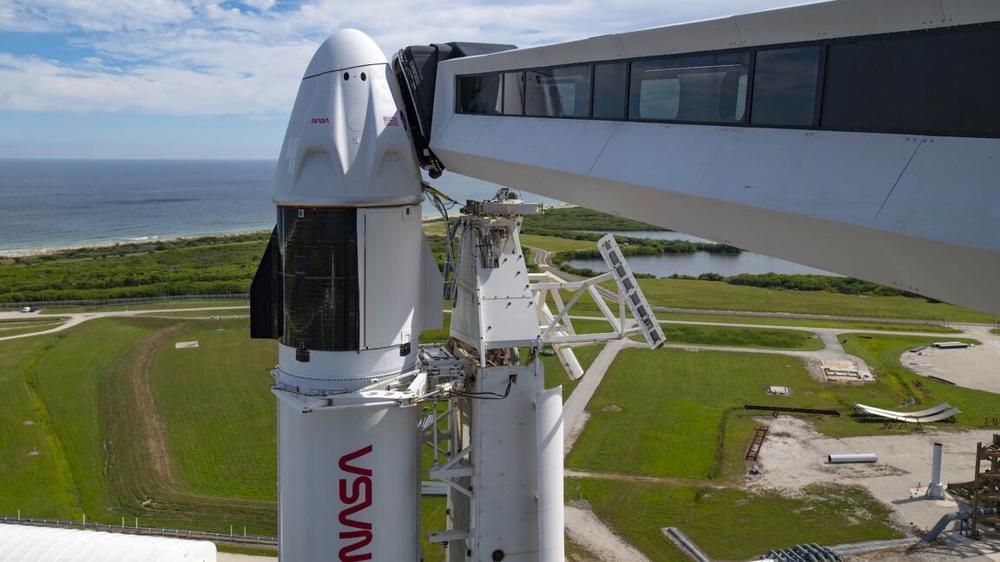
Launch Complex 39A at NASA’s Kennedy Space Center in Florida is accustomed to getting makeovers. It got another one Wednesday with the removal of the Crew Access Arm used by astronauts to board their rides to space.
Construction workers first carved the footprint for the launch pad from the Florida wetlands more than 60 years ago. NASA used the site to launch Saturn V rockets dispatching astronauts to the Moon, then converted the pad for the Space Shuttle program. The last shuttle flight lifted off from Pad 39A in 2011, and the agency leased the site to SpaceX for use as the departure point for the company’s Falcon 9 and Falcon Heavy rockets.
SpaceX started launching from Pad 39A in 2017, then installed a new Crew Access Arm on the pad’s tower the following year, replacing the aging shuttle-era arm that connected to the hatches of NASA’s orbiters. SpaceX added the new arm ahead of the first test flight of the company’s human-rated Crew Dragon spacecraft in 2019. Astronauts started using the pathway, suspended more than 200 feet above the pad surface, beginning with the first crew flight on a Dragon spacecraft in 2020.
Now, Pad 39A is undergoing another facelift in preparation for launches of SpaceX’s powerful Starship rocket. Construction of a new launch tower for Starship is well along about 1,000 feet east of the existing tower at Pad 39A, still inside the facility’s circular perimeter. SpaceX aims to launch the first Starship flight from Kennedy Space Center later this year, following a series of flights from the company’s Starbase test site in South Texas.
With the arrival of Starship, SpaceX is suspending Falcon 9 flights from Pad 39A in favor of launches from nearby Pad 40, located a few miles to the south at Cape Canaveral Space Force Station, on property leased from the US Space Force. Kiko Dontchev, SpaceX’s vice president of launch, wrote on X in December that the decision will allow teams to “put full focus on Falcon Heavy launches and ramping Starship from the Cape.”
Au revoir, not adieu
SpaceX’s Falcon Heavy, primarily used to launch payloads for the Space Force and NASA, will continue flying from Pad 39A, the only site currently outfitted to accommodate the triple-core rocket. The next Falcon Heavy launch is scheduled for no earlier than April, with no more than a handful of flights per year planned for the rest of the 2020s.
Ground teams installed a Crew Access Arm at Pad 40 ahead of the first crew launch there in 2024. All future Crew Dragon flights will now depart from Pad 40 for the foreseeable future, beginning with the launch of the Crew-12 mission to the International Space Station later this week.
“It’s great to have two launch pads off the Florida coast. For our manifest going forward, we’re planning to launch most of our Falcon 9 launches off of Space Launch Complex 40. That will include all Dragon missions going forward,” said Lee Echerd, a SpaceX senior mission manager for human spaceflight. “That will allow our Cape team to focus at 39A on Falcon Heavy launches and hopefully our first Starship launches later this year.”
Pad 40 has been the primary Falcon 9 launch site for most of the rocket’s history, while Pad 39A provided a location for crew launches and an augmentation to support SpaceX’s growing launch cadence. But there are signs the Falcon 9 launch cadence, which reached 165 missions last year, may be peaking as the company turns its attention to Starship. And SpaceX has steadily reduced the time it takes to reconfigure Pad 40 between launches, cutting the turnaround time to less than 48 hours.
If needed, SpaceX officials said they could reinstall the crew arm for Dragon missions launching from Pad 39A.
Repairs required
Bill Gerstenmaier, SpaceX’s vice president of build and flight reliability, said there’s another pressing reason for removing the crew arm at Pad 39A. The bearings that connect the arm to the launch pad’s tower need repairs.
“To physically get access to those, the arm needs to be removed,” Gerstenmaier said. “Those bearings have to come out and they have to be reinstalled. We’ll do that work at the Kennedy Space Center. And the intent there is, we don’t need to put the arm back up … When we get a call-up for a mission and we have to go fly a mission, if it requires that, we have plenty of time to get the arm back up.”
SpaceX has continued launching Falcon 9 and Falcon Heavy rockets from Pad 39A amid the nearby construction work to prepare for Starship flights. “That doesn’t impact our ability to launch from the pad,” Gerstenmaier said.
That could change as SpaceX begins testing and launching Starships from Kennedy Space Center. Starship launch operations may routinely force the closure of Pad 39A to personnel.
“The right thing to do is get those bearings replaced in the environment on the ground, make some upgrades to them, and then we’ll be ready to go and put the arm back up when it’s time to go fly, if we need to go fly,” Gerstenmaier said.
 AU Deals: Serious Games at Silly Prices Across Every Major Platform