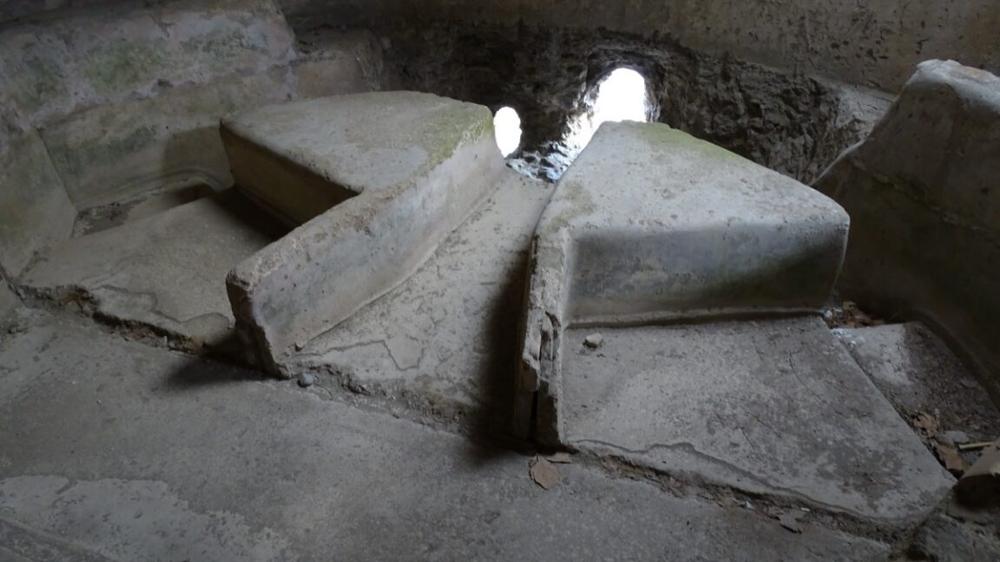
The eruption of Mount Vesuvius in 79 CE released thermal energy roughly equivalent to 100,000 times the atomic bombs dropped on Hiroshima and Nagasaki at the end of World War II, spewing molten rock, pumice, and hot ash over Pompeii. Pompeii’s public baths, aqueduct, and water towers were among the preserved structures frozen in time. A new paper published in the Proceedings of the National Academy of Sciences analyzed calcium carbonate deposits from those structures to learn more about the city’s water supply and how it changed over time.
Pompeii was founded in the sixth century BCE. Prior research revealed that, early on, the city relied on rainwater stored in cisterns and wells for its water supply. The public baths used weight-lifting machinery to lift water up well shafts that were as deep as 40 meters. As the city developed, so did the complexity of its water supply system, most notably with the construction of an aqueduct between 27 BCE and 14 CE.
The authors of this latest paper were interested in the calcium carbonate deposits left by water in well shafts as well as the baths and aqueduct. The different layers have “different chemical and isotope composition, calcite crystal size, and shape,” which in turn could reveal information about seasonal changes in temperature, as well as changes over time in the chemical composition of the water. Analyzing those properties would enable them to “reconstruct the history of such systems—particularly public baths—revealing aspects of their maintenance and the adaptations made during their period of use,” the authors wrote.
The authors focused on four distinct time periods: from the second century to 80 BCE; after 80 BCE, when Pompeii became a Roman colony; the reign of Emperor Augustus (31 BCE to 14 CE); and after the earthquake that rocked the city in 62 CE. It was easy enough to collect calcium carbonate samples during field work in 2016 and 2017. The team had to sample present-day groundwater and springs believed to have supplied the aqueduct; however, acknowledging that the properties may have changed significantly, particularly after the 79 CE eruption.
From well to aqueduct
The specific sites studied included the Stabian baths and related structures, which were built after 130 BCE and remained active until the aforementioned eruption; the Republican baths, built around the same period but abandoned around 30 BCE; the Forum baths, built after 80 BCE; and the aqueduct and its 14 water towers, constructed during the Augustan period.
There were variations in the chemical composition of the deposits, indicating the replacement of boilers for heating water and a renewal of water pipes in the infrastructure of Pompeii, particularly during the time period when modifications were being made to the Republican baths. The results for the Republican baths’ heated pools, for instance, showed clear contamination from human activity, specifically human waste (sweat, sebum, urine, or bathing oil), which suggests the water wasn’t changed regularly.
That is consistent with the limitations of supplying water at the time; the water-lifting machines could really only refresh the water about once a day. After the well shaft was enlarged, the carbonate deposits were much thinner, evidence of technological improvements that reduced sloshing as the water was raised. Once the aqueduct had been built, the bathing facilities were expanded with a likely corresponding improvement in hygiene.
On the whole, the aqueduct was a net good for Pompeii. “The changes in the water supply system of Pompeii revealed by carbonate deposits show an evolution from well-based to aqueduct-based supply with an increase in available water volume and in the scale of the bathing facilities, and likely an increase in hygiene,” the authors concluded. Granted, there was evidence of lead contamination in the water, particularly that supplied by the aqueduct, but carbonate deposits in the lead pipes seem to have reduced those levels over time.
The results may also help resolve a scientific debate about the origins of the aqueduct water: Was it water from the town of Avella that connected to the Aqua Augusta aqueduct or from the wells of Pompeii/springs of Vesuvius? Per the authors, the stable isotope composition of carbonate in the aqueduct is inconsistent with carbonate from volcanic rock sources, thus supporting the Avella source hypothesis.
PNAS, 2025. DOI: 10.1073/pnas.2517276122 (About DOIs).
 X Users Ask Grok To Put More Clothes On Elon Musk Pictures