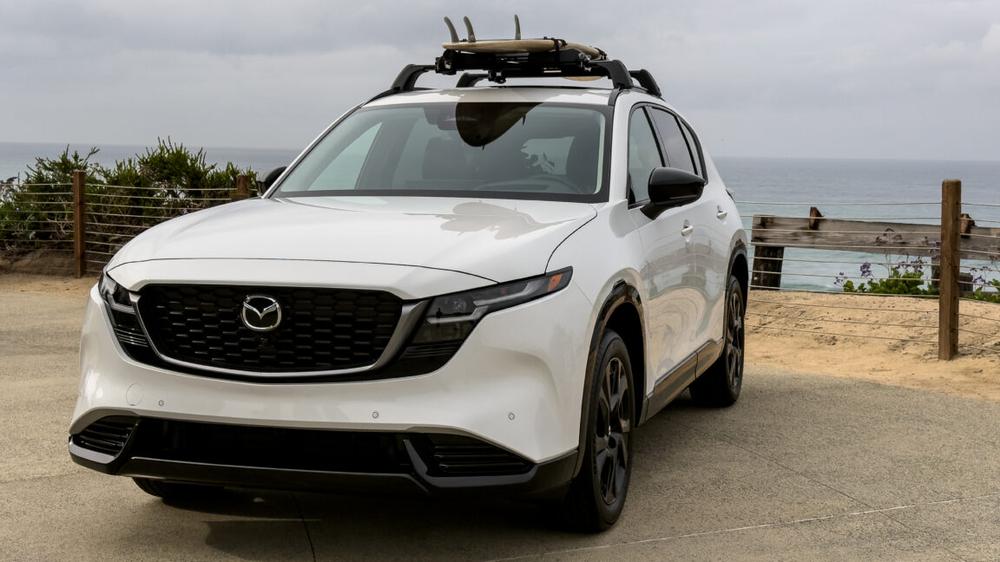
ENCINITAS, Calif.—Its sales may have been buoyed of late by the big CX-90 and CX-70 SUVs, but for Mazda, the CX-5 is still where most of the action is. Unlike the similar-sized, similar-priced CX-50, which was designed just for North America, the all-new CX-5 is a global car, and it’s also Mazda’s standard-bearer for a range of new technologies. Gone is the basic but effective infotainment system, replaced by an all-new Google-based experience as Mazda starts its journey toward software-defined vehicles. There’s even an in-house hybrid on the way, albeit not until next year. And it starts at a competitive $29,990.
The new CX-5 is bigger than the car it replaces, 4.5 inches (114.5 mm) longer and half an inch (13 mm) wider than before, at 184.6 inches (4,689 mm) long, 73.2 inches (1,859 mm) wide, and 66.7 inches (1,694 mm) tall. Much of that extra space is between the axles—the wheelbase is now 110 inches (2,794 mm) long, which translates to more interior space. From the outside, there’s a new light signature, and the way the bodywork curves around the front and wraps down the fenders gives me strong Range Rover vibes, even if I could never adequately capture what I’m talking about with a camera. As ever, Mazda’s arresting Soul Red Crystal metallic paint (a $595 option) sparkles, even on a day when the sun remained hidden from view.
The last time that Mazda evolved this compact crossover, it did so with a new upmarket interior. Since then, the brand has staked out that space across its model lineup, with cabins that punch well above their price tags. Happily, the company’s designers haven’t lost much mojo since then, with a restrained approach that looks good across the five different trim levels, each of which is a $2,000 step up from the one that precedes it. But if you’re a current CX-5 driver, you’ll find much has changed, perhaps not entirely for the better.
What’s new?
There’s an all-new multifunction steering wheel for starters. It replaces a wheel that I remain convinced is the best in the industry after McLaren, and I’m not such a fan of the new tiller at all. The rim is thicker now, and there’s some padding that gives it more of a soft touch; fans of BMW’s more recent steering wheels might appreciate it, I suppose. The multifunction controls are now touch-sensitive rather than discrete buttons, but there’s some haptic feedback when you use them.
A digital display replaces the old analog gauge cluster, with a restrained and not particularly customizable UI; there’s no way to show a map here, for instance. To your right is a touchscreen—12.9 inches for some trims, or 15.6 inches if you opt for the $38,990 Premium Plus. Either way, it runs a new Android Automotive OS-based infotainment system that does without the rotary controller on the center console. That rotary controller was a bit love-it-or-hate-it—once you got used to the shortcut buttons and built up muscle memory, it worked very well. But the new system has a more complicated UI that Mazda didn’t think would be well-navigated that way, and ditching it means a driver can’t accidentally interact with it if their wrist is resting on the console.
Mazda told us that the infotainment system will receive upgrades over the lifetime of the vehicle, and being AAOS-based, a growing number of apps are available, including most audio streaming platforms and an increasing number of console-like games that you control with your phone. The car also has Google’s automotive services built-in, although after the first year, owners will need to pay a subscription. However, you can also supply your own data connection instead and still maintain access to Google Maps and most other connected services.
We were able to test this thoroughly on our drive, and because Mazda’s US servers weren’t set up yet for the new CX-5, the company put an Internet hotspot in all the cars. Out in the more remote parts of San Diego’s North County, the reduced signal sometimes frustrated efforts, but otherwise it worked well, and it’s good to see at least one OEM has made provisions for people to just leverage tethering to their own smartphones rather than require yet another sub.
How does it drive?
As mentioned, next year we’ll see a hybrid CX-5, but for now, the crossover launches here in the US with Mazda’s venerable Skyactiv-G four-cylinder. It generates 187 hp (140 kW) and 186 lb-ft (252 Nm), which goes to all four wheels via a six-speed automatic transmission. Given the CX-5’s 3,856-lb (1,749-kg) curb weight, it’s not particularly fast, and the engine becomes loud and intrusive if you keep it in the upper reaches of its 6,500-rpm rev range. The ride is not the softest, but it won’t shake loose a filling, and there’s a fair amount of body roll in the corners and understeer as you approach the limit of the tires. Sadly, Mazda has yet to make another car that steers as well as the smaller CX-30, but the CX-5 is still pleasant to drive, even if it’s not going to reward an enthusiast.
It probably will make you drive slowly, though. Frequently on the twisty part of the drive, I noticed I was about 5 mph below the speed limit, so you won’t set any point-to-point records, but I can’t say I particularly minded.
Being a bit slow helps with the CX-5’s biggest weakness, too: Its fuel economy. This has never been a Mazda strength, so it’s fortunate for the automaker that the US has now essentially abandoned regulating such things. Officially, the EPA rates the CX-5 at 24 mpg (9.8 L/100km) city, 30 mpg (7.8 L/100km) highway, for a combined 26 mpg (9 L/100km). My particular test car had averaged 22.3 mpg (10.5 L/100km) over a few hundred miles before I got my hands on it, and I ended the day having eked this up to 23 mpg (10.2 L/100km) over the course of a hundred miles or so. That Skyactiv-Z hybrid can’t come soon enough, although there is always the option of the CX-50 hybrid (which borrows Toyota’s hybrid powertrain from the RAV4).
 “Rot in hell”: Team USA hockey slammed for laughing at Trump’s sexist locker room joke