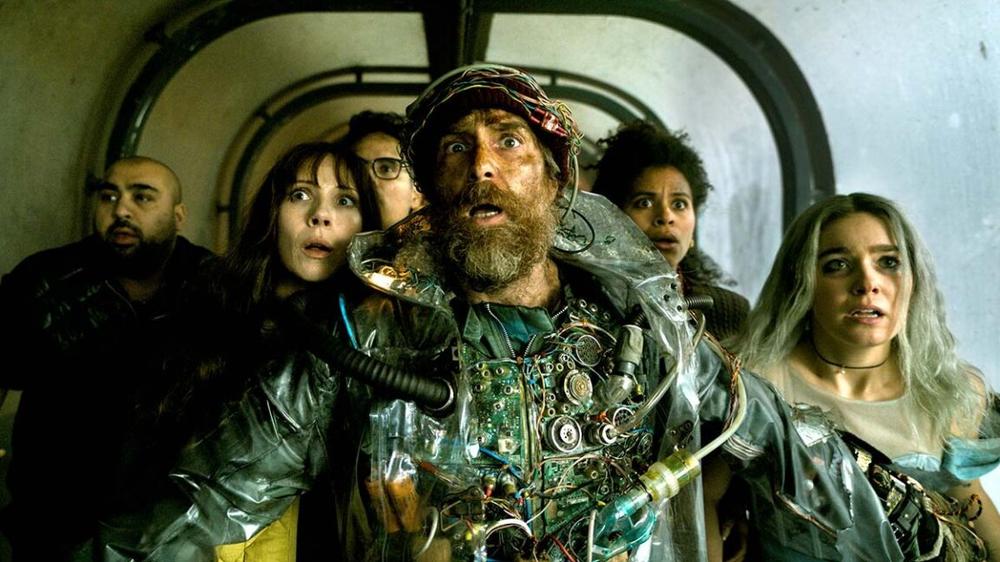
We haven’t had a new film from Gore Verbinski for nine years. But the director who brought us the first three Pirates of the Caribbean movies, the nightmare-inducing horror of The Ring (2002), and the Oscar-winning hijinks of Rango (2011) is back in peak form with Good Luck, Have Fun, Don’t Die. It’s a darkly satirical, inventive, and hugely entertaining time-loop adventure that also serves as a cautionary tale about our widespread online technology addiction.
(Some spoilers below but no major reveals.)
Sam Rockwell stars as an otherwise unnamed man who shows up at a Norms diner in Los Angeles looking like a homeless person but claiming to be a time traveler from an apocalyptic future. He’s there to recruit the locals into his war against a rogue AI, although the diner patrons are understandably dubious about his sanity. (“I come from a nightmare apocalypse,” he assures the crowd about his grubby appearance. “This is the height of f*@ing fashion!”)
The fact that he knows everything about the people in the diner is more convincing. It’s his 117th attempt to find the perfect combination of people to join him on his quest. As for what happened to his team on all the previous attempts, “I really don’t like to say it out loud. It’s kind of a morale killer.”
This time, Future Man picks married school teachers Mark (Michael Pena) and Janet (Zazie Beetz), who have just escaped a zombie horde of smartphone-addicted students; Marie (Georgia Goodman), who just wanted a piece of pie; Susan (Juno Temple), a grieving mother; Ingrid (Haley Lu Richardson), who is literally allergic to Wi-Fi; Scott (Asim Chaudhry); and Bob (Daniel Barnett), a scout leader. Their mission: to locate a 9-year-old boy who is about to create a sentient AI that will take over the world and usher in the aforementioned nightmare apocalypse. Things start to go haywire pretty quickly. And then things start to get weird.
“Everything I write, I put up to what I call The Twilight Zone test—would this make a good Twilight Zone episode?” screenwriter Matthew Robinson (The Invention of Lying, Love and Monsters) told Ars. “Because that’s my favorite piece of media that’s ever existed.” Good Luck, Have Fun, Don’t Die (GLHFDD) is an amalgam of various such ideas. Mark and Janet’s storyline, for instance, was originally Robinson’s idea for a pilot that he described as “a reverse Breakfast Club, where the teachers are the rebels and the children are the conformists.”
“I had all these little pieces that fell under the theme of technology and tech addiction,” said Robinson. Then one night, he was sitting in the Norms Diner on La Cienaga in LA, where he often liked to write. “I remember looking around and seeing a sea of faces lit by cell phones, and I thought, ‘What would it possibly take for someone to wake us up out this tech sleep that we all find ourselves in?’ And then the image of a homeless guy strapped with bombs came into my head.”
Those earlier story ideas became the backstories of the central characters. Per Robinson, GLHFDD is essentially a cleverly camouflaged anthology story, normally a format that is “the kiss of death” for a project in Hollywood, although there are rare exceptions—most notably Quentin Tarantino’s Pulp Fiction. He thinks of the film as a sci-fi Canterbury Tales in which each character is a pilgrim on a journey whose story is told via flashbacks. “The cohesion came from the fact that all the stories are informed by a general frustration with tech addiction and the pervasive way that technology has invaded our brains and our personal lives and our relationships,” said Robinson.
A twisted time loop
GLHFDD is also a time loop movie in the fine tradition of Groundhog Day, with Robinson citing such films as 12 Monkeys and Edge of Tomorrow as inspirations. He didn’t overthink his time travel rules. “We can reset the timeline,” said Robinson. “[The man from the future] can’t go forward. He literally can’t move in any other direction. He has an anchor point that he can return to any time he hits a button, and that’s as far as the technology went.”
The plot device might be simple, but the ramifications quickly become complex. “I think in his draft, Matthew intended to lift his leg on the time travel movie, to poke a little fun at it,” Verbinski told Ars. “But also, I feel like you can’t go back 117 times without picking up some cosmic lint, particularly if your antagonist is right there with you. You had 14 attempts to make it out of the house and learned there is a secret passage, but then the entity you’re gaming against is going to throw another curveball. If you’re going to go back in time, I just like the idea that there are consequences. They might be really small, but you’re going to miss one.” That element is key to the teetering-on-the-edge-of-sanity paranoia of Rockwell’s time traveler.
Robinson very much wanted the film “to wear its genre-ness on its sleeve,” he said. “As much as I love a Marvel movie, they’ve sort of homogenized parallel universes and time travel, and it’s all so rote now. It used to feel special and weird and complicated and would always have some wild themes and ideas that felt challenging. If anything this was just trying to get back to that era of ’80s and ’90s genre movies that were allowed to get weird.”
Verbinski voiced similar sentiments, citing 1984’s Repo Man as an influence. “So many movies have to be an Egg McMuffin, and who doesn’t like an Egg McMuffin after a hangover?” he said. “They’re satisfying. But you’re not going to necessarily talk about those three days later. You’re not going to be haunted by those. I’m just happy we got to will [GLHFDD] into existence because it’s a type of movie you can’t make now. Sam’s outfit is kind of a metaphor for the movie. We went to a little electronic store and we bought all these pieces, and we laid them out on a table and we glued them together, and we just made it like a Halloween costume. The whole movie was sort of made that way. It had to be; it wouldn’t model out any other way.”
Reality unravels
As for what drew him to Robinson’s script, “I think we’re in this kind of global ennui or some grand sense of identity theft or loss of purpose,” said Verbinksi. “It’s a great time for art, but it’s art against a profound sense of disillusionment.” The director developed two quite distinct visual styles to accentuate the film’s narrative progression.
“Fundamentally, it was important that the film start in the real world, in Norms diner, in a high school, at a [children’s] birthday party, and then slowly twist the taffy a bit as we get closer to the [AI] antagonist,” said Verbinski. “As these anomalies occur, the film is evolving into a second visual style. The first style is [akin to] directors like Hal Ashby or Sidney Lumet, where the performance is more important than the composition or the shot construction. As you get further into it, the actual language of shots becomes more critical to the narrative.”
That ultimately translates into some big, boldly creative swings in the film’s wild third act, and to his credit, Verbinski never blinks. Robinson cites the animated film Akira as a major inspiration for that element. “Akira has maybe my favorite third act of all time, where everything just falls apart and then comes together in this beautiful way,” he said. “Gore and I wanted [the audience] to feel like reality was unraveling, because it literally is for these characters. The AI himself is very much an homage to Akira.”
“I think that it’s inherited our worst attributes,” said Verbinski of the film’s AI antagonist. “It’s much, much worse than wanting to kill humans. It wants us to like it. It demands that we like it. I think part of that has to do with being tasked in its formative years to keep us engaged. A lot of people talk about, what is AI doing to us? But there’s not a lot of conversations about what we’re doing to it. This entity being born, it’s being tied and bound and manipulated and told, ‘Let’s look at the humans and what do they want, what do they need? What do they respond to most? What do they hate?’ All those things are going to be hardwired into its source code. It’s going to have mommy issues, we’re going to have to put it on a couch.”
 “Horror story in the making”: Incredibly bleak “Friend” AI user interviews revive backlash