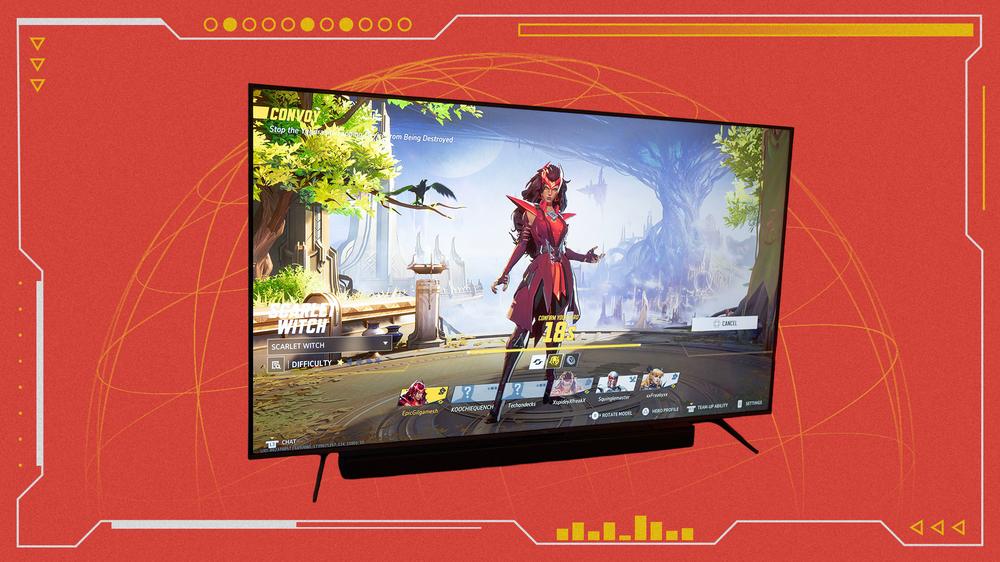
For TV/gaming enthusiasts on a budget, we live in a remarkable time: A 65" 4K television can be had for as little as $300. Before you get too excited, we’d argue that this Big Box Retailer Special class of TVs is compromised in so many ways that the gaming experience is simply not good enough. At best, you'll be getting a dim TV with poor viewing angles, limited color depth, no high refresh rates, and lackluster pixel response times.
These TVs don't look much different from a mid-range TV pulled straight out of 2016, and they likely won't last anywhere near as long. Can you play games on it? Sure, but based on our testing, we’ve found the true entry point for gaming TVs really starts around $650. That’s where we finally get access to tech that was just barely creeping into very expensive, high-end sets a decade ago. I'm confident enough to say that our winner for the best budget gaming TV, the TCL QM6K, has met and/or exceeded that previous top-end performance.
But first, a bit about our criteria.
All candidates in the budget gaming TV category had to meet three specific requirements:
- Full array local dimming
- Quantum dot or other enhanced backlight
- 120Hz + refresh rate with Variable Refresh Rate (VRR) support
There are a lot of “decent” televisions out there that meet some of these criteria ($300 buys you none), but in 2025, great HDR gaming requires all three. Edge-lit TVs can’t show the stark local contrast that makes HDR content pop, and they suffer from serious blooming, especially off-angle. Standard LED backlights also fall well short of covering the DCI-P3 color space, leaving pictures dull and lifeless. And with modern gaming consoles fully supporting 120Hz “performance” modes with VRR, a fixed 60Hz refresh rate means the gaming experience is tarnished with the tearing and judder associated with typical V-Sync behavior.
We know that $650 seems steep for a budget category, but we’re honestly impressed with TCL’s ability to deliver high-end features – ones that make HDR gaming quite literally a game-changing experience – into a package that only costs $650. TCL isn’t alone, though; Hisense is also incredibly competitive at the entry level, and its U65QF was right up there in contention for the win. Both are great sets (the U65QF is brighter and more colorful), but the QM6K gets the nod because its motion performance – critical for blur-free gaming – is stand-out better.
Speaking of motion performance, LG’s entry-tier B5 OLED, with its perfect response times, is still the superior option for gamers who demand the best, pure gaming experience, but at $1,000 for the 65” version, it represents a serious hike in price, stretching the bounds of our budget category.
 QUIZ: Do You Have an iPhone Charger? Ah No, I Need the Other One