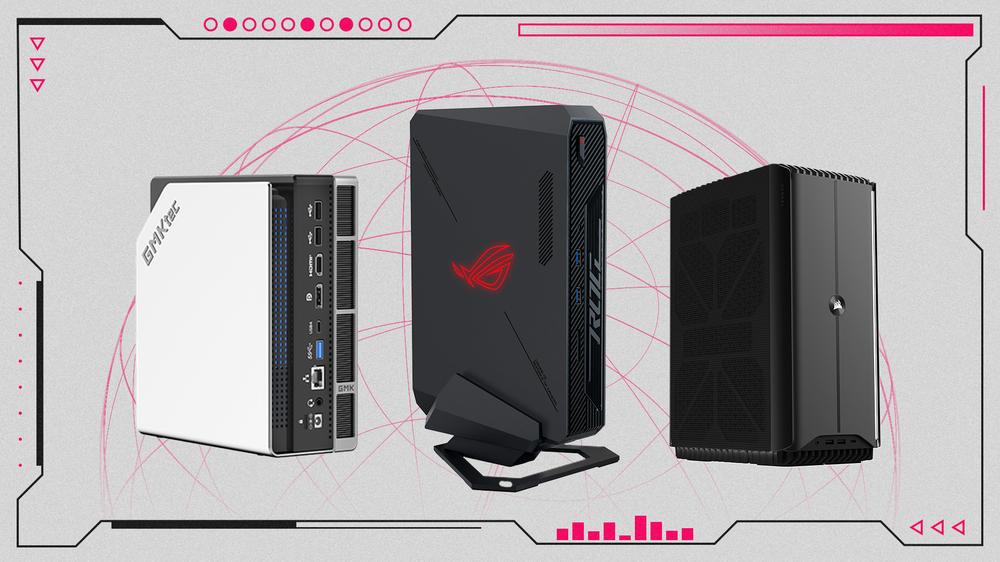
There's this idea that a gaming PC is inherently a giant tower of metal and plastic that takes up so much space that you need to have a dedicated desk to handle it. These days, you don't need a massive hog of a tower to get incredible gaming performance. Instead, the best mini PCs can take up as little space as a cable box.
TL;DR – These Are the Best Mini PCs for Gaming:
There are inevitably some downsides when going with a mini gaming PC instead of a full tower. For one, the smaller form factor means there's simply less space for high-end graphics cards and CPU coolers. As such, you probably won't find many mini gaming PCs out there with an RTX 5090 and an Intel Core Ultra 9 285K, at least not at a price that doesn't rival a down payment on your house. Instead, you're more likely to find something like the GMKTec Evo-X2, which uses a powerful APU, rather than discrete graphics.
Different PC manufacturers deal with the space constraints in different ways. For instance, Asus bought out the NUC (next unit of computing) brand from Intel to make desktop PCs that use mobile hardware to fit into extremely small cases. Other companies, like Zotac, found a way to shove powerful desktop-class hardware into a tiny chassis. They'll be inherently harder to service or upgrade than other towers, and also much more expensive, but hey, at least they're tiny.
Best Mini PC for Gaming
Best Budget Mini PC for Gaming
Best Mini PC Not Just for Gaming
Mini PC With the Best Graphics
The MacOS Option
Valve just announced the new Steam Machine last week, a tiny gaming PC with the equivalent of a Radeon RX 7600M running SteamOS. In a lot of ways, I expect the Steam Machine to do for mini gaming PCs what the Steam Deck did for handheld gaming PCs. Because just like handhelds, mini PCs have been around for a while, but they've lacked a budget-friendly entry point, at least if you want to get some serious gaming done.
While we still don't know how much the Steam Machine is going to cost, it's probably going to be much more affordable than something like the ROG NUC, despite having very similar specs. It's still early, and I need to get it in the lab to benchmark it, but if you've been thinking about getting a super living-room-friendly mini PC for gaming, it's probably best to wait a couple months for the Steam Machine – at least just to see how expensive it will be.
Even beyond the Steam Machine itself, I expect other manufacturers to start taking mini PCs more seriously. Over the next few years, I wouldn't be surprised to see more mainstream options from manufacturers like Lenovo, Asus, or MSI.
Just like with any gaming PC, finding the best mini PC for gaming is all about what games you're looking to play, and at what resolution. Mini PCs are much smaller compared to desktop PCs, and even some laptops, and size constraints naturally limit the components included.
GPU
If you want to play the latest titles without any hiccups, you'll want to aim for a mini PC with a solid GPU. Look for models that come equipped with modern graphics like the Nvidia RTX series or AMD Radeon cards rather than integrated graphics. However, if you’re on a budget and you’re not fussed about playing games that have just been released, you could get away with something less powerful.
CPU
A good CPU is crucial for gaming performance and overall system responsiveness. Aim for mini PCs with mid-to-high-end CPUs, ideally with around 4 cores, 8 threads, and a high clockspeed – around 4.0GHz or higher – just so your computer doesn't grind to a hault when you're trying to multitask. Similarly, you’ll need a decent amount of RAM (at least 16GB) and storage (at least 512GB SSD) to run and store your games smoothly.
Ports
Once you’ve nailed down the specs, make sure the mini PC has enough ports for your peripherals, as well as HDMI or DisplayPort outputs for connecting to external monitors or TVs. Thunderbolt ports are also a nice bonus if you plan on connecting high-speed external storage or other devices.
Are mini PCs good for gaming?
It kind of depends on what you mean by "good for gaming." It's unlikely that you're going to find any mini gaming PC that's going to be great at 4K gaming, but lower your expectations a bit and these tiny machines can surprise you. If you mostly play games at 1080p, especially if you play a lot of indie games, even mini gaming PCs with integrated graphics are good enough these days to give you a solid gaming experience. We're entering an age of PC gaming where basically any PC can play PC games to some extent and mini gaming PCs are certainly no different.
What is better: mini PC or PC?
Again, this depends entirely on what you're looking for. Because, yeah, a full-sized gaming PC with a Ryzen 9 processor and an RTX 5090 is going to wipe the floor with every mini gaming PC on the market when it comes to pure performance numbers. But no matter what you've heard on Reddit, performance isn't everything. Take it from someone that lives in a tiny NYC apartment: Sometimes having a small gaming PC is extremely important and can make up for the lack of performance, especially if you're pairing it with a lower-resolution gaming monitor.
What are the downsides to a mini PC?
When you're getting a mini gaming PC, you're going to have to make compromises in at least one of three categories: price, performance, and upgradability. There are some tiny gaming PCs that pack high-end desktop components, but you're going to have to fork over a huge wad of cash for them. On the other hand, there are some really affordable mini gaming PCs out there, but those are mostly using integrated graphics and are really only good for playing PC games at 1080p with medium-high settings. If you want a PC with swappable components, you really only have a few options in a small form factor, though these tend to be more powerful (and expensive) than other mini gaming PCs.
 Toyota keeps betting on hybrid vehicles in the US