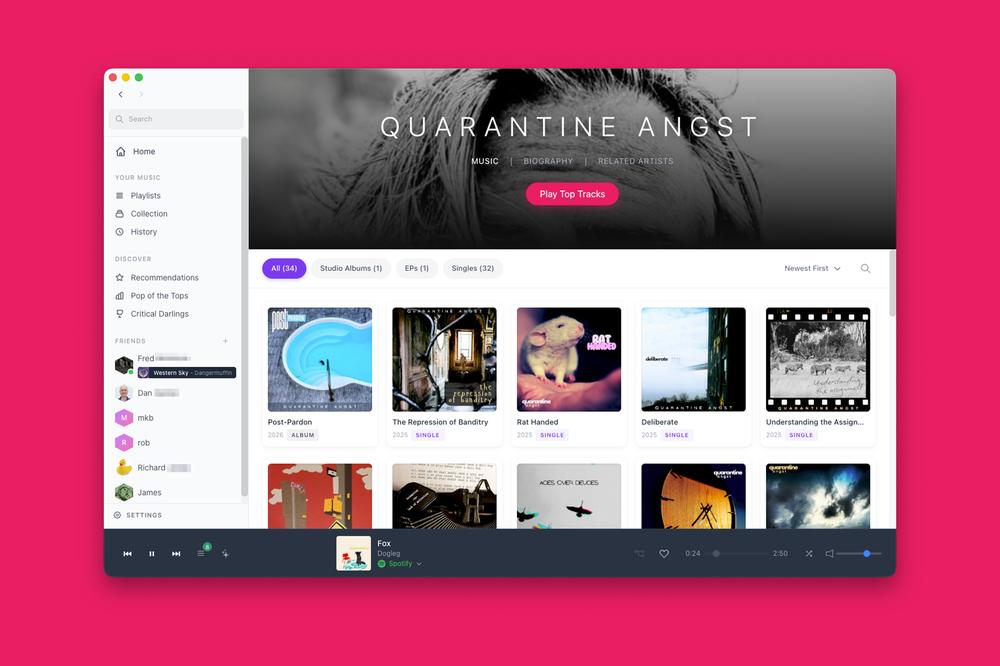
This is Lowpass by Janko Roettgers, a newsletter on the ever-evolving intersection of tech and entertainment, syndicated just for The Verge subscribers once a week.
Wouldn’t it be great if you could exchange music recommendations with your friends, no matter whether they use Spotify, Apple Music, or Bandcamp? What if you could follow DJs and other tastemakers online and automatically turn their social media feeds into playlists? Or what if you could fine-tune your music recommendations with AI to only get recommendations for songs you’ve never played before?
Those are a few of the tasks the new music app Parachord is trying to take on by freeing music metadata from individual subscription service silos. In essence, Parachord wants to one day make songs universally playable and shareable, no matter what services you subscribe to. For now, Parachord is still very much in its infancy, with a series of unstable, experimental builds slowly laying the path to a beta release.
Parachord is still very much in its infancy, with a series of unstable, experimental builds slowly laying the path to a beta release.
But the idea behind it is something Parachord mastermind J Herskowitz has been noodling over for a long time. Not only is Herskowitz a music tech veteran who’s worked at Spotify, LimeWire, and AOL Music, he also built this very app before.
Back in 2011, Herskowitz banded together with a small group of likeminded misfits to build a music app called Tomahawk that used a plug-in architecture to tap into the music libraries of services like Rdio, Grooveshark, and Beats Music. The app also offered access to a social layer for music fans and allowed bands to share their latest tracks with universal links.
It was a fascinating idea, but without a clear business model, it was ultimately not sustainable. Tomahawk development effectively ended in 2015. “We all needed to get jobs,” Herskowitz remembers. “I was very sad when Tomahawk went away.”
Except, it never fully went away. As an open-source project, Tomahawk’s code continues to be available on GitHub. Around a month ago, Herskowitz decided to take another look at it, with some help from AI. “I fired up Claude Code, pointed it at the Tomahawk repo on GitHub, and said: Look at this, understand what it does, and let’s see if we can rebuild it.”
Herskowitz freely admits he’s not a developer in the traditional sense. “My whole career was in product management,” he says. “I never [wrote] real code.” But with Claude Code, he managed to rewrite Tomahawk and turn it into a working version of the new Parachord app within a couple of weeks, without hiring a developer.
The music industry has changed quite a bit over the past 15 years, as has the way many people listen to music. A bunch of once-promising streaming services have since disappeared. Consumers have largely flocked to three or four major services, with Spotify leading the pack. “When it comes to subscriptions, Spotify won,” Herskowitz says, acknowledging that people who only care about listening to their Discover Weekly likely won’t get a whole lot out of his app.
Parachord is built with a different audience in mind. People who buy songs on Bandcamp, track their listening history with Last.fm, and religiously follow bands on Bluesky. Back in his Tomahawk days, Herskowitz used to think there was a huge audience like this out there. Now, he realizes that it’s much more niche and at times even wonders if anyone other than himself really cares about the ideas behind Parachord. Not that that has stopped him. “That’s the beauty of where we are today,” he says. “Technologically speaking, I can build an app for [just] me.”
“I fired up Claude Code, pointed it at the Tomahawk repo on GitHub, and said: Look at this, understand what it does, and let’s see if we can rebuild it.”
Vibe-coding is often being talked about in the context of productivity apps, but there are some fascinating implications for the media space as well. Fifteen to 20 years ago, a bunch of developers tried to figure out new ways to consume music and video online, often with surprising results: Songbird turned MP3 blogs into playlists. Boxee pioneered universal movie and TV show libraries across streaming services. Miro experimented with alternative, P2P-powered distribution models for video podcasts. The list goes on.
In the end, many of these efforts were more passion projects than businesses. Back then, that was often a death sentence for niche apps. These days, vibe coding can give these niche projects a new lease on life.
Of course, other things have changed, too: Most major media services are a lot more restrictive when it comes to data sharing and API access, forcing Herskowitz to rely on complicated work-arounds. Users who want Parachord to play nice with Spotify have to register it as a personal app in their Spotify developer profile, and then generate an individual API key. That personal key model also extends to the integration of AI services like Claude, Gemini, and ChatGPT.
The flip side: By relying on personal keys, Parachord requires far fewer resources. “I don’t need to limit features to paid tiers to cover third-party API or hosting bills - because there aren’t any,” Herskowitz wrote on LinkedIn last week, adding: “I’m building Parachord as a personal app because music listening is personal. Your taste, your library, your preferred sources, your friends, your desired social experiences around listening to music, your history—these aren’t things that should live inside someone else’s walled garden.”
And while Herskowitz is building Parachord as a personal passion project, he also hasn’t given up on the idea that there are business models waiting to be unlocked if you can break free of the silos of the big music streaming services.
“Nobody’s going to start a streaming business from the ground up to compete with Spotify,” he says. “[But there is] an opportunity for a little cottage industry to build experiences on top of the content that people are already paying for.”
 Super Mario Galaxy trailer leaves fans convinced of Star Fox crossover