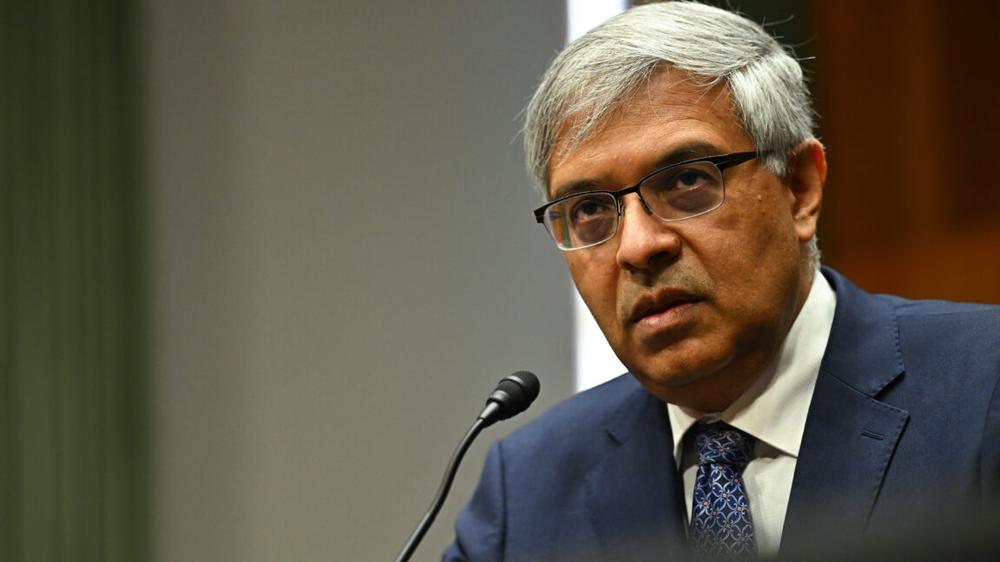
Jay Bhattacharya, director of the National Institutes of Health under the Trump administration, appeared before the Senate Committee on Health, Education, Labor, and Pensions (HELP) Tuesday. In the wide-ranging hearing, Bhattacharya defended the chaotic and disruptive cuts at the institutes he helms while carefully wording responses related to vaccines—seemingly to avoid contradicting his boss, anti-vaccine Health Secretary Robert F. Kennedy Jr.
As Bhattacharya testified, Sen. Bernie Sanders (I-Vt.), the HELP committee’s ranking member, released a report outlining the state of the NIH. The report concluded that the Trump administration is “failing American patients,” and “destroying medical research through cuts to research grants, terminations of clinical trials, and the chaos it has created.”
Since Trump took office, the NIH has terminated or frozen hundreds of millions of dollars for research grants, including $561 million in grants to research the four leading causes of death in America, the report found.
Destruction
Specifically, Bhattacharya oversaw the disruption of: 116 grants for cancer research, totaling $273 million; 71 grants to study heart disease, totaling $111 million; 65 grants for Alzheimer’s disease, totaling $94 million; and 68 grants for diabetes, totaling $83 million. The report also identified at least 304 clinical trials that were defunded, including 69 that were for children.
In the hearing Tuesday, Senators repeatedly brought up the grant and trial cuts, emphasizing that they are disrupting, if not ending, research that could lead to biomedical advances. Senators relayed reports of scientists scaling back their lab work and some being unable to pay their graduate students. Early career scientists are looking to move abroad—while China and Europe are actively recruiting top scientific talent. Meanwhile, patients, some with dire medical conditions, have been abruptly dropped from potentially life-saving clinical trials.
Bhattacharya was dismissive of all these concerns. “We didn’t cut any funding,” he claimed. “The United States remains the single best place in the world to do biomedical research.”
But at other points in the hearing, he acknowledged some cuts, arguing that although grants and trials were terminated, some had been restored. “The estimates I’m hearing from my folks is that ultimately it was only a dozen or so trials that were actually terminated. Almost every single other one of them we’ve refocused, removed to depoliticize them and focus them on the actual science.”
“Outrageous” impacts
He did not explain how studies were “depoliticized,” but the Senate report noted that the NIH issued a “Staff Guidance” that all funded research be scanned for words that may not align with the Trump administration’s ideology. The lengthy list (provided with the Senate report) includes words such as “diversity,” “climate change,” “gender,” and “ethnic.”
Sen. Angela Alsobrooks (D-Md.) pointed out that some of the funding was only restored as a result of a lawsuit. “So, let’s be honest about that,” Alsobrooks said. “Some of these… the courts had to force.”
Sen. Maggie Hassan (D-N.H.) pushed Bhattacharya on the impact the cuts had on patients, asking specifically if there were any plans to study effects on cancer patients. Bhattacharya responded saying that there shouldn’t have been any effects because he had ordered continuity of care for any disrupted trials. “If there were disruptions, then it is the responsibility of the researchers that were managing the patients, not the NIH,” he said.
“That is really an unacceptable and outrageous response,” Hassan responded. “You all disrupted funding. You can make an edict from Washington, DC: ‘Oh, don’t disrupt continuity of care.’ But that can be a very complicated thing and I know that in my state, there were disruptions in these studies that have really put patients at risk.”
Senators also pressed the director on the future of the NIH, noting that it has been hamstrung by the ongoing chaos, putting upcoming grant funding at risk, too. Of the NIH’s 27 institutes and centers, Bhattacharya testified, “I think it’s 15″ that are without a director. Senator Patty Murray (D-Wash.), meanwhile, noted that more than half of the institutes are on track to lose all their voting advisory committee members by the end of the year—and grants cannot be approved without sign-off from these committees. Bhattacharya responded that they’re working on it.
Weasely answers on vaccines
In the course of the hearing, Senators also tried to assess Bhattacharya’s loyalty to Kennedy’s dangerous anti-vaccine ideology—which includes the false and thoroughly debunked claim that vaccines cause autism.
Sanders asked Bhattacharya directly: “Do vaccines cause autism? Yes/no?”
“I do not believe that the measles vaccine causes autism,” Bhattacharya responded.
“No, uh-uh,” Sanders quickly interjected. “I didn’t ask [about] measles. Do vaccines cause autism.”
“I have not seen a study that suggests any single vaccine causes autism,” Bhattacharya responded.
But this, too, is an evasive answer. Note that he said “any single vaccine,” leaving open the possibility that he believes vaccines collectively or in some combination could cause autism. The measles vaccine, for instance, is given in combination with immunizations against mumps, rubella, and sometimes varicella (chickenpox).
It would also be false to suggest vaccines in combination are linked to autism; numerous studies have found no link between autism and vaccination generally. Still, this is a false idea that Kennedy and the like-minded anti-vaccine advocates he has installed into critical federal vaccine advisory roles are now pursuing.
Later in the hearing, Bhattacharya also indicated that when he said “I have not seen a study,” he was suggesting that it was because such studies have not been done—which is also false; routine childhood vaccines have been extensively studied for safety and efficacy.
“I’ve seen so many studies on measles vaccines and autism that established that there is no link,” [to autism], he said in an exchange with Sen. Hassan on the subject. “The other vaccines are less well studied.”
 An old “Simpsons” episode about “crazy creeps on an island” is fueling conspiracy chatter