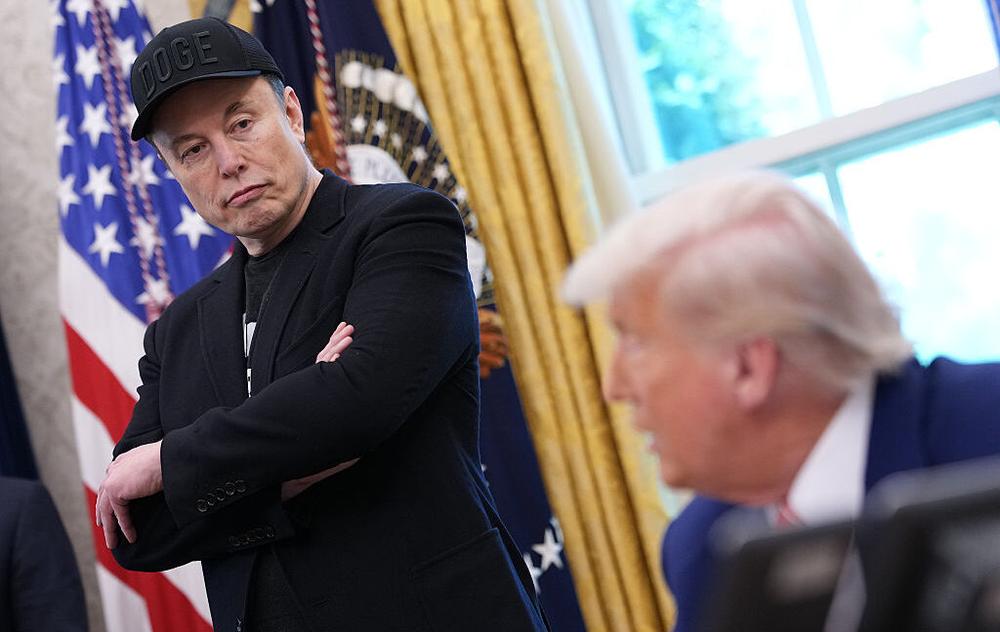
Donald Trump is so far not stepping in to help Elon Musk end a lawsuit raised by the Securities and Exchange Commission (SEC) over his 2022 Twitter takeover, a US district judge said this week.
Filed by the SEC in the final days of Joe Biden’s administration, the lawsuit seeks $150 million in disgorgement, plus interest, as well as civil penalties and an injunction blocking Musk from future wrongdoing.
The complaint alleged that Musk quietly acquired a 9 percent stake in Twitter without filing necessary timely disclosures to alert other investors of a potential change in company control. This allowed Musk to acquire over 70 million shares at an artificially lower price, the SEC alleged, causing substantial economic harm to investors selling Twitter common stock, some of whom have separately sued.
Last year, Musk claimed the Biden administration gave him 48 hours to settle the SEC lawsuit, which he refused, or face fraud charges while demanding to know “who directed these actions.” In his defense, he tried to argue that the SEC was singling him out as a political foe and selectively enforcing the statute requiring disclosures. He also claimed that his free speech rights were infringed by the SEC requirement “forcing him to speak” about his “thoughts” and “intentions” “against his will.” As he saw it, he was the only person ever targeted in a case where the SEC sought disgorgement, without alleging intentional, deliberate, or willful misconduct. And further, the amount of disgorgements seemed disproportional, he argued. When the SEC has previously sought disgorgements, the amount was typically under $200,000—not the eye-popping $150 million.
After the lawsuit was filed, it was expected that the incoming Trump administration might intervene to stop the litigation, especially since Musk was a special government employee. However, The Wall Street Journal noted that the disclosure requirement that Musk is fighting is “routinely enforced.” That could make it harder for Trump’s SEC to immediately dismiss it, WSJ reported.
It’s unclear if that’s why Trump hasn’t intervened. In an opinion Tuesday denying Musk’s motion to dismiss the lawsuit, Judge Sparkle Sooknanan said Musk failed to show he’d been “singled out.” She also picked apart Musk’s long-running theory that the lawsuit was part of a politically motivated SEC harassment campaign, and in doing so, she suggested there was no sign that Trump planned to help Musk escape the litigation.
One of Musk’s arguments was that in proceeding with the lawsuit, the SEC allegedly violated a Trump executive order launching probes into Biden-era enforcement actions taken by agencies, including the SEC. Trump claimed that many such probes “targeted individuals who voiced opposition to the prior administration’s policies,” and Musk seemingly believed that he was among those targets.
However, Sooknanan wrote that Musk failed to connect Trump’s order to his arguments in his case. “If anything, the fact that this case is ongoing despite President Trump’s order means that the President has elected not to intercede on Mr. Musk’s behalf,” she wrote.
Further, Musk’s claim that he was harmed by an SEC politicized by Biden seemed “especially implausible given that two of the three current Commissioners were appointed by President Trump,” she wrote.
Unclear if Musk can win without Trump
The billionaire—who eventually rebranded Twitter as X, then folded that company into xAI and just days ago merged xAI into SpaceX—clearly wants distance from that bumpy transition period after his takeover that nearly bankrupted the social network.
But he’s stuck discussing those days for the foreseeable future because the SEC says that shareholders were entitled to full disclosure of his intent to take over Twitter within 10 days of acquiring shares beyond 5 percent.
Now, Musk may be running out of arguments after Sooknanan shot down his First Amendment claims and other claims nitpicking the statute as unconstitutionally vague.
Whether Musk can defeat the SEC lawsuit without Trump’s intervention remains to be seen as the lawsuit advances. In her opinion, the judge found that the government’s interest in requiring disclosures to ensure fair markets outweighed Musk’s fears that disclosures compelled speech revealing his “thoughts” and “strategy.” Accepting Musk’s arguments would be an “odd” choice to break “new ground,” she suggested, as it could foreseeably impact a wide range of laws.
“Many laws require regulated parties to state or explain their purposes, plans, or intentions,” Sooknanan wrote, noting courts have long upheld those laws. Additionally, it seemed to be “common sense” for the SEC to compel disclosures “alerting the investing public to potential changes in control,” she said.
“The Court does not doubt that Mr. Musk would prefer to avoid having to disclose information that might raise stock prices while he makes a play for corporate control,” Sooknanan wrote. But there was no violation of the First Amendment, she said, as Congress struck the appropriate balance when it wrote the statute requiring disclosures.
Musk may be able to develop his arguments on selective enforcement as a possible path to victory. But Sooknanan noted that “despite having very able counsel,” his case right now seems weak.
In her opinion, Sooknanan also denied as premature Musk’s motions to strike from potential remedies the SEC requests for disgorgement and injunctive relief.
Likely troubling Musk, instead of balking at the potential fines, the judge suggested that “the SEC’s request to disgorge $150 million” appeared reasonable. That amount, while larger than past cases flagged by Musk, “corresponds to the Complaint’s allegation” that Musk’s violation of SEC requirements “allowed him to net that amount,” Sooknanan wrote.
“A straightforward application of the law reveals that none” of Musk’s arguments “warrant dismissal of this lawsuit,” Sooknanan said.
 This Town, 2.0