We’re in something of a purple patch if you’re a fan of clever new technology in single-seat race cars. Out in the Middle East, the autonomous A2RL crew held another race at Yas Marina, one that by all accounts was a lot more impressive than the last time the self-driving race cars competed against a human. Formula E teams are getting ready for the debut next year of their Gen4 era, which sees cars with real downforce and almost twice as much power. Meanwhile we only have a few months left before we see the results of F1’s new technical rules change, as the sport adopts far more powerful electrical propulsion and active aerodynamics. But what if there was an electric single-seater that was faster around a track than any of these?
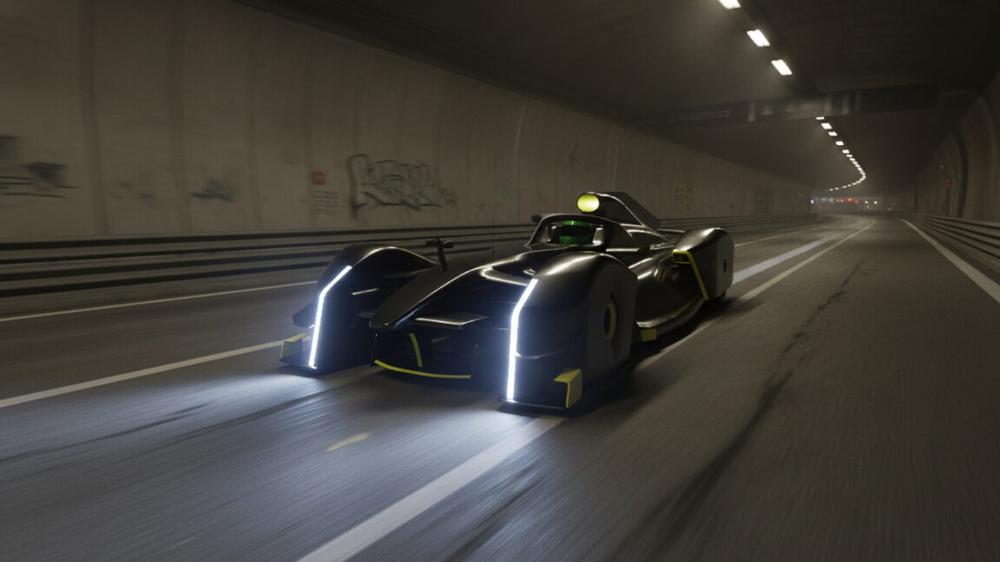
That’s the idea behind the DRG-Lola, a racing concept designed from the ground up by Lola Cars, the storied-now-reborn British race car manufacturer, and Lucas di Grassi, veteran of the hybrid LMP1 sportscar days and FIA Formula E champion. Di Grassi is one of the more thoughtful racing drivers out there and is a passionate advocate of clean technologies in racing—in 2020 he shared his earlier thoughts on where Formula E could take its technical direction.
The DRG-Lola is much closer to reality than that 2020 concept; di Grassi has relied on existing battery and motor technology, rather than some uninvented unobtanium to make it all work. It generates 804 hp (600 kW) from a pair of electric motors driving the front and rear axles and is powered by a 60 kWh battery pack that’s arranged in modules on either side of the driver’s cockpit.
Unlike an F1 or Formula E car, the wheels are covered, similar to the Adrian Newey-designed Red Bull X2010 and X2019 cars in the Gran Turismo series—doing so seriously reduces the car’s drag coefficient and therefore allows for significantly longer race distances, as the car needs to use less energy to push itself through the air.
Di Grassi has taken an interesting approach to generating downforce, the aerodynamic effect that pushes a car down onto the road surface to aid grip. At high speeds, most of this is generated by the car’s underbody and rear diffuser—roughly 530 kg of downforce at 180 km/h, according to Lola’s simulations.
What do you mean it sucks?
The real magic happens at lower speeds, courtesy of a pair of turbines that suck air in from under the car’s floor and route it out the back. Similar fan-based approaches to generating downforce have been used before to very good effect, notably the Chaparral J1, Brabham BT46, and most recently the McMurtry Spéirling, an EV with scarcely believable performance.
That descriptor would probably apply to the DRG-Lola too. With the fans active at lower speeds, the car generates as much downforce as it does in triple digits, and di Grassi’s simulations suggest that could equate to 3-Gs of lateral grip in slow corners; by contrast, an F1 car relying on just mechanical grip is less than half that. “You’re able to use all the stresses that have been tested for the car [to make sure it holds together during high-speed cornering] in any corner,” di Grassi said.
One advantage of the suction fans is how efficient they are, requiring five times less energy per unit of downforce generated than a conventional rear wing (which creates drag and therefore requires energy to counter). The covered wheels should also help minimize spray during wet races.
“You gain so much time in the low-speed corners that you’re able to have this amazing difference in performance,” he said. How much difference? About 4.3 seconds a lap at Monaco, and with a tenth of the energy per lap as a current F1 car, di Grassi and Lola reckon. Qualifying performance could be even greater, as cars could run with a minimum battery pack for the occasion, making a dent in what should be a 1,100 kg curb weight.
Just don’t expect to see a DRG-Lola race series just yet. For one thing, Formula E has the exclusive rights to the FIA’s single-seat electric championship, and with the Gen4 car due to arrive at the end of 2026, that series won’t be looking for a new car for another few years. But the idea is to inspire race car designers and series organizers, di Grassi said. “This is not a technical challenge anymore; we can do this,” he said.
“This project should serve as an inspiration for the future generations of electric racing cars. The question of whether such cars can be faster than Formula 1 has been answered with data and simulation. My plan is to build this car in the next two years,” he said.
For Lola, the project serves as notice that the marque, which was once well-represented across the motorsports world selling customer cars to numerous series, wants to reclaim those days. “At Lola, we are always looking for new ways to drive innovation through motorsport, and supporting Lucas with this design through utilizing our in-house expertise and state-of-the-art R&D facilities was a perfect project for this. The result is a car which pushes the boundaries of what is possible in electric racing through maximizing technological solutions which are already available,” said Lola Cars technical director Peter McCool.
 Twitch clarifies gambling sponsor rules for StarLadder Budapest CS2 major