It may be happening quietly, but there is a revolution taking place with in-space transportation, and it opens up a world of possibilities.
Back in January, a small spacecraft built by a California-based company called Impulse Space launched along with a stack of other satellites on a Falcon 9 rocket. Upon reaching orbit, the rocket’s upper stage sent the satellites zipping off on their various missions.
And so it went with the Mira spacecraft built by Impulse, which is known as an orbital transfer vehicle. Mira dropped off several small CubeSats and then performed a number of high-thrust maneuvers to demonstrate its capabilities. This was the second flight by a Mira spacecraft, so Impulse Space was eager to continue testing the vehicle in flight.
Giving up control
This was all well and good up until this summer, when a funny thing happened. Impulse handed control of Mira over to another company, which had installed its own software package on the vehicle. And this second company, Starfish Space, took control.
This was more than a little weird, acknowledged Eric Romo, the president and chief operating officer of Impulse Space, in an interview.
“I would walk past mission control, and our teams would be on a call together, and I would just pop my head in and say, ‘Hey, don’t crash spaceship, please,'” Romo said. “It was definitely a new thing.”
But Starfish Space did not crash Mira. Rather, it activated its camera on board the spacecraft and started flying the vehicle. To what end? Founded in 2019, the Washington-based company seeks to build affordable spacecraft that can service satellites in space, providing propulsion or other aids to extend their lifetimes.
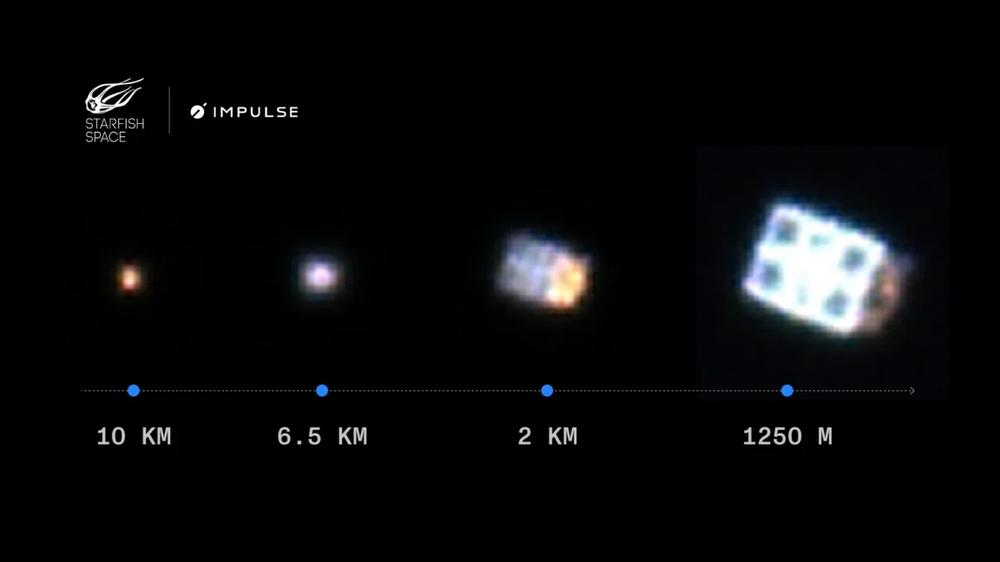
Now, flying Mira, the company sought to demonstrate that a single lightweight camera system, along with its closed-loop guidance, navigation, and control software, could autonomously rendezvous with another spacecraft. In this case, it was the very first Mira spacecraft launched by Impulse, in November 2023. This vehicle no longer has propellant on board to control its orientation, but its solar panels periodically receive enough charge to allow it to communicate with Impulse’s engineers in California.
Pushing the envelope
When the newer Mira got to within about 20 km of the older spacecraft, the Starfish team handed control over to the onboard computer. If they were going to test the vehicle’s software in flight for rendezvous and proximity operations, or RPO, they were really going to test it.
“We had to push the envelope a little bit here,” said Trevor Bennett, a co-founder of Starfish, in an interview. “And so there was always going to be that level of discomfort because we knew that this was an unpracticed and undemonstrated thing before, and then we wanted to go make it demonstrated, and go build that trust.”
The Starfish software guided Mira closer and closer to the older spacecraft, bringing it within 1,250 meters and validating the company’s autonomous software. It was quite a coup, demonstrating the agility of Mira and the ingenuity of the Starfish software. And it happened fast, with the whole plan coming together in less than a year.
Success gives Starfish confidence that its full-sized “Otter” spacecraft, about the size of an oven, will work upon its debut flight next year when it launches to provide propulsion to an SES satellite in geostationary orbit.
Seeking to bring down costs
This is far from the first rendezvous in space. NASA and the Soviet Union space program were testing rendezvous and docking all the way back in the 1960s. It is not even the first commercial rendezvous and proximity mission. Back in 2020, Northrop Grumman’s MEV-1 spacecraft docked with another satellite in geostationary orbit, 36,000 km above the Earth.
However, Starfish says the full-size Otter’s cost is significantly lower than existing solutions, about an order of magnitude lower than MEV-1 or other options that limit the number of applications for servicing satellites.
“The Northrop Grumman spacecraft, or others, are still really large spacecraft, really exquisite sensors, exquisite hardware, multiple thrusters and geometry specifically designed for that kind of mission,” Bennett said. “I think what is really impressive in this case is we took a vehicle that’s rather versatile in its own right but then upgraded it to something that’s RPO capable, with just a camera and a little bit of software.”
 The wellness wild west is back on its bullshit with unapproved weight loss drugs