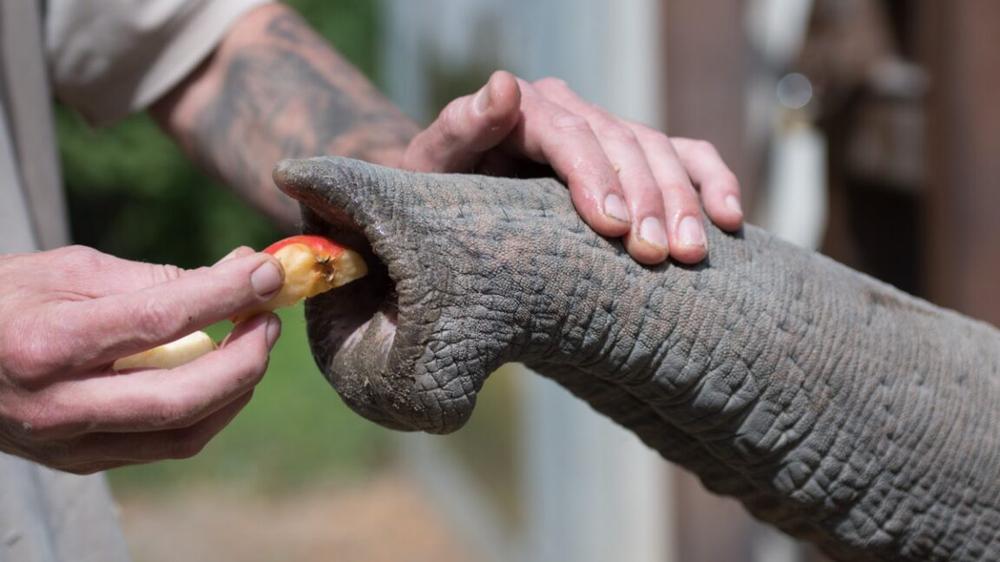
An elephant’s trunk is a marvelous thing, flexible enough to bend and stretch as it forages for food, but also stiff enough to grasp and maneuver even delicate objects like peanuts or a tortilla chip. That’s because the trunk is highly sensitive when it comes to sensing touch. Scientists have determined that the whiskers lining the trunk are crucial for that sensitivity thanks to their unique structure, amounting to a kind of innate “material intelligence, according to a new paper published in the journal Science.
As previously reported, there is a long history of studying whiskers (vibrissae) in mammals. Rats, cats, tree squirrels, manatees, harbor seals, sea otters, pole cats, shrews, tammar wallabies, sea lions, and naked mole-rats all share strikingly similar basic whisker anatomies, according to various prior studies. Among other potential applications, such research could one day enable scientists to build artificial whiskers as tactile sensors in robotics, as well as learn more about human touch.
Whiskers are much more complex than one might think, both in structure and function. Rats, for instance, have about 30 large whiskers and dozens of smaller ones, part of a complex “scanning sensorimotor system” that enables the rat to perform such diverse tasks as texture analysis, active touch for path finding, pattern recognition, and object location, just by scanning the terrain with its whiskers.
Technically, the whiskers are just hairs, a collection of dead keratin cells. It’s what they’re attached to that makes them as sensitive as human fingertips. Each rat whisker is inserted into a follicle that connects it to a “barrel” made up of as many as 4,000 densely packed neurons. Together, they form a grid or array that serves as a topographic “map,” telling the rat’s brain exactly what objects are present and what movements are taking place in their immediate environment. All those barrels in turn are wired together into a kind of neural network, so the rat gets multidimensional cues about its environment. Rat whiskers also resonate certain frequencies; there are shorter whiskers near the nose, with longer ones further back, enabling rats to create a kind of “frequency map” by poking their noses all over the place
Elephant whiskers are probably most akin to cat whiskers, according to the authors of this latest paper. Unlike cat whiskers, however, an elephant’s do not move. The whiskers grow in rows along each side of the trunk’s surface; how many there are and the patterns in which they are arranged depend on the species. Andrew Schulz, a postdoc working on haptics at the Max Planck Institute for Intelligent Systems, and co-authors used a combination of micro-CTR imaging, electron microscopy, mechanical testing, and functional computer modeling to learn more about Asian elephant whiskers: not only their shape (geometry) but also their porosity and their material stiffness (i.e., how soft they are).
By a whisker
The micro-CT scans revealed that elephant whiskers are thick and blade-like, unlike the tapered whiskers of mice and rats. The structure is porous, with a hollow base and several internal channels, similar to those found in horse hooves or sheep horns. That makes the whiskers more resistant to impact and less prone to breakage—an important feature, since once damaged, elephant whiskers don’t grow back.
The researchers also used a diamond cube the size of a single cell to push against the walls of individual elephant and cat whiskers, both at the base and the tip. They found that the base of both elephant and cat whiskers was stiff like plastic, gradually softening to a more resilient, rubber-like tip—unlike the body hair of Asian elephants, which is stiff everywhere.
But could that stiffness gradient actually affect the trunk’s sensitivity to touch? To find out, the team 3D-printed a larger version of an elephant whisker about the size of a wand. Co-author Katherine Kuchenbecker, Schultz’s mentor at MPI, tested the wand as she walked through the halls, tapping columns and railings as she went. And yes, it did turn out to be a sensitive instrument. “I noticed that tapping the railing with different parts of the whisker wand felt distinct—soft and gentle at the tip, and sharp and strong at the base,” said Kuchenbecker. “I didn’t need to look to know where the contact was happening; I could just feel it.”
The team’s computational simulations confirmed that hypothesis. “The stiffness gradient provides a map to allow elephants to detect where contact occurs along each whisker,” said Schultz. “This property helps them know how close or how far their trunk is from an object … all baked into the geometry, porosity, and stiffness of the whisker. Engineers call this natural phenomenon embodied intelligence. Bio-inspired sensors that have an artificial elephant-like stiffness gradient could give precise information with little computational cost purely by intelligent material design.”
Science, 2026. DOI: 10.1126/science.adx8981 (About DOIs).
 James Van Der Beek’s final message about dying is wrecking people in the best way