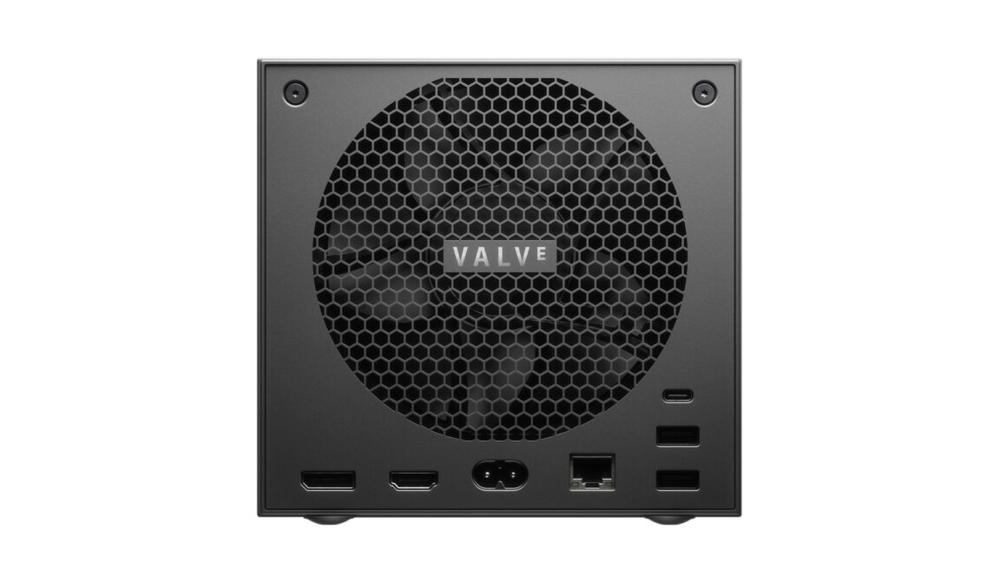
After Valve announced its upcoming Steam Machine living room box earlier this month, some analysts suggested to Ars that Valve could and should aggressively subsidize that hardware with “loss leader” pricing that leads to more revenue from improved Steam software sales. In a new interview with YouTube channel Skill Up, though, Valve’s Pierre-Loup Griffais ruled out that kind of console-style pricing model, saying that the Steam Machine will be “more in line with what you might expect from the current PC market.”
Griffais said the AMD Zen 4 CPU and RDNA3 GPU in the Steam Machine were designed to outperform the bottom 70 percent of machines that opt-in to Valve’s regular hardware survey. And Steam Machine owners should expect to pay roughly what they would for desktop hardware with similar specs, he added.
“If you build a PC from parts and get to basically the same level of performance, that’s the general price window that we aim to be at,” Griffais said.
The new comments follow similar sentiments relayed by Linus Sebastian on a recent episode of his WAN Show podcast. Sebastian said that, when talking to Valve representatives at a preview event, he suggested that a heavily subsidized price point would make the Steam Machine hardware into “a more meaningful product.” But when he suggested that he was imagining a console-style price in the range of $500, “nobody said anything, but the energy of the room wasn’t great.”
Forget about $500
Based on these comments, we could start estimating a potential Steam Machine price range by speccing out a comparable desktop machine. That would likely require building around a Ryzen 5 7600X CPU and Radeon RX 7600 GPU, which would probably push the overall build into the $700-plus range. That would make the Steam Machine competitive with the pricey PS5 Pro, even though some estimates price out the actual internal Steam Machine components in the $400 to $500 range.
Regardless, the volatility in RAM and storage costs these days makes it hard to know exactly where the Steam Machine’s total costs and asking price will end up by the time we hit the early 2026 launch window. Griffais gestured toward this to Skill Up, noting that “right now is just a hard time to have a really good idea of what the price is going to be because there’s a lot of different things… a lot of external things.”
If the Steam Machine won’t cost significantly less than a similarly powerful gaming PC, some gamers may decide to just create their own Steam Machine alternative by installing SteamOS on a custom PC build, of course. Going that route also gives players the flexibility to future-proof against some potential Steam Machine deficiencies, like the relatively paltry 8GB of VRAM.
But Griffais told Skill Up that the official Steam Machine would still set itself apart from similar gaming PCs via features like its small form factor, ultra-quiet fan design, HDMI-CEC support, and strong integration with the Steam Controller and other Bluetooth controls.
“There’s people that are going to be perfectly happy building their PC at whatever level of spec, and that’s going to be a great experience for them,” Griffais said. “But we expect the machine is a nice baseline offering that lets you have some features that are really hard to get to otherwise.”
 Arturia’s AstroLab 37 crams 44 synths into a tiny keyboard