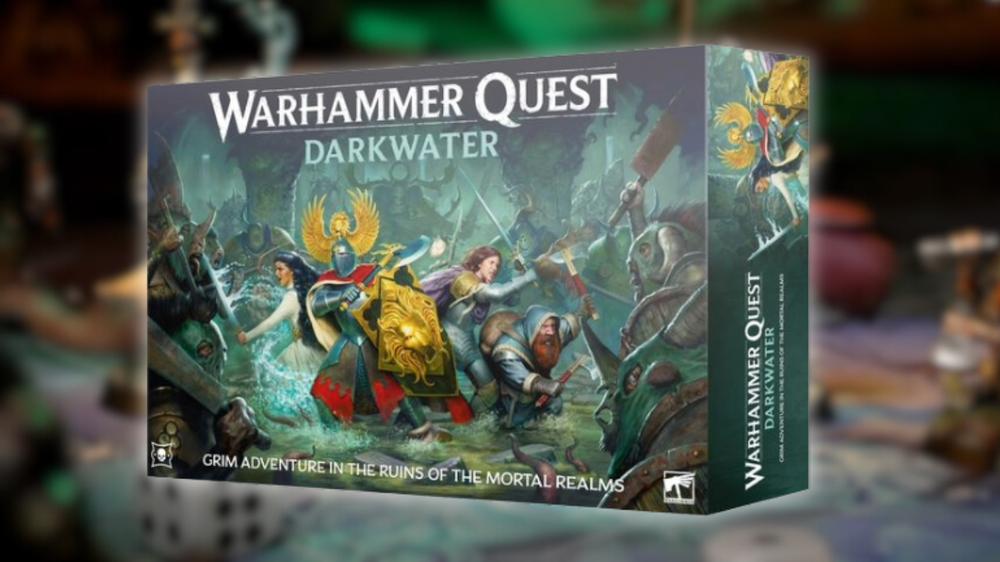
For gamers of a certain age, Warhammer Quest is a name to conjure with. The original 1995 release was the premier dungeon-crawler of its day, a rare cooperative title in an age of head-to-head conflict games. Once it was out of print it became, and remains, highly collectable. But in 2016, publisher Games Workshop resurrected the brand with the well-received Silver Tower. Darkwater is the latest iteration, with a few new tweaks and a lot of new toys on board to try and uphold its considerable legacy.
Warhammer Quest: Darkwater is a cooperative board game, but you’ll play with four heroes in every game, so it’s best with two or four players: solo is possible, but you’ll end up juggling a lot as the campaign progresses. It has two game modes, a one-off skirmish fight or a longer campaign game. The focus is definitely on the latter mode, as single fights can be unbalanced depending on the scenario you end up playing, and you don’t get the fun of slowly building up your characters and revealing your own narrative of attempting to free the Jade Abbey from Nurgle’s putrefaction.
A campaign consists of three acts, each of which sees you dealing out 14 random encounter cards from that act’s deck, with a boss card beneath. You then get a choice of two possible encounter cards for each adventure, and this is an important decision. Many of the encounters aren’t skirmish fights but little narrative snippets or mini-games. Most of these are of the push your luck or risk versus reward variety, but there are a couple of the more imaginative designs that made Silver Tower’s scenarios such a pleasure.
When it comes to battle scenarios, it’s important to read the cards carefully and consider how the fight might play out. They offer a variety of maps, of enemies to fight, sidequests, victory conditions and special rules. These cause them to vary wildly in difficulty, and some can be almost impossible if you haven’t found certain rewards for your party. This is a big deal because the price for failure is high: you lose some rewards and get to try again, with a second fail ending the campaign.
Duking it out on the map is based on a set of rules from another game in the series, Warhammer Quest: The Adventure Card Game (see it at Amazon). Each hero has three action cards: move, attack, and aid. Using one requires you to expend energy, which is most commonly obtained by exhausting one of said cards, either for the action you’re taking or one of the others. Essentially this boils down to heroes taking three actions each turn, which can be any combination of the available options, although some of the rewards you can get later in the campaign complicate the picture a little.
Combat involves you rolling dice, almost always a pair, hoping to achieve a target number depending on what you’re fighting. Many enemies have a defense value that cancels out an equal number of hits, meaning you’ll have to hit on both dice to hurt them. Between the probabilities involved and the flexibility of the action system, this provides a satisfying balance of decision-making and randomness. This is not a deep game by any means, but you’ll often be torn as to how to best distribute your actions, while the turn limit on completing each battle can lead to some thrilling, high-stakes rolls towards the close.
Between each hero’s turn, the monsters get to activate. How they behave depends on a dice roll, and most enemies switch between a sedate black die and a more threatening red die with each passing battle round. Mostly they’ll move toward a target at variable speed and try to attack, although all the monsters also have a special effect: horrible little pox-wretches spawn new companions, while the tough daemonic cankerborn blast all nearby heroes with an area effect attack. This roll can have a major impact on the difficulty of a scenario, as monsters sometimes do nothing and sometimes unleash a terrifying onslaught, a quirk that the rules put down to their chaotic nature.
One flaw in this system and the map design is that most of the boards have one or more choke points caused by impassable hexes, and most of the scenarios require players to get somewhere and do something in order to win. The result is that both players and monsters get funneled toward the tight corners and scenarios can bog down in repeated roll-offs until you either clear the enemies or the time runs out. Some character abilities and items can bypass this – the dwarf ranger Drolf Ironhead can move through the odd impassable hex – but while this gives some scenarios the feel of a spatial puzzle, in others having one or two characters get a shortcut doesn’t make much difference to achieving the goal. This issue also causes a sense of repetition, despite the fairly varied scenario design.
Victory, and the completion of sidequest goals, results in reward cards being doled out to the adventurers. Like the scenarios themselves these vary in power, with better items being available later in the campaign, but the more impressive items are often one-shot, while more minor power-ups can be re-used. They all add more tactical options to battles, which is absolutely a good thing. Weighing up whether or not to throw your magical one-off widget into the mix in an attempt to save a scenario that’s going south is always a knife-edge decision and adds extra frisson to the dice-rolls that usually result.
Even on-board battle scenarios only last about 30 minutes so, when you mix in the much shorter mini-game encounters, playing through an act doesn’t take all that long. “Saving” the game state between sessions is a minor pain but perfectly possible. All the adventure cards have their own text preamble to set the scene and, as you progress through the campaign, there are secrets to uncover and some new playable characters to unlock. The unfolding narrative isn’t going to win any literary awards but it’s effective at giving your playthrough a solid storybook backbone. Nurgle is a particularly fun opponent to tackle, his servitors by turns fatherly and feculent, so freeing the once-pristine Jade Abbey from their clutches feels like a worthy goal.
 OnePlus 15 finally gets FCC clearance after government shutdown delay—preorders live