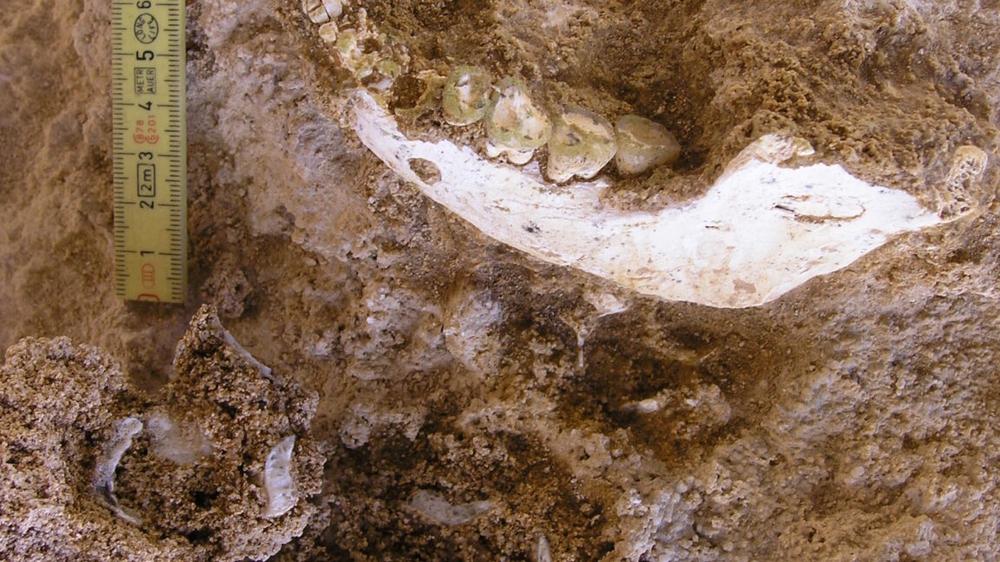
A group of 773,000-year-old hominin fossils from Morocco may shed new light on when our species branched off from the ancestors of Neanderthals and Denisovans.
A team of anthropologists recently examined a collection of fossil hominin jawbones, teeth, and vertebrae that belong to hominins who probably lived very close in time to our species’ last common ancestor with Neanderthals and Denisovans. They reveal a little more about a murky but important moment in our evolutionary history.
From predators’ quarry to rock quarry
Archaeologists unearthed the 773,000-year-old bones just southwest of Casablanca in a cave aptly named Grotte à Hominidés. They’re just fragments of what used to be hominins: an adult’s lower jawbone, plus the partial lower jaw from another adult and a very young child, along with a handful of teeth and vertebrae. A hominin femur from the same layer of sediment in the cave has clear gnaw marks from sharp carnivore teeth, offering a chilling clue about how the bones got there.
The layer of sediment in which the fossils lay spanned a few thousand years on either side of a long-ago flip in the polarity of Earth’s magnetic field (periodically our planet just… does that), which happened around 773,000 years ago. It’s a slice of time not quite narrow enough to say whether the three jawbones’ owners might have known each other but narrow enough to put them all at a crucial point in the story of human evolution.
Around 1.8 million years ago, a species called Homo erectus emerged in Africa and spread around most of the world (sorry, Americas and Australia). And around a million years ago, populations of Homo erectus living in different places started to evolve along their own paths. Potentially with a few species in between, this process likely gave rise to species like Homo floresiensis and Homo luzonensis in the islands of Southeast Asia.
In Europe and Asia, we got Neanderthals and Denisovans (or Homo longi, if you prefer). And our species, Homo sapiens, evolved in Africa. We, Neanderthals, and Denisovans share a branch of the hominin family tree, with the latter two splitting off from our branch sometime between 765,000 and 550,000 years ago. That timing is what makes the Grotte à Hominidés fossils so important. At 773,000 years old, they’re all that’s left of hominins who lived right around the time of that big split between our ancestors on one path and those of Neanderthals and Denisovans on another.
Max Planck Institute anthropologist Jean-Jacques Hublin and his colleagues used micro-CT imaging to build detailed digital models of all the bones and teeth. They then compared the shapes of certain features—like the boundary between enamel and dentine in the teeth or the points on the jawbone where chewing muscles would have attached—to compare the fossils to other hominin species. Archaeologists call that technique geometric morphometry, and it helps shed light on how closely related two species might be.
In this case, the results suggest that the Grotte à Hominidés hominins were a very late model of Homo erectus, already beginning to evolve in the general direction of our species.
How old is our branch of the family tree?
Anthropologists still aren’t sure what our last common ancestor with Neanderthals and Denisovans looked like or where they lived because we just don’t have many African fossils of the right age. The Casablanca fossils at least bring us closer to that pivotal moment in human evolution, and they may even suggest that it happened a little earlier than we thought, closer to 800,000 years ago (although it will take more data from more fossils to be sure).
The Casablanca fossils are about the same age as hominin fossils from Spain, which belong to a species called Homo antecessor. This species has been suggested to be a likely ancestor of Neanderthals and Denisovans. Overall, it looks like the fossils from Casablanca are a North African counterpart to Homo antecessor, with the Spanish hominins eventually leading to Neanderthals and the North African ones eventually leading to us.
Both groups share some features in their teeth and lower jaws, but they’re also different in some important ways. The teeth and chins in particular share some older features with Homo erectus. But the jaws have more newfangled features in the places where chewing muscles once attached to the bone—features that Neanderthals and our species share. On the other hand, the teeth are missing some other relatively recent features that would later help define Neanderthals (and were already beginning to show up in Homo antecessor).
Altogether, it looks like the Homo erectus populations and the Neanderthals and Denisovans had been separated for a while by the time the hominins at Grotte à Hominidés lived. But not that long. These hominins were probably part of a generation that was fairly close to that big split, near the base of our branch of the hominin family tree.
Here’s looking at you, hominin
Based on ancient DNA, it looks like Neanderthals and Denisovans started evolving into two separate species sometime between 470,000 and 430,000 years ago. Meanwhile, our branch would eventually become recognizable as us sometime around 300,000 years ago, or possibly earlier. At various times and places, all three species would eventually come back together to mingle and swap DNA, leaving traces of those interactions buried deep in each other’s genomes.
And 773,000 years after a predator dragged the remains of a few unfortunate hominins into its den in northern Africa, those hominins’ distant descendants would unearth the gnawed, broken bones and begin piecing together the story.
Nature, 2025 DOI: 10.1038/s41586-025-09914-y (About DOIs).
 How Quilt solved the heat pump’s biggest challenge