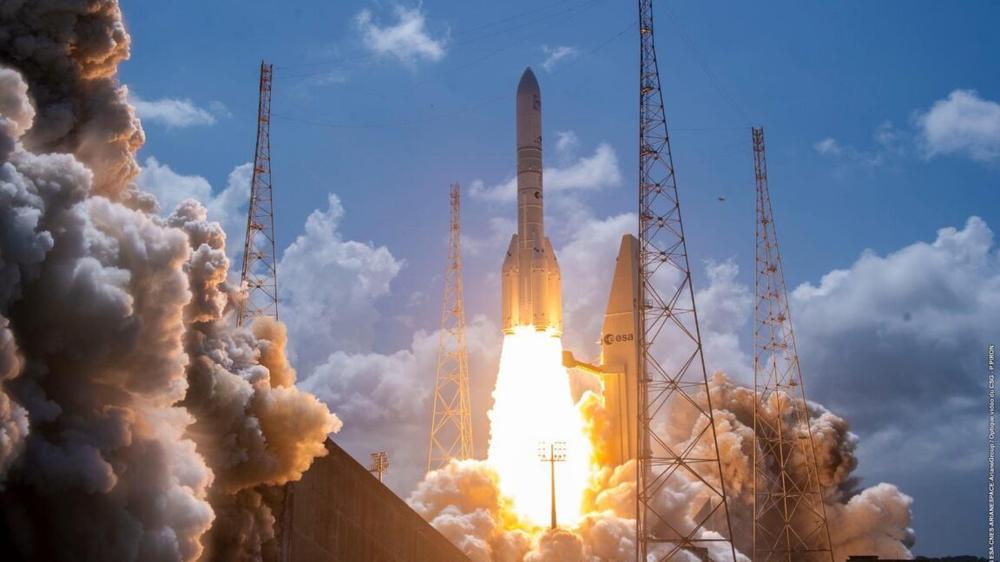
The heavy version of Europe’s Ariane 6 rocket launched for the first time Thursday, hauling 32 spacecraft to low-Earth orbit for Amazon’s satellite broadband constellation.
The Ariane 6 rocket lifted off from the Guiana Space Center on the northeastern coast of South America at 11:45 am EST (16:45 UTC), quickly soaring into a clear sky at the tropical spaceport on the power of a hydrogen-fueled main engine and four strap-on solid rocket boosters.
This Ariane 6 configuration, called Ariane 64, is the first to use the rocket’s full complement of four boosters. Collectively, the rocket generated more than 3.4 million pounds of thrust (15,400 kilonewtons) of thrust as it steered northeast over the Atlantic Ocean. Less than two hours later, the rocket’s upper stage released all 32 of Amazon’s satellites into an on-target orbit at an altitude of 289 miles (465 kilometers).
Amazon and Arianespace, the French launch services provider, declared the mission a success.
“With the powerful roar of four boosters at liftoff comes more than double the payload mass to orbit, setting Europe back on stage for launching all satellites to all orbits,” said Josef Aschbacher, director general of the European Space Agency, which funded development of the Ariane 6. “With today’s launch, our rocket fleet is now complete, but we will not rest. Upgrades are already in progress for future launches, starting with the launch of our planet-hunter Plato that is set to launch on an upgraded Ariane 6.”
Finding a ride
“With the first flight of Ariane 64, Europe’s heavy-lift launcher has demonstrated its ability to deliver the most demanding large-scale constellation missions,” said David Cavaillolès, CEO of Arianespace. “We are proud to support Amazon Leo with a reliable, high-performance European launch solution as we begin a series of 18 missions enabling the deployment of their constellation.”
The Ariane 64 flew with an extended payload shroud to fit all 32 Amazon Leo satellites. Combined, the payload totaled around 20 metric tons, or about 44,000 pounds, according to Arianespace. This is close to maxing out the Ariane 64’s lift capability.
Amazon has booked more than 100 missions across four launch providers to populate the company’s planned fleet of more than 3,200 satellites. With Thursday’s launch, Amazon has launched 214 production satellites on eight missions with United Launch Alliance, SpaceX, and now Arianespace.
The Amazon Leo constellation is a competitor with SpaceX’s Starlink Internet network. SpaceX now has more than 9,000 satellites in orbit beaming broadband to more than 9 million subscribers, and all have launched on the company’s own Falcon 9 rockets. Amazon, meanwhile, initially bypassed SpaceX when selecting which companies would launch satellites for the Amazon Leo program, formerly known as Project Kuiper.
Amazon booked the last nine launches on ULA’s soon-to-retire Atlas V, five of which have now flown, and reserved the rest of its launches in 2022 on rockets that had never launched before: 38 flights on ULA’s new Vulcan rocket, 24 launches on Blue Origin’s New Glenn, and 18 on Europe’s Ariane 6.
Meanwhile, in Florida
All three new rockets suffered delays but are now in service. The Ariane 6 has enjoyed the fastest ramp-up in launch cadence, with six flights under its belt after Thursday’s mission from French Guiana. ULA’s Vulcan rocket has flown four times, and Amazon says its first batch of satellites to fly on Vulcan is now complete. But a malfunction with one of the Vulcan launcher’s solid rocket boosters on a military launch from Florida early Thursday—the second such anomaly in three flights—raises questions about when Amazon will get its first ride on Vulcan.
Blue Origin, owned by Amazon founder Jeff Bezos, is gearing up for the third flight of its heavy-lift New Glenn rocket from Florida as soon as next month. Amazon and Blue Origin have not announced when the first group of Amazon Leo satellites will launch on New Glenn.
Among its launch contractors, Amazon is most invested in ULA’s Vulcan rocket. The online retailer-turned-satellite-operator has committed more than $2 billion to upgrade and expand ULA’s manufacturing and launch infrastructure to support up to 25 Vulcan launches per year, divided between Amazon and missions for the US military. The Vulcan rocket is far away from achieving that kind of launch rate, and ULA’s plans for 16 to 18 Vulcan flights this year are already in doubt following Thursday morning’s booster anomaly.
Last month, Amazon said in a filing with the FCC that it faces a “near-term shortage of launch capacity” and is securing additional launch options “wherever available.” The purpose of the filing was to request that the regulator extend or waive a July deadline requiring Amazon deploy half of its Amazon Leo constellation. That simply won’t happen. Amazon did not request a change to the FCC’s 2029 deadline for full deployment of the constellation.
The scarcity in launch capacity forced Amazon to purchase three Falcon 9 launches from SpaceX, each carrying 24 Amazon Leo satellites. Those three missions were completed last year, and Amazon confirmed last month that it had reserved 10 more SpaceX launches to fill the gap created by other companies’ delays. Amazon also has four Atlas V rockets still available from United Launch Alliance.
Amazon announced in a quarterly earnings call last week that it planned 20 or more launches this year. This was before the Vulcan rocket’s booster problem on Thursday. Officials did not disclose the mix of rockets that will make up the busy launch schedule.
For now, Arianespace seems to be stepping up. After Thursday’s launch, the company’s CEO said the next Ariane 6 launch will carry another set of Amazon Leo satellites to orbit. A launch date will be announced in the coming weeks, he said.
 Disney+ Has a Treasure Trove of Nostalgic Valentine’s Day Episodes