A Knight of the Seven Kingdoms is set roughly ninety years after the events of House of the Dragon, but it hasn’t been plain sailing for House Targaryen in the intervening years. You’ll have heard several references to the Blackfyres in the latest show, and here’s what that means.
If you haven’t seen A Knight of the Seven Kingdoms Episode 3 yet, look away, as there are spoilers ahead.
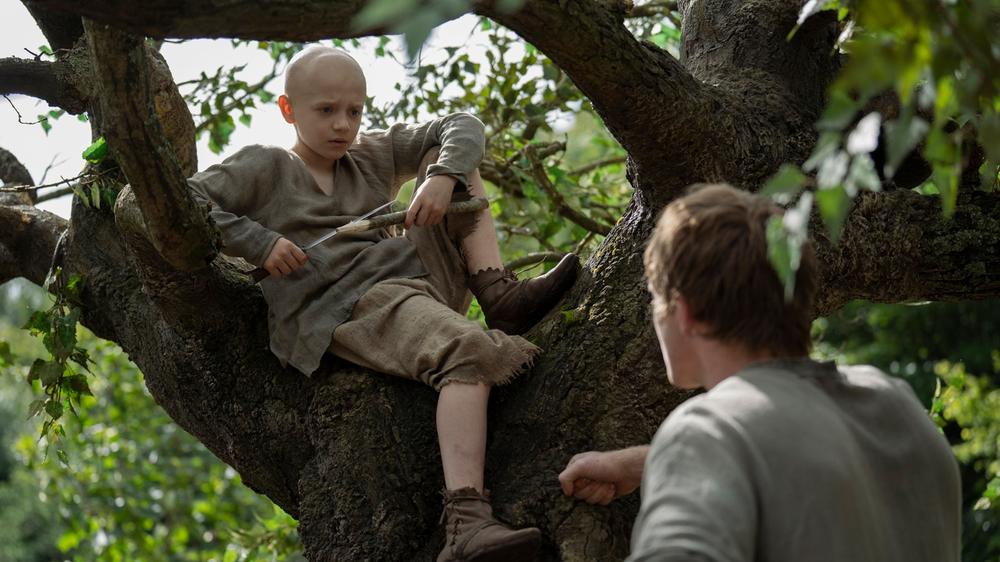
Okay, the cat’s officially out of the bag – Egg is actually Aegon V Targaryen. There have been subtle hints along the way, including Egg’s posh accent and uncanny knowledge of Westerosi nobility.
The young squire also has a strong hatred of a group called the Blackfyres, who haven’t appeared in any of the shows so far. So, who are they, and what does Egg’s song mean?
Who are the Blackfyres?
The Blackfyres are a branch of House Targaryen who openly rebelled against the crown roughly 13 years before A Knight of the Seven Kingdoms takes place.
Egg’s great-grandfather King Aegon IV Targaryen, known as Aegon the Unworthy, had lots of illegitimate children, including Daemon Waters and Brynden Rivers (the three-eyed raven from Game of Thrones).
Daemon was knighted by his father and given Aegon the Conqueror’s sword – Blackfyre. This legendary Valyrian steel sword was previously given to Aegon II (Tom Glynn-Carney) to strengthen his claim against Rhaenyra (Emma D’Arcy) in House of the Dragon Season 1.
If that didn’t cause enough unrest, Aegon the Unworthy legitimized all of his bastard children on his deathbed.
After being legitimized, Daemon created a new Westerosi House, the Blackfyres, named after his sword. Its banner is the same as House Targaryen, but with the colors inverted (a black dragon on a red field).
During Daeron II’s reign (Egg’s grandfather), House Blackfyre openly rebelled. Many smaller noble houses joined the cause, sparking a bloody civil war that lasted around a year.
It all ended at the Battle of the Redgrass Field. Daemon marched on King’s Landing but was beaten by the Targaryen forces and killed. The Weeks Ahead trailer seems to show that we’ll see the aftermath of the battle in a future episode.
Since Egg’s family fought against House Blackfyre, he has been raised with the idea that the Blackfyres are the enemy, so they’re who he imagines he’s dueling when playfighting. “Do you yield, Blackfyre bastards?” he shouts in Episode 2.
Egg’s song ‘The Anvil and the Hammer’ explained
In A Knight of the Seven Kingdoms Episode 3, Egg sings a (censored) version of the song ‘The Anvil and the Hammer,’ with the crude rhymes removed:
“Prince Baelor was the firstborn. Prince Maekar sprang out last. Daemon was the bastard, so they kicked his bastard…”
This talks about Egg’s uncle and father, Baelor (Bertie Carvel) and Maekar (Sam Spruell), and their illegitimate uncle, Daemon Blackfyre.
“Grass is green in summer, green grass I adore. But grass is red all over when you kill a rebel…”
The second verse recounts the events of the Battle of the Redgrass Field, in which Daemon and two of his children were killed, and the war ended.
“Horses die in battle, this battle was the front. Blackfyre’s not a trueborn, he came from the wrong…”
Not much to dissect here. It repeats the fact that Daemon Blackfyre wasn’t a legitimate Targaryen.
“Country was in peril, the Anvil was a rock, the Hammer smashed the bastard with his giant veiny… Host of Dornish spearmen.”
The Hammer and the Anvil are nicknames for Baelor and Maekar, after their strategy in the battle. Baelor flanked Daemon’s army with his Dornish spearmen (the Hammer), pushing them against Maekar’s shield wall (the Anvil).
The Redgrass Fields took place 13 years before A Knight of the Seven Kingdoms, so it’s very much in living memory, and Egg would’ve been raised with stories and songs about his uncle and father’s victory.
 Hungary takes EU to court over Russian energy ban