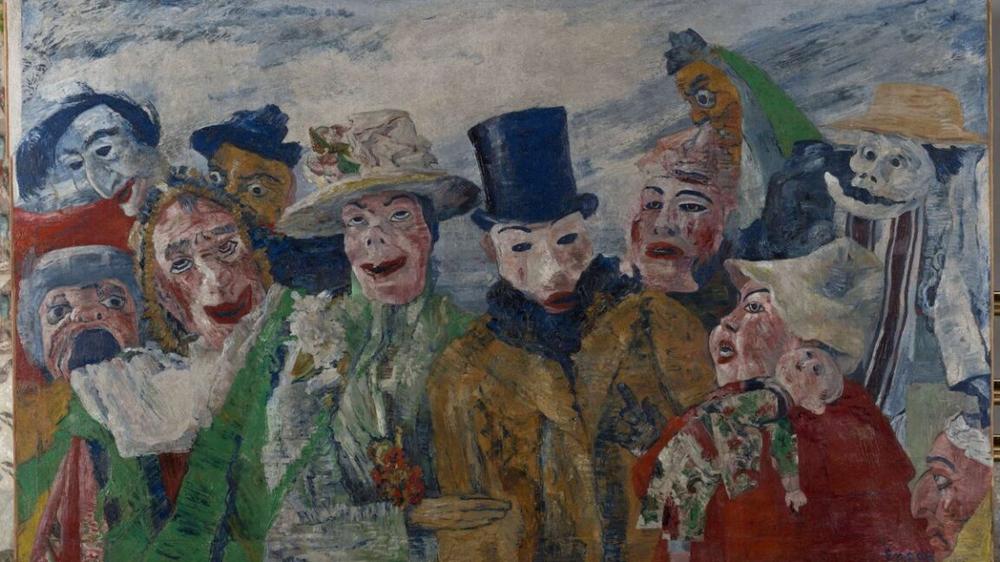
The emergence of synthetic pigments in the 19th century had an immense impact on the art world, particularly the availability of emerald-green pigments, prized for their intense brilliance by such masters as Paul Cézanne, Edvard Munch, Vincent van Gogh, and Claude Monet. The downside was that these pigments often degraded over time, resulting in cracks and uneven surfaces and the formation of dark copper oxides—even the release of arsenic compounds.
Naturally it’s a major concern for conservationists of such masterpieces. So it should be welcome news that European researchers have used synchrotron radiation and various other analytical tools to determine whether light and/or humidity are the culprits behind that degradation and how, specifically, it occurs, according to a paper published in the journal Science Advances.
Science has become a valuable tool for art conservationists, especially various X-ray imaging methods. For instance, in 2019, we reported on how many of the oil paintings at the Georgia O’Keeffe Museum in Santa Fe, New Mexico, had been developing tiny, pin-sized blisters, almost like acne, for decades. Chemists concluded that the blisters are actually metal carboxylate soaps, the result of a chemical reaction between metal ions in the lead and zinc pigments and fatty acids in the binding medium used in the paint. The soaps start to clump together to form the blisters and migrate through the paint film.
Conservators have found similar deterioration in oil-based masterpieces across all time periods, including in works by Rembrandt. The Metropolitan Museum of Art in New York City has an ongoing project to determine the causes and mechanisms of metal soap formations on traditional oil paintings. And in 2023 researchers with the Rijksmuseum’s Operation Night Watch found rare traces of a compound called lead formate in that Rembrandt painting. In March 2022, scientists studied the deterioration of Jean-Baptiste-Camille Corot’s Gypsy Woman with Mandolin (circa 1870). They used three complementary techniques to analyze paint samples under infrared light to determine the composition of the damaging metal carboxylate soaps that had formed on the top layer of paint.
Perhaps most relevant to this current paper is a 2020 study in which scientists analyzed Edvard Munch’s The Scream, which was showing alarming signs of degradation. They concluded the damage was not the result of exposure to light, but humidity—specifically, from the breath of museum visitors, perhaps as they lean in to take a closer look at the master’s brushstrokes.
Let there be (X-ray) light
Emerald-green pigments are particularly prone to degradation, so that’s the pigment the authors of this latest paper decided to analyze. “It was already known that emerald-green decays over time, but we wanted to understand exactly the role of light and humidity in this degradation,” said co-author Letizia Monico of the University of Perugia in Italy.
The first step was to collect emerald-green paint microsamples with a scalpel and stereomicroscope from an artwork of that period—in this case, The Intrigue (1890) by James Ensor, currently housed in the Royal Museum of Fine Arts, Antwerp in Belgium. The team analyzed the untreated samples using Fourier transform infrared imaging, then embedded the samples in polyester resin for synchrotron radiation X-ray analysis. They conducted separate analysis on both commercial and historical samples of emerald-green pigment powders and paint tubes, including one from a museum collection of paint tubes used by Munch.
Next, the authors created their own paint mockups by mixing both commercial emerald-green pigment powders and their own lab-made powders with linseed oil, and then applied the concoctions to polycarbonate substrates. They also squeezed paint from the Munch paint tube onto a substrate. Once the mockups were dry, thin samples were sliced from each mockup and also analyzed with synchrotron radiation. Then the mockups were subjected to two aging protocols designed to determine the effects of UV light (to simulate indoor lighting) and humidity on the pigments.
The results: In the mockups, light and humidity trigger different degradation pathways in emerald-green paints. Humidity results in the formation of arsenolite, making the paint brittle and prone to flaking. Light dulls the color by causing trivalent arsenic already in the pigment to oxidize into pentavalent compounds, forming a thin white layer on the surface. Those findings are consistent with the analyzed samples taken from The Intrigue, confirming the degradation is due to photo-oxidation. Light, it turns out, is the greatest threat to that particular painting, and possibly other masterpieces from the same period.
DOI: Science Advances, 2025. 10.1126/sciadv.ady1807 (About DOIs).
 AI-Enabled Teddy Bear Pulled From Shelves For Giving Advice On BDSM, Where To Find Knives