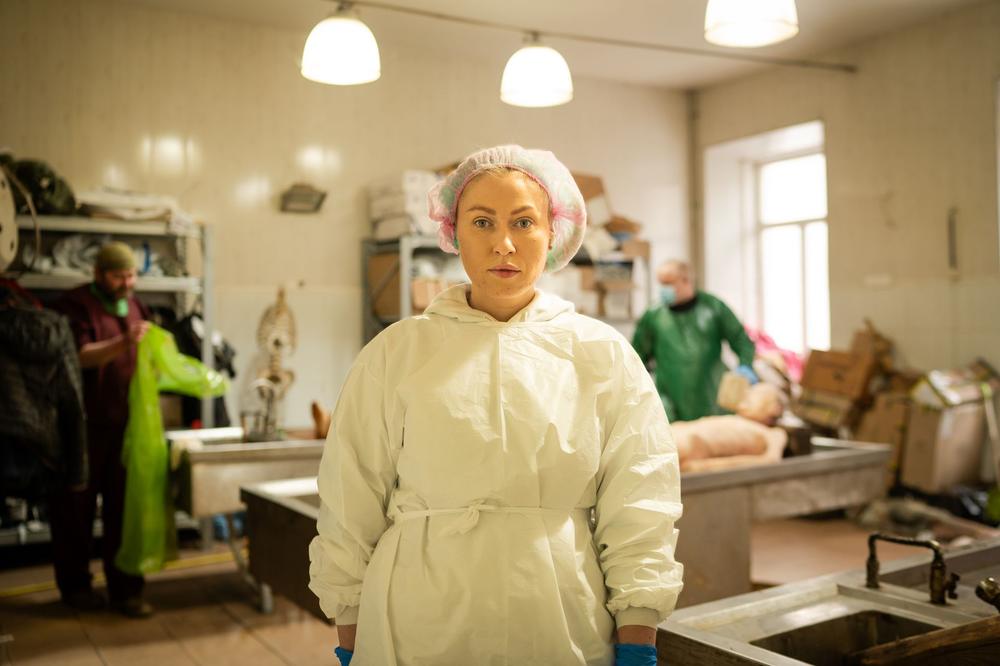
KHARKIV, KHARKIV OBLAST — A blonde-haired woman walks through a slim pathway between corpses lying against walls and autopsy tables inside Ukraine's oldest morgue.
The main autopsy room, connected with two additional rooms and equipped with an elevator to lift the corpses from the basement, is busy with forensic experts like her going through three bodies on the table.
One belongs to a Ukrainian soldier, while the other two are civilians — an elderly lady and a middle-aged man.
"It's most likely a blast injury," the woman, 35-year-old Inga Gerbst, tells the Kyiv Independent, pointing at what appears to be a fatal shrapnel wound on the soldier's stomach.
An overpowering musty and sour odor surrounds those working through the corpses to obtain DNA samples and identify the cause of death, with one assigned per body. The rest of the corpses are scattered along the edges of the white-walled room, no larger than a classroom, some half-packed into plastic bags.
Others were hastily wrapped in whatever could be found at the place of death. One is covered in a threadbare carpet.
The corpses are in various conditions, ranging from slightly hollowed bodies that were brought in shortly after death to ones remarkably altered by time, blackened and inflated like a balloon. Experts work with what they have to gather as much data as possible, even if only a fragment — such as a finger — arrives on the stainless-steel autopsy table.
"Determining the cause of death is difficult when the body is severely decomposed or reduced to skeletal, fragmented remains," Yurii Kravchenko, the head of Kharkiv Regional Bureau of Forensic Medical Examination, tells the Kyiv Independent.
"If there are no visible injuries on the body or the bones, then, as a rule, establishing the cause of death is very difficult."
Four years into Russia's full-scale invasion of Ukraine, experts at the Kharkiv Oblast forensic medical bureau — the oldest in Ukraine and founded in 1797 — continue to work tirelessly in what they see as their battle to bring justice to Ukrainians killed by Russia's war.
Located about 30 kilometers (about 19 miles) from the Russian border and not far from the front, Kharkiv, Ukraine's second-largest city, endures regular deadly attacks.
Kravchenko refrained from sharing the monthly number of corpses brought to the morgue, referred to by those who work there as the forensic medical bureau, saying that it is confidential information. Workers say they have to work through more than twice as many bodies as before the full-scale invasion.
"This was once a living person, and they must be treated the same way — with dignity."
Overstretched by the sheer volume of corpses from the battlefield or from indiscriminate Russian attacks on civilian areas, in addition to bodies from non-war-related deaths, the experts are coping with the stress day to day.
Burnout and exhaustion have no place in the autopsy room, as lapses in concentration can lead to minor errors that may compromise cause-of-death findings.
The experts stress that emotions and bias, even when working with recovered bodies of Russian soldiers, are factors that could lead to errors. Kravchenko said fallen soldiers from both sides must be treated equally to abide by the Geneva Convention and then be sent to Kyiv for possible repatriation.
"This was once a living person, and they must be treated the same way — with dignity," Kravchenko said.
While they have learned to stay hyper-focused and calm no matter the circumstances of the death during the autopsy, they also have to manage coping with emotions outside of the autopsy room, especially during war.
For Gerbst, who has worked at the morgue since 2016, the toughest moments are when the bodies of children or young soldiers who had their whole lives ahead of them arrive.
"There are times when you just can't turn off your emotions, no matter how much you want to," Gerbst tells the Kyiv Independent. "It's impossible to forget (what you saw here)."
"But in most cases, every expert has one goal — to determine the cause of death. And here, it's not about emotions, it's about proving, establishing, and confirming what needs to be confirmed."
Another challenge is calmly explaining the forensic results to the families of children killed by Russian attacks, trying to support them and staying strong for them despite their own emotions, Gerbst says.
The experts all find their own way of coping with the psychological toll. For Gerbst, it's listening to music on her drive back home, and having two cats — one at home and one at the morgue.
But work inevitably follows her home. She discusses what she sees with her husband, who is also a colleague. He travels across the city to examine victims at the site of their death, so they try to connect the dots and understand what happened to the body better. The passion to find out the truth drives them.
read also
Her workdays — six each week — start around 6:30 a.m. with a strong, black coffee. After feeding her cat at home, she drives to the morgue to start working at 9 a.m., where her department head assigns the corpses and orders the necessary tests.
Bodies are cut open on the table before Gerbst enters the autopsy room, wearing a white cloak and plastic gloves. She carefully observes the corpse externally from head to toe before moving on to all the internal organs, dissecting them, and measuring their size and weight to detect abnormalities.
The length of an autopsy depends on the body's state and the number and scale of wounds, but is usually around an hour and a half to two hours, according to Gerbst. She examines one to four bodies a day. Shrapnel wounds are often multiple, with each requiring a detailed examination, and even a single gunshot wound can be complicated, since tracing the wound and finding the projectile is a challenge.
Time is another complicating factor. The longer the bodies take to get to the morgue, the harder it is to identify the cause of death.
Most bodies are not brought in immediately after death, with the decomposition process starting to break down the body and destroying certain important signs, Dmitriy Lys, a 52-year-old forensic expert at the morgue, says. He explained that this makes it extremely difficult to determine the exact cause of death.
The most difficult case is when only a finger or a bone is retrieved. This is especially common when bodies are repatriated from Russian possession, which can often be months or years after death.
Balancing the quality of work with the increased stress from having to go through more than twice as many corpses is not easy, Lys says. The veteran expert conducts an autopsy on 30 to 50 corpses a month, which adds up to roughly 400 a year. Taking care of one's psychological health, such as taking breaks when necessary, is crucial to accurately examining bodies, he says.
"Our specialty and work are very serious and carry great responsibility, so we must be extremely attentive, because sometimes the smallest details matter," Lys says.
"Our work is the kind where mistakes are not forgiven. We are forensic medical experts, and we are accountable for every word we write."
Lys stressed that "we have very few" forensic experts at the morgue, especially given the increased workload and the hours it often takes to fill out detailed answers to the questionnaires for each body. The number of bodies brought in varies each day, from seven to 14, but can be 100 at once after a repatriation, which happens roughly once a month, he added.
Trying to cope with work stress, Lys says he developed two new hobbies during the war — experimenting with new recipes and leatherwork. He tries to take his mind off work at home, discussing movies and books with his wife and his 22-year-old son.
But four years of war can only take a toll, and the morgue has had more than its fair share of difficulties.
The early days of the full-scale war were the toughest when Kharkiv's fate was uncertain as Russian troops closed in on the northeastern city. Gerbst recalls how she and others, who lived for months at the morgue due to the temporary closure of public transport, had to hide in a basement while a Russian warplane circled above. The corpses were stored in outdoor tents because the cemetery was closed back then.
The rest of 2022 didn't get much easier. Kharkiv regional morgue head Kravchenko says one of his employees, an elderly man with a prosthetic leg who had worked as a forensic expert his whole life, was shot dead by Russian troops for refusing to hand over his car when his hometown of Izium faced a brief Russian occupation.
With the Ukrainian liberation of Izium in September 2022 came the harrowing exhumation of about 450 bodies in the town, an hour and a half drive east from Kharkiv, which Kravchenko says took about a month to complete. A Russian missile strike on Kharkiv that Kravchenko believes may have targeted a military storage nearby hit a container carrying about 100 bodies from the exhumation.
"When we arrived, the wagon had overturned, and the bodies had been thrown out," Kravchenko says, showing no emotion.
"They were in bags. We gathered them and loaded them into an intact carriage."
The first year of the full-scale invasion proved difficult, with experts working to adjust to a war they had not anticipated, but 2026 brings further potential hardships — rolling blackouts nationwide amid an energy crisis and a mounting psychological toll.
Kravchenko, whose native city of Horlivka in eastern Donetsk Oblast was occupied by Russia in 2014 and has not since been able to return home in all that time, not even for his mother's death.
Yet despite how hard things are, the 60-year-old says he will continue.
"This is our work," he says.
 Twitch announces major change to bans with two new suspension types